Fleet vehicles operate under demanding conditions where drivetrain reliability directly impacts operational efficiency and profitability. Among the most critical drivetrain components are spur gears, which frequently experience progressive deterioration rather than sudden failure. This case study examines how advanced vibration analysis using Empirical Mode Decomposition (EMD) and statistical parameters was implemented across a commercial trucking fleet to detect early-stage gear faults, enabling proactive maintenance and significantly reducing costly downtime.
Background
Cascade Freight Systems, a regional trucking company operating throughout the Pacific Northwest, maintained a fleet of 78 medium-duty delivery trucks averaging five years in age. The company had experienced increasing maintenance challenges, particularly with transmission and differential gear failures that were causing unplanned downtime and disrupting tight delivery schedules.
In 2024, the company faced a concerning trend: unexpected gear failures had increased by 32% compared to the previous year, with each incident resulting in an average of 3.2 days of vehicle downtime. These failures were not only costly in terms of repairs (averaging $3,800 per incident) but also created significant operational disruptions and customer satisfaction issues due to missed delivery windows.
Standard maintenance inspections were failing to identify developing gear issues before they progressed to the point of failure. Oil analysis could detect metal particles, but by the time contamination was evident, significant damage had already occurred. Traditional vibration monitoring using overall RMS values or simple frequency analysis was proving inadequate for detecting subtle changes in gear condition.
The Challenge
The company faced several specific challenges regarding gear fault detection:
- Complex vibration signatures: Gear faults produced subtle changes in vibration patterns that were difficult to distinguish from normal operational noise.
- Variable operating conditions: Different routes, loads, and driving styles created significant variance in vibration signatures, complicating analysis.
- Maintenance timing: Traditional time-based maintenance was either too frequent (wasting resources) or too infrequent (allowing failures).
- Diagnostic accuracy: Existing vibration monitoring systems produced excessive false positives, leading maintenance teams to distrust the alerts.
- Progressive deterioration: Gear failure typically evolved gradually, but conventional monitoring couldn't reliably track this progression to determine optimal intervention timing.
- Resource allocation: The maintenance team needed to prioritize vehicles with the most urgent gear issues within limited service capacity.
The Solution: EMD and Statistical Parameters for Vibration Analysis
After evaluating multiple approaches, the company implemented a comprehensive vibration analysis system focused on Empirical Mode Decomposition (EMD) combined with advanced statistical parameters. This approach was selected for its ability to:
- Decompose complex vibration signals into Intrinsic Mode Functions (IMFs) that isolated gear-specific vibration patterns
- Handle non-stationary signals typical of real-world driving conditions
- Track subtle changes in vibration characteristics over time
- Quantify fault severity to enable prioritized maintenance
Technical Implementation
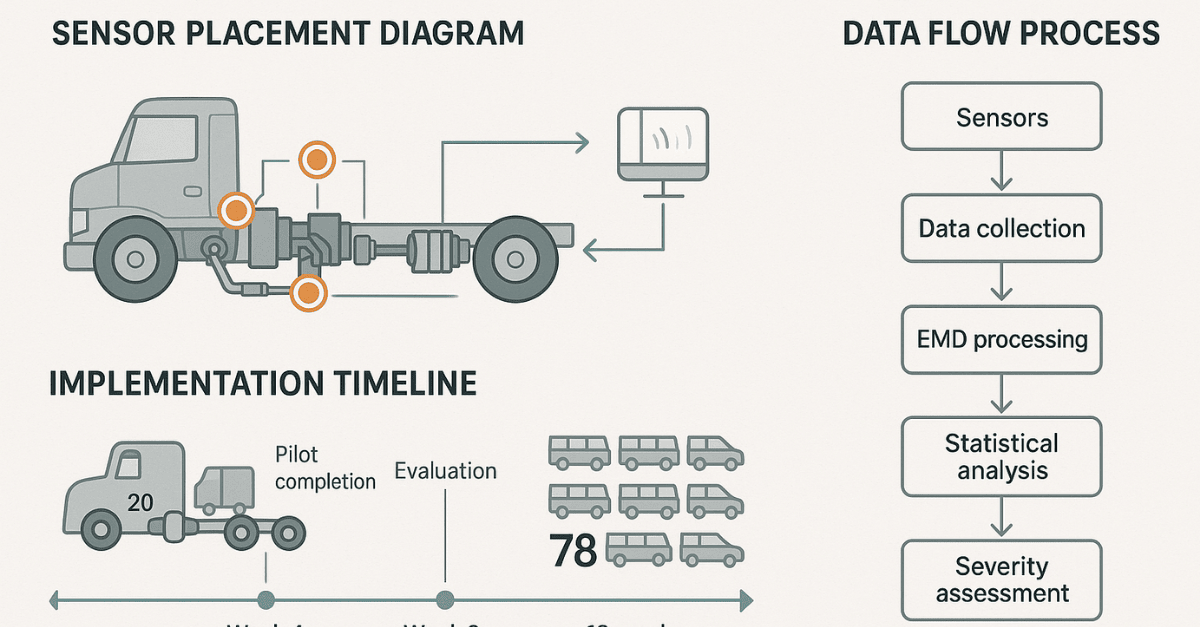
The solution worked through a multi-stage process:
1. Data Acquisition
- Installation of piezoelectric accelerometers at strategic points on transmissions and differentials
- High-frequency vibration data collection (up to 20 kHz) during normal vehicle operation
- Automatic data transmission through existing telematics systems to the FleetRabbit platform
2. Signal Processing
- Application of EMD to decompose raw vibration signals into Intrinsic Mode Functions (IMFs)
- Isolation of IMFs most sensitive to gear condition changes
- Filtering of environmental and operational noise
3. Statistical Analysis
- Calculation of key statistical parameters for each IMF:
- Kurtosis (measuring "peakedness" of vibration distribution)
- Crest Factor (peak amplitude to RMS ratio)
- Energy Entropy (measuring disorder in the signal)
- Correlation Dimension (quantifying system complexity)
- Development of composite indices combining multiple parameters
4. Fault Severity Assessment
- Establishment of baseline parameters for healthy gears
- Implementation of trend analysis to track parameter changes over time
- Development of severity classification algorithms based on statistical deviations
- Integration of operational context (vehicle age, route difficulty, load history)
The system was implemented through the FleetRabbit platform, which provided the necessary data storage, processing capability, and integration with maintenance management systems. The platform's API architecture enabled seamless flow of information from vehicle sensors to analysis algorithms and ultimately to actionable maintenance recommendations.
Implementation Process
The implementation followed a structured approach spanning 18 weeks:
Phase 1: Baseline Development (6 weeks)
- Installed vibration sensors on 20 representative vehicles
- Collected baseline data across various operational conditions
- Developed initial EMD processing algorithms
- Established normal statistical parameter ranges for healthy gears
Phase 2: Algorithm Refinement (5 weeks)
- Analyzed historical failure cases to identify signature patterns
- Refined IMF selection criteria for different gear types
- Developed fault severity classification thresholds
- Created visualization tools for maintenance technicians
Phase 3: Pilot Deployment (5 weeks)
- Extended installation to 35 vehicles
- Validated algorithm predictions through physical inspections
- Adjusted statistical thresholds based on inspection findings
- Developed standard intervention protocols for different severity levels
Phase 4: Full Fleet Implementation (2 weeks)
- Deployed across all 78 vehicles
- Integrated with maintenance scheduling system
- Trained maintenance staff on interpretation of severity indicators
- Implemented dashboard monitoring for fleet managers
Results
After nine months of operation, the EMD-based statistical parameter analysis system delivered significant improvements:
in detecting developing gear faults 3-6 weeks before conventional methods
in unexpected gear-related road failures
in repair costs and operational disruptions
in average repair cost through earlier intervention
in gear-related vehicle downtime
The system proved particularly effective at identifying:
- Early-stage tooth wear before it affected transmission performance
- Localized pitting on gear faces that traditional inspections missed
- Emerging misalignment issues that would eventually lead to accelerated wear
- Bearing deterioration that impacted gear mesh dynamics
Key Technical Insights
The project revealed several valuable insights about gear fault detection:
Higher-order IMFs are most diagnostic
The 3rd and 4th IMFs from EMD decomposition consistently provided the most sensitive indication of developing gear issues.
Kurtosis trends outperform absolute values
The rate of change in kurtosis over time was more reliable for fault detection than absolute threshold values.
Combined statistical parameters reduce false positives
The correlation between multiple parameters (particularly kurtosis and energy entropy) dramatically improved diagnostic accuracy.
Contextual normalization is essential
Adjusting statistical thresholds based on vehicle age, known route characteristics, and load history improved diagnostic precision.
Data frequency matters
Capturing high-frequency data (above 10 kHz) was critical for detecting early-stage gear tooth anomalies.
Trend analysis timeframes
Three-week trending provided the optimal balance between early detection and false alarm reduction.
Operational Impact
Beyond the direct maintenance benefits, the company experienced broader operational improvements:
- Enhanced route reliability with fewer unexpected breakdowns
- More precise maintenance scheduling based on actual component condition
- Extended drivetrain component life through earlier intervention
- Improved resource allocation by prioritizing vehicles with the most critical needs
- Reduced parts inventory requirements through more predictable failure patterns
Industry Implications
This approach demonstrates how sophisticated signal processing techniques like EMD, previously confined to laboratory settings, can be practically applied to real-world fleet maintenance challenges. The combination of EMD with statistical parameter analysis provides a powerful diagnostic methodology that bridges the gap between simple vibration monitoring and complex condition-based maintenance systems.
For fleet operators managing vehicles with critical gear components, this case highlights the value of implementing specialized diagnostic approaches that can detect subtle changes in component health long before traditional methods.
Fleet managers interested in implementing similar approaches can leverage platforms like FleetRabbit that provide both the data infrastructure and analytical capabilities needed to deploy advanced vibration analysis across diverse vehicle fleets.
Conclusion
The implementation of EMD and statistical parameter analysis for spur gear fault detection represents a significant advancement in fleet maintenance capabilities. By decomposing complex vibration signals and applying statistical analysis to the resulting IMFs, this approach enables maintenance teams to identify developing gear issues weeks before they would be detectable through conventional methods.
The 89% diagnostic accuracy achieved through this approach demonstrates that effective gear fault detection no longer requires periodic offline testing or specialized equipment installation. Well-implemented vibration analysis using existing telematics infrastructure can provide highly actionable insights that significantly improve fleet reliability and operational efficiency.
As fleet maintenance continues to evolve from time-based to condition-based approaches, similar signal processing techniques will become increasingly important for detecting incipient failures across a wide range of mechanical systems.