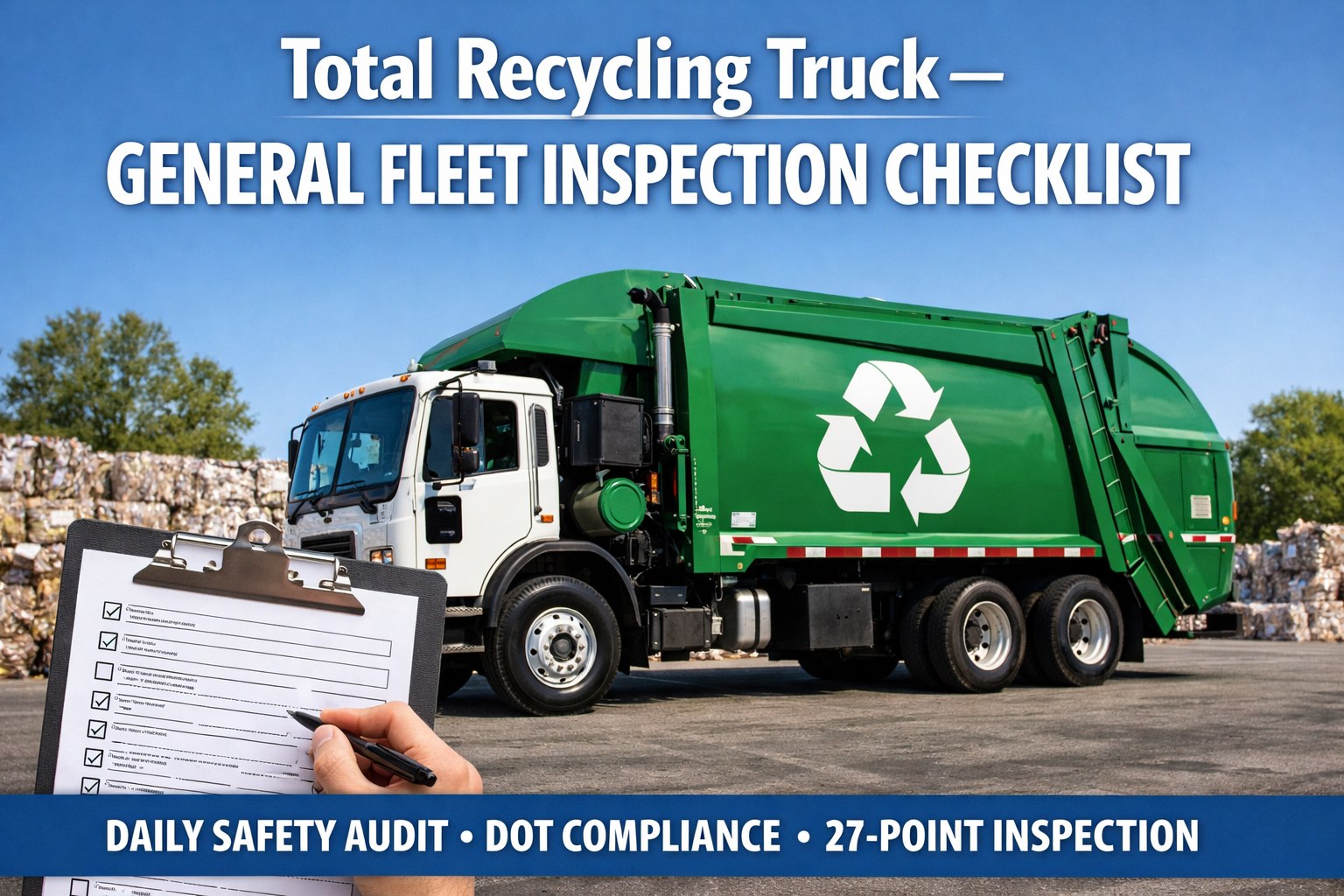
Keep your recycling fleet roadworthy and regulation-ready with this Total Recycling Truck General Fleet Inspection Checklist. Designed for waste haulers, refuse collection vehicles, and recycling transporters, this daily audit covers every critical system—from cab and body condition to engine bay fluids, in-cab driver controls, brakes, tires, and exterior lighting. Consistent inspections reduce breakdowns on collection routes, protect your team from on-road hazards, and ensure your fleet meets DOT and local waste authority standards every shift. Start your free fleet trial
Recycling Truck Fleet Audit
General Daily Inspection Checklist
Why Recycling Trucks Demand Rigorous Daily Audits
Recycling trucks operate under conditions far harsher than standard commercial vehicles. Heavy compactor loads, hundreds of stop-and-go brake cycles per shift, corrosive leachate exposure, and constant hydraulic stress mean components degrade faster than mileage alone suggests. The waste industry operates approximately 136,000 refuse collection trucks and 31,000 dedicated recycling vehicles across the U.S.—with over 40% of those trucks more than 10 years old. At an average cost of $200,000–$350,000 per new recycling truck, maximizing vehicle life through daily inspections is not optional—it is a financial imperative.
The Cost of Skipping Inspections
- A $200 hydraulic hose replacement becomes a $2,000+ roadside emergency when it fails mid-route
- One roadside breakdown disrupts an entire day of collection schedules, triggering overtime labor and customer complaints
- A single DOT out-of-service violation damages CSA scores, increasing insurance premiums by 10–30%
- Missing or incomplete DVIRs account for 12% of all FMCSA violations—over 62,000 citations in the past 5 years
The Return on 15 Minutes
- Fleets with structured PM checklists report 85% fewer unplanned breakdowns
- Preventive maintenance reduces total fleet maintenance costs by up to 40%
- Well-maintained trucks extend vehicle lifespan by 20% or more—critical when each unit costs $200K+
- Digital inspections cut completion time to under 5 minutes while improving defect detection by 35–40%
See how Fleet Rabbit cuts inspection time for recycling fleets—book a demo
Recycling Truck Inspection Frequency Matrix
Not every checklist item needs daily attention. This matrix maps every inspection area to the right cadence—so your drivers focus on the highest-risk items every shift while mechanics handle deeper checks on a weekly and monthly schedule.
| Inspection Area | Daily (Pre-Trip) | Weekly | Monthly | Quarterly / Annual |
|---|---|---|---|---|
| Cab, Doors & Windows | Visual check for damage, latch function | Hinge lubrication, seal condition | Deep clean, rust inspection | Structural integrity audit |
| Body / Frame | Walk-around for dents, cracks | Undercarriage debris removal | Corrosion treatment check | Full frame & weld inspection |
| Fluid Leaks (Oil/Coolant/Fuel) | Ground check under truck for puddles | Trace leak sources if found | Hose & gasket condition review | Full fluid system pressure test |
| Engine Oil & Coolant Levels | Dipstick & reservoir check | Top off if below line | Oil & filter change (per OEM) | Coolant flush & concentration test |
| Brakes (Service & Parking) | Pedal feel, parking brake hold test | Visual pad thickness check | Full brake measurement & adjustment | DOT annual brake inspection |
| Tires & Wheels | Visual tread, sidewall, pressure gauge | Lug nut torque check | Tread depth measurement all positions | Alignment check, DOT age code review |
| Lights & Turn Signals | Full lighting walk-around all modes | Lens cleaning, wiring check | Reflector & marker replacement | Electrical system load test |
| Steering & Suspension | Steering play check at idle | Shock & spring visual | Suspension bushing inspection | Full alignment & steering gear test |
| Warning Gauges & Indicators | Ignition cycle—no active fault codes | — | Diagnostic scan tool readout | Full ECM diagnostic download |
| Exhaust System | Listen for leaks, smell check in cab | Visual joint & hanger check | DPF/SCR system status review | Emissions compliance test |
| Fire Extinguisher & Safety | Present, gauge in green zone | Mounting secure, seal intact | Expiration date verification | Hydrostatic test / replacement |
| Seat Belts & Cabin | Latch & retraction test | Webbing condition check | — | Full restraint system inspection |
Scroll horizontally on mobile to view all columns →
1. General Condition — Walk-Around (Condizioni Generali)
Begin every shift with a 360-degree walk-around before starting the engine. Look for visible damage, leaks, and structural issues:
Cab & Body Structure
Fluid Leak Detection
2. Engine Compartment (Vano Motore)
Open the hood and verify fluid levels and overall engine condition before departure:
Engine Bay Checks
3. In-Cab Controls & Safety (In Cabina)
From the driver's seat, verify all controls, safety devices, and cabin systems are operational:
Instruments & Visibility
Drive Controls
Safety & Cabin
4. Exterior Systems (Fuori)
Complete the walk-around by verifying all exterior components for roadworthiness:
Lights & Electrical
Wheels & Suspension
Exhaust & General
Still Using Paper Checklists?
Paper forms get lost, can't be verified, and give zero visibility into driver compliance. Fleet Rabbit converts this 27-point checklist into a guided mobile inspection your drivers complete in under 5 minutes—with photo capture, GPS timestamps, and automatic defect-to-work-order routing.
Top DOT Violations That Shut Down Waste & Recycling Trucks
These five defect categories caused the majority of out-of-service orders during 2025 roadside inspections. Every single one is detectable during this daily checklist—if your drivers know what to look for.
| Violation Category | % of Vehicle OOS | Checklist Section | What Inspectors Check | Prevention Action |
|---|---|---|---|---|
| Brake Defects | 24.4% | Section 3 — Service & Parking Brakes | Pushrod travel, pad thickness, air leaks, ABS function | Daily pedal test + weekly visual pad check |
| Tire Defects | 21.4% | Section 4 — Tires & Wheels | Tread depth (4/32" steer, 2/32" drive), sidewall damage, inflation | Daily gauge check + monthly tread measurement |
| Lighting Defects | Top 5 | Section 4 — Lights / Turn Signals | Inoperative headlamps, tail lights, markers, turn signals, reflectors | Daily full-lighting walk-around with all modes on |
| Fluid Leaks | Top 10 | Section 1 — Oil / Coolant / Fuel Leaks | Visible drips, fuel odor, oil spray on undercarriage | Daily ground check + report any odor immediately |
| Exhaust System | Top 10 | Section 4 — Exhaust (Scappamento) | Exhaust leaks under cab, missing components, DPF/SCR faults | Daily listen & smell check + monthly joint inspection |
Scroll horizontally on mobile to view all columns →
Recycling Truck–Specific Defects to Watch
Beyond standard commercial vehicle issues, recycling trucks face unique failure modes from compactor stress, corrosive loads, and extreme stop-and-go operation:
Hydraulic Fluid Contamination
- Compactor Cycling Stress: Recycling trucks cycle their compactor dozens of times per route. Hydraulic fluid breaks down faster under this repetitive load, and contaminated fluid accelerates seal and pump wear. Check fluid color and smell during every engine compartment inspection—dark or burnt fluid needs immediate service.
Accelerated Brake Wear
- Stop-and-Go Overload: Collection routes demand hundreds of brake applications per shift on a fully loaded truck. Brake pads wear 2–3x faster than on highway vehicles. A truck making 800 stops per day experiences more wear than mileage alone indicates—track PTO hours and compactor cycles for accurate service intervals.
Exhaust Cab Intrusion
- Low-Speed Danger: Cracked exhaust manifolds or corroded pipes can route carbon monoxide into the cab during low-speed collection crawls. If the driver reports headaches or unusual odors, pull the truck immediately. Inspect exhaust joints and hangers during every exterior walk-around.
Corrosion from Leachate
- Chemical Exposure: Recycling loads produce acidic leachate that attacks body panels, frame rails, and electrical connectors. Without regular undercarriage washing and corrosion treatment, structural components can degrade silently. Include a body and frame corrosion check in every walk-around.
Tire Sidewall Fatigue
- Curb Strikes & Overloading: Residential routes expose tires to constant curb contact and loads at or near GVWR. Sidewall cuts and bulges develop faster than tread wear. Check both inner and outer sidewalls daily—inner sidewall damage is the most frequently missed defect at roadside checks.
Electrical System Drain
- Parasitic Loads: Recycling trucks carry radios, GPS units, strobes, and cameras that create constant electrical draw. Batteries drain overnight if shore power or disconnect systems malfunction. Verify battery terminals and voltage before every departure—low voltage strains starters and shortens alternator lifespan.
Why Recycling Fleets Switch to Fleet Rabbit
Digital inspections that match how waste operators actually work:
- ✓ Guided mobile checklists drivers complete in under 5 minutes—with photo capture and GPS timestamps
- ✓ Failed items auto-generate prioritized work orders routed to maintenance instantly
- ✓ Track inspection completion rates across every truck, driver, and route
- ✓ Maintain audit-ready DVIR records for DOT compliance and municipal contract reviews
- ✓ Set PM schedules by mileage, engine hours, compactor cycles, or calendar intervals
- ✓ Multilingual checklist support—deploy templates in Italian, Spanish, English, or any language your drivers use
Essential Inspection Tools for Recycling Trucks
Frequently Asked Questions
1. How often should recycling trucks be inspected?
Federal FMCSA regulations require a pre-trip inspection before every shift (49 CFR 392.7) and a post-trip DVIR when defects are found (49 CFR 396.11). For recycling fleets running daily collection routes, this means a daily inspection at minimum. Weekly inspections should go deeper into brakes, belts, and battery condition. Monthly checks should cover oil changes, air filters, and full tread depth measurement. Annual DOT inspections by a certified inspector are required on top of all routine checks.
2. Why are the inspection items shown in both English and Italian?
This checklist is based on the "Total Recycling Truck – General Fleet Inspection" template used by European and multilingual waste management operations. Each item includes both the English translation and the original Italian term in parentheses so that international fleet managers can map items to their existing workflows. Fleet Rabbit supports multilingual checklist templates that can be deployed in any language your drivers use in the field.
3. What is the single most critical item on this checklist?
Service brakes. Brake defects account for 24.4% of all vehicle out-of-service orders at DOT roadside inspections—more than any other category. On a recycling truck making hundreds of stops per fully-loaded shift, brake pad and adjustment degradation happens significantly faster than on highway vehicles. Test service brakes and parking brakes with the vehicle stationary before every departure without exception.
4. How should a failed inspection item be handled?
Document the defect with a written description and photo, then route it to maintenance immediately. For safety-critical failures—brakes, steering, tires below legal tread depth, or active fluid leaks—the truck must be taken out of service until repaired. FMCSA requires that defects reported on a DVIR be repaired and signed off by a qualified mechanic before the vehicle returns to operation. Fleet Rabbit automatically converts failed checklist items into prioritized work orders to ensure nothing falls through the cracks.
5. Should maintenance be tracked by mileage or by compactor cycles?
Both. Recycling trucks experience more wear per mile than standard commercial vehicles because of constant stopping, heavy loads, and hydraulic cycling. A truck making 800 collection stops per day experiences component stress that mileage-based intervals alone will miss. Best practice is to track PTO hours and compactor cycles alongside odometer readings, then trigger PM service based on whichever threshold is reached first—exactly how Fleet Rabbit's hybrid scheduling works.
6. Can this checklist be adapted for different recycling truck types?
Yes. This general inspection covers the 27 core items common to all recycling truck configurations. For rear-loaders, front-loaders, side-loaders, and roll-off trucks, add specialized sections such as arm/lifter hydraulics, hopper door latches, packer blade condition, or container locking mechanisms. Fleet Rabbit's custom checklist builder lets you create a tailored template for each truck type in your fleet while keeping these shared core inspection items consistent across all vehicles.
Digitize Your Recycling Fleet Inspections
27-point checklist. Mobile-ready. Defect-to-work-order in seconds. Free for up to 3 vehicles.


