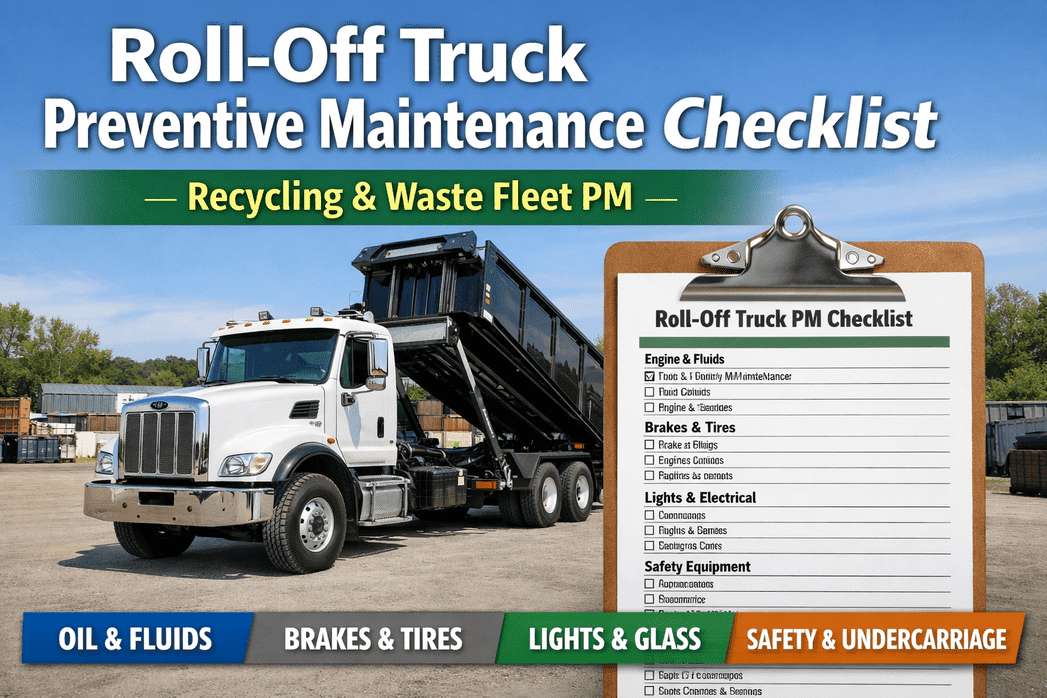
Roll-off trucks are the workhorses of America's recycling and waste industry — hauling 20-40 yard containers across construction sites, industrial facilities, and transfer stations every day. These Class 8 vehicles endure extreme duty cycles: heavy hydraulic loading, frequent stops, steep inclines at landfills, and constant exposure to corrosive waste materials. The waste management industry's fatality rate is more than 5 times the national average, and powered haulage accidents are a leading cause. This preventive maintenance checklist covers 36 items across 8 critical systems: engine oil change and all vital fluids, exterior lighting and back-up alarm, body/glass/mirrors, position-specific tire inspection (all 6 wheel positions on tandem axle), brakes by axle, complete cab interior including bin heaters and air ride seats, undercarriage/chassis grease, and safety equipment. Book a demo to see how Fleet Rabbit manages roll-off truck PM scheduling for waste and recycling fleets.
Roll-Off Truck PM Checklist
Recycling & Waste Fleet — Preventive Maintenance • DOT Compliant
Why Roll-Off Trucks Need Rigorous PM Programs
Extreme Duty Cycle
- Roll-off trucks operate under the heaviest duty cycles in commercial trucking: constant hydraulic loading/unloading, PTO-driven systems running at high RPM, steep landfill grades, unpaved job sites, and exposure to corrosive waste materials. This accelerates wear on brakes, hydraulics, drivetrain, and chassis components far faster than highway trucking. PM intervals must be shorter and inspections more thorough.
5x the Fatality Rate
- The US waste management industry's fatality rate is more than 5 times the rate for all industries combined (BLS). Roll-off truck operations add specific hazards: container tip-overs during loading, cable/chain failures, hydraulic hose bursts, and backing incidents at construction sites with limited visibility. Consistent PM catches the brake wear, hydraulic degradation, and lighting failures that contribute to these incidents. Book a demo for waste fleet PM tracking.
DOT + Insurance Requirements
- Roll-off trucks operating over 10,001 lbs GVWR are CMVs subject to FMCSA regulations, DOT annual inspection, and CDL requirements. Insurance carriers for waste haulers increasingly require documented PM programs with timestamped records. After an incident, maintenance history is the first document examined by OSHA investigators, insurance adjusters, and plaintiff attorneys.
Fluids, Lighting & Exterior Body
Engine service, all exterior lights verification, and body/glass condition:
Vital Fluid Levels
Exterior Lighting
Exterior Body & Glass
Tires & Brakes — Position-Specific
Every tire and brake position checked individually — tandem axle roll-off trucks have 6 wheel positions plus steer axle:
Steer Axle Tires
Drive Axle Tires (Tandem)
Brakes — By Axle
Book a demo to see position-specific tire tracking and brake measurement history
Cab Interior & Operator Environment
Complete cab inspection — seats, belts, controls, climate, and roll-off specific items:
Seats & Safety
Controls & Gauges
Climate & Roll-Off Specific
Undercarriage, Chassis & Safety Equipment
Under-vehicle drivetrain inspection, complete chassis lubrication, and emergency equipment:
Undercarriage
Chassis Lubrication
Safety Equipment
Roll-Off Truck Tire Position Map — Tandem Axle
Roll-off trucks have 10-14 tires across steer and tandem drive axles. Each position has different wear patterns and minimum tread requirements:
| Position | Location | Min Tread | Common Wear Issue | Roll-Off Specific Risk |
|---|---|---|---|---|
| Left Steer | Front left | 4/32" | Shoulder wear from turns | Heavy turning at job sites wears edges faster |
| Right Steer | Front right | 4/32" | Curb impact, shoulder wear | Curbside maneuvering at pickup locations |
| Left Drive | Rear left outer/inner | 2/32" | Center wear from highway, heel-toe from stops | Loaded weight causes accelerated center wear |
| Right Drive | Rear right outer/inner | 2/32" | Same as left drive | Uneven loading shifts weight to one side |
| Forward Left Drive | Forward tandem left | 2/32" | Scrubbing from tight turns | Tight job site turns cause severe scrubbing on tandem axle |
| Forward Right Drive | Forward tandem right | 2/32" | Same as forward left | Same — worst on construction site access roads |
Book a Demo — Built for US Waste & Recycling Fleets
Whether you operate 5 roll-off trucks or 50+, Fleet Rabbit manages the complete PM lifecycle — oil change scheduling, position-specific tire tracking, axle-by-axle brake measurements, hydraulic system monitoring, and bin heater verification. Your DOT inspector, your insurance carrier, and your maintenance team all get the documentation they need.
Roll-Off Truck PM Interval Schedule — Severe Duty
Roll-off trucks operate under severe-duty conditions requiring shorter PM intervals than highway trucks:
| Interval | Oil & Filter | Brakes | Tires | Hydraulics | Chassis Grease | Full PM (This Checklist) |
|---|---|---|---|---|---|---|
| Daily | Check level | Pedal test | Visual + pressure | Check level | — | Pre-trip walk-around |
| Every 5,000 mi | Change oil & filter | Adjust all | Measure tread per position | Check hoses, leaks | Full chassis | Complete this checklist |
| Every 15,000 mi | Change + sample | Full measurement | Rotate if applicable | Filter change, fluid sample | Full + pivot points | This checklist + extended |
| Every 30,000 mi | Change + analysis | Reline evaluation | Replace evaluation | Full system flush | Complete re-grease | Major PM + component eval |
Regulatory Framework
CMV Requirements
Roll-off trucks over 10,001 lbs GVWR are commercial motor vehicles requiring CDL, pre-trip inspection (392.7), DVIR (396.11), and DOT annual inspection. This PM checklist covers all 11 FMCSA-required component categories. Book a demo for DOT-compliant PM documentation.
Waste Collection Safety
OSHA's waste collection safety standards apply to roll-off operations. Lockout/tagout procedures (29 CFR 1910.147) apply during hydraulic system maintenance. The back-up alarm verification on this checklist addresses OSHA's emphasis on preventing struck-by and run-over incidents in waste operations.
Industry Best Practices
The National Waste & Recycling Association and SWANA publish safety best practices for waste collection. SWANA's zero-fatality goal emphasizes pre-trip inspections, PM program documentation, and hydraulic system maintenance as foundational safety practices for roll-off truck operations.
Roll-Off Truck PM FAQs
Why are tires checked by position on roll-off trucks?
Roll-off trucks have tandem rear axles with different wear patterns per position. Steer tires wear on edges from constant turning at job sites. Drive tires wear in the center from loaded highway runs. Forward tandem tires scrub severely from tight construction site turns. Checking each position individually catches uneven wear that averaging across all tires would miss — and prevents blowouts at the worst possible time.
What are bin heaters and why are they on a PM checklist?
Bin heaters are heating elements that prevent waste material from freezing to the container during cold weather operations. A frozen load won't discharge from the container, causing the truck to carry dead weight and requiring dangerous manual intervention to break the material loose. Bin heater failure in winter means a roll-off truck that can't complete its route — checking them during PM prevents cold-weather service disruptions.
How often should roll-off trucks get PM service?
Roll-off trucks operate under severe-duty conditions requiring shorter intervals than highway trucks. Most waste haulers service at 5,000-mile intervals (vs. 10,000-15,000 for highway trucks). Oil change intervals are shorter because of constant PTO operation, frequent idle time, and exposure to dust and debris. Book a demo to see mileage-based PM scheduling for severe-duty cycles.
Why check the entry grab bar on PM?
Roll-off truck drivers mount and dismount the cab dozens of times per shift — at every pickup location, drop-off site, and container swap. The entry grab bar is their primary handhold. A loose or broken grab bar causes slip-and-fall injuries that are among the most common non-fatal injuries in waste collection. Checking mounting bolts and rail condition during PM prevents an injury that takes a driver off the route for weeks.
Why does this checklist include photo documentation for body damage?
The CSV specifies "photo if visible damage requires repair" — this is best practice for roll-off trucks that operate on construction sites and industrial facilities where damage claims are common. Photo documentation during PM establishes the truck's condition at the time of inspection, making it easier to determine when and where damage occurred for insurance claims and customer dispute resolution.
What is the tractor hand valve check?
The tractor hand valve (trailer brake control) is used to apply trailer brakes independently of the tractor brakes. For roll-off trucks, this valve controls brake application during container loading/unloading to prevent the truck from rolling. A malfunctioning hand valve means the operator cannot hold the truck stationary during hydraulic operations — creating rollaway risk. The hitch and chain loop check verifies the container-securing mechanism is functional.
Why is the low air warning checked during interior inspection?
Roll-off trucks use air brakes that can lose pressure from system leaks, glad hand disconnection, or compressor failure. The low air warning buzzer and light must activate before pressure drops below 60 psi — giving the driver time to stop safely before brakes fail entirely. This is a FMCSA OOS item. Checking it during PM ensures the warning system will function when the driver needs it most — on a loaded downhill run to the landfill.
Why is chassis grease so important for roll-off trucks?
Roll-off trucks have significantly more grease points than highway trucks — the roll-off rail slides, hydraulic pivot points, container latch mechanisms, and tailgate hinges all require regular lubrication. Operating in dusty, wet, and corrosive environments accelerates grease washout. Under-greased pivot points bind and wear, leading to hydraulic system overload, cable/chain failures, and container handling malfunctions. Book a demo for chassis grease tracking per service interval.
Conclusion
Roll-off trucks are the hardest-working vehicles in the waste and recycling industry — hauling 20-40 yard containers across construction debris, industrial waste, and demolition material every day. The severe-duty cycle they endure demands shorter PM intervals, position-specific tire tracking, axle-by-axle brake documentation, and roll-off-specific items like bin heater verification and rail slide lubrication that standard truck PM checklists don't cover. This 36-item checklist addresses every system that keeps a roll-off truck operational, DOT compliant, and — most importantly — safe for the operators who work America's 4th deadliest job.
Severe Duty. Shorter Intervals. Better Documentation.
Roll-off trucks endure the hardest duty cycle in commercial trucking — and they deserve PM programs built for that reality. Fleet Rabbit manages position-specific tire tracking, axle-by-axle brake measurements, oil change scheduling at severe-duty intervals, and roll-off specific items like bin heater verification and rail slide lubrication. Every PM is timestamped, photo-documented, and audit-ready.


