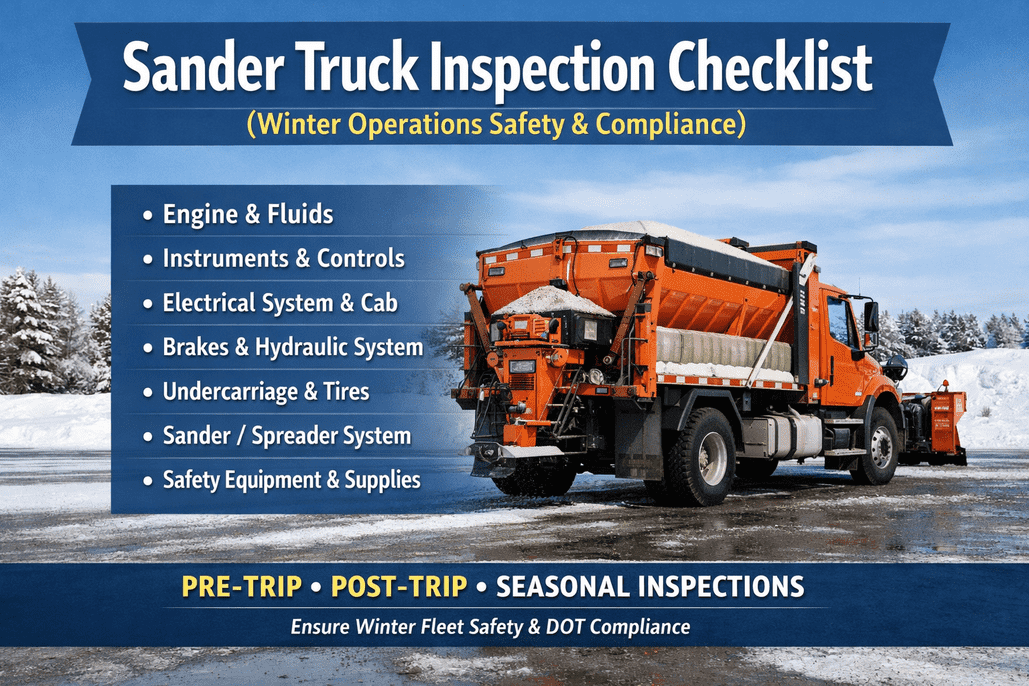
Sander trucks operate in the worst conditions imaginable—freezing temperatures, icy roads, heavy salt loads, and zero-visibility storms. When a municipality or contractor dispatches a sander truck, there's no room for a failed hydraulic spreader, dead beacon light, or soft brake pedal. This comprehensive sander truck inspection checklist covers every critical system from engine fluids and instrument gauges to the dump box, spreading mechanism, and electrical systems, ensuring your winter maintenance fleet is road-ready before every storm response. Start your free fleet trial
Sander Truck Inspection Checklist
Winter Operations Safety & Compliance — Pre-Trip • Post-Trip • Seasonal
Inspection Purpose
Storm Response Readiness
- Sander trucks are dispatched during active storms when conditions are at their worst. A pre-trip inspection ensures the engine starts reliably in sub-zero temperatures, brakes respond on ice-covered roads, and the spreading system delivers material consistently—because a breakdown during a storm means untreated roads and public safety risk.
Operator & Public Safety
- Operating a heavy loaded truck on icy roads with reduced visibility demands every safety system working perfectly. Verifying headlamps, rotating beacons, back-up alarms, and brake operation before departure prevents collisions, rollovers, and pedestrian incidents during winter operations.
Equipment & Cost Protection
- Salt and brine accelerate corrosion on every component they contact. Regular inspections catch hydraulic hose degradation, undercarriage rust, and electrical failures caused by salt intrusion before they become expensive emergency repairs during the busiest season of the year.
Digitize your sander truck inspection logs with Fleet Rabbit
1. Engine
Check all engine fluids, components, and condition before starting winter operations:
Fluids & Levels
Leaks & Condition
Cold Weather Readiness
2. Instrument Operation
Verify all dashboard gauges and warning indicators are functional and reading correctly:
Primary Gauges
Secondary Indicators
Warning Lights
3. Electrical System & Cab Condition
Inspect all lights, signals, warning devices, and cab components for safe operation:
Exterior Lights
Warning Devices
Cab Condition
4. Brakes & Hydraulic System
Test brake operation and inspect all hydraulic components for the dump box and spreading system:
Brake System
Hydraulic System
Dump Box
5. Undercarriage & Tires
Examine the frame, suspension, tires, and undercarriage for road-safe condition:
Suspension
Tires & Wheels
Undercarriage Condition
6. Sander / Spreader System
Inspect the salt/sand spreading mechanism for reliable material delivery during operations:
Spreader Mechanism
Controls & Calibration
Hopper & Material
Track spreader calibration & material usage digitally with Fleet Rabbit
7. Safety Equipment & Supplies
Confirm all required safety gear and emergency supplies are on-board for winter operations:
Emergency Equipment
Winter Supplies
Documentation
Streamline Sander Truck Fleet Inspections
Fleet Rabbit's Winter Fleet Benefits:
- ✓ Digital pre-trip inspections with photo evidence & GPS-tagged timestamps
- ✓ Automated alerts for spreader calibration, hydraulic service & beacon lamp replacement
- ✓ Track salt usage, material inventory & route completion across your sander fleet
- ✓ Instant defect notifications to maintenance with storm-season priority flagging
- ✓ DOT compliant inspection records & seasonal readiness reports in the cloud
Common Defects to Watch For
Salt Corrosion on Hydraulics
- Accelerated Hose Failure: Salt spray from the spreader coats every undercarriage component including hydraulic hoses, fittings, and cylinders. Salt draws moisture and accelerates corrosion, causing fittings to seize and hose covers to crack prematurely. A hydraulic line failure during a dump or spread operation can leave the truck disabled mid-route in a storm. Wash the undercarriage after every shift and inspect hydraulic connections weekly during the season.
Spreader Chain / Auger Freeze-Up
- Moisture in Hopper: Wet salt or sand left in the hopper overnight freezes into a solid mass that jams the conveyor chain or auger at startup. This bends chain links, shears auger pins, and delays dispatch. Always run the spreader empty before parking if possible. If material must stay loaded, ensure the vibrator is functional and test spreader operation before leaving the yard—not on the route.
Rotating Beacon Failure
- Visibility Critical: Sander trucks operate at slow speeds on active roadways during storms with near-zero visibility. A non-functioning rotating orange beacon makes the truck almost invisible to approaching traffic. Salt film, snow buildup, and vibration loosen beacon mounts and corrode bulb contacts. Clean the beacon lens, test the motor, and check mounting bolts before every shift. LED upgrades eliminate most bulb failures.
Essential Inspection Tools
Equip your team with the right tools for thorough sander truck evaluations:
Measurement & Testing
- Tire Pressure Gauge: Calibrated gauge for heavy truck dual tires.
- Multimeter: For checking battery voltage & beacon electrical circuits.
- Antifreeze Tester: To verify coolant freeze protection level.
- Hydraulic Pressure Gauge: For testing dump and spreader circuits.
Fluid & Condition
- Torque Wrench: For confirming lug nut torque on all positions.
- Belt Tension Gauge: For verifying drive belt tension in cold.
- Brake Stroke Gauge: For measuring push rod travel per axle.
- Fluid Sample Bottles: For hydraulic fluid contamination checks.
Visual & Documentation
- High-Lumen Flashlight: For pre-dawn undercarriage & hopper checks.
- Inspection Mirror: Telescoping mirror for behind-axle & frame checks.
- Chalk / Paint Marker: For marking corrosion spots & defects.
- Digital Camera: For documenting defects—or use Fleet Rabbit's in-app photo capture.
Sander Truck Inspection FAQs
1. How often should sander trucks be inspected?
A pre-trip inspection is required before every dispatch, which is especially critical during storm season when trucks may run multiple shifts per day. A post-trip walkaround should document any new damage or defects. During the active winter season, weekly detailed inspections of the hydraulic system, spreader mechanism, and undercarriage corrosion are recommended. A comprehensive seasonal prep inspection should be completed before the first storm, and a season-end decommission inspection before summer storage. Start a free Fleet Rabbit trial to automate seasonal and per-storm inspection scheduling.
2. Why is the rotating orange beacon checked during a pre-trip inspection?
Sander trucks travel at 15–25 mph on active roadways during storms with severely reduced visibility. The rotating beacon is often the only warning approaching drivers have that a slow-moving truck is ahead. A failed beacon—from a burned bulb, corroded contact, or loose mount—makes the truck nearly invisible and dramatically increases rear-end collision risk. Test the beacon at full brightness before every departure and keep a spare bulb on-board.
3. How do I prevent spreader freeze-ups in cold weather?
The best prevention is running the hopper empty before parking whenever possible. If material must stay loaded overnight, ensure the hopper vibrator is functional and activate it before attempting to run the conveyor. Add pre-treated or dry material on top of damp material to reduce surface freezing. Test spreader operation in the yard before departing on route—a frozen chain or auger is better discovered at the shop than on a hill at 3 AM. Book a Fleet Rabbit demo to track spreader condition checks and material loading logs.
4. What damage does salt cause to sander trucks and how do I mitigate it?
Salt accelerates corrosion on every metal surface it contacts—frame rails, hydraulic fittings, brake lines, electrical connectors, and the dump box floor. Salt also draws moisture, which freezes and expands in crevices, cracking welds and loosening bolts. Mitigation requires washing the entire undercarriage after every shift (or at minimum every 48 hours during active use), applying corrosion inhibitor to exposed metal, and inspecting hydraulic connections weekly for salt-induced deterioration.
5. What should the seasonal prep inspection cover before winter?
Before the first storm: verify all engine fluids are winter-rated (coolant antifreeze concentration, winter-blend diesel, cold-rated hydraulic fluid). Test the block heater, battery cold-cranking amps, and defroster output. Inspect the entire spreader system including conveyor chain tension, spinner disc balance, material gate operation, and calibration. Check all lights and the rotating beacon. Verify tire tread depth is adequate for ice conditions. Replace any worn wiper blades. Use Fleet Rabbit to create seasonal prep checklists and track fleet-wide winter readiness.
6. Why is the dump box safety prop on the checklist?
The dump box safety prop is a mechanical bar that holds the raised box in position when someone is working underneath or inspecting the hydraulic cylinders. If the prop is missing, bent, or not used, a hydraulic failure drops the box without warning—a scenario that has caused multiple crush fatalities. Verify the prop is present, undamaged, and that the operator knows to use it anytime the box is raised for any reason other than active dumping.
7. How do I check brake operation in cold weather?
Start the engine and build full air pressure. Test the service brakes at low speed on a flat surface—brakes should engage firmly with no pull to either side. Set the park brake and confirm the truck holds on a slight grade. In freezing conditions, brake shoes can freeze to drums overnight—rock the truck gently before applying full braking force. Check for air leaks at all fittings; cold temperatures shrink seals and can create leaks that don't exist in warm weather. Schedule a demo to see how Fleet Rabbit logs brake test results with pass/fail tracking per axle.
8. What should the season-end decommission inspection cover?
After the last storm: thoroughly wash the entire truck—undercarriage, frame, dump box, spreader, and engine compartment—to remove all salt residue. Drain and flush the brine system if equipped. Inspect for corrosion damage that occurred during the season. Change hydraulic fluid and filters. Grease all fittings. Document all defects for off-season repair. Disconnect the battery or use a trickle charger for storage. A detailed decommission report ensures the truck is ready to prep quickly next season.
Standardize Sander Truck Fleet Inspections
Storm season doesn't wait for paperwork. Sander trucks get dispatched at 2 AM in blizzard conditions, and paper checklists get skipped, lost, or signed without being done. Fleet Rabbit gives every operator a mobile-first inspection app that captures engine checks, beacon verification, spreader tests, and brake operation with timestamped photos and GPS—so every truck leaves the yard verified, every defect gets tracked to resolution, and your winter fleet stays DOT compliant through the hardest season of the year.


