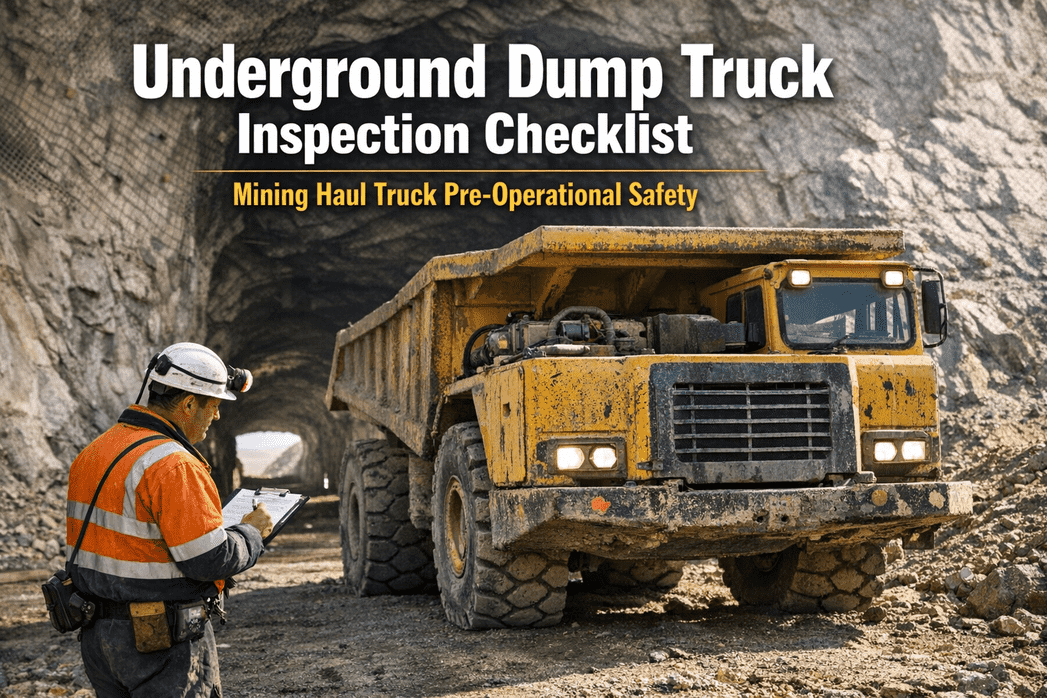
Powered haulage — the category that includes underground dump trucks — accounts for more mining fatalities than any other accident class in the United States. MSHA reported 28 off-road mine haul truck tip-overs or rollovers between 2018 and 2024, and the agency's enhanced enforcement program specifically targets pre-operational inspections (30 CFR 57.14100), brake functionality, and seat belt compliance on haul trucks. Underground operations multiply every risk: limited visibility, confined haul roads, steep grades, wet conditions, and no room for evasive maneuvers. This underground dump truck inspection checklist covers 29 items across engine, instruments, electrical/cab, undercarriage/dump box/brakes/hydraulics, and safety accessories — every item that MSHA inspectors evaluate and that keeps operators alive 1,000 feet below the surface. Book a demo to see how Fleet Rabbit digitizes MSHA-compliant pre-shift inspections for underground mining fleets.
Underground Dump Truck Inspection
Mining Haul Truck — Pre-Operational • MSHA 30 CFR 57.14100 • Underground Safety
Why Pre-Operational Inspections Are Non-Negotiable Underground
MSHA Requires It — 30 CFR 57.14100
- MSHA regulation 30 CFR 57.14100(a) requires that self-propelled mobile equipment be inspected by the equipment operator before being placed in operation on each shift. Defects affecting safety must be corrected before equipment is used. MSHA's enhanced enforcement program specifically targets pre-operational inspections on haul trucks — citations may receive special assessments with elevated penalties. Underground mines receive 4 MSHA inspections per year. Book a demo for MSHA-compliant digital inspections.
Powered Haulage: #1 Fatal Category
- Powered haulage consistently ranks as the leading cause of mining fatalities in the United States. MSHA reported that more than half of recent fatal mining accidents involved powered haulage. Between 2018 and 2024, mine operators reported 28 off-road mine haul truck tip-overs or rollovers causing injuries. Underground operations intensify every risk — limited headroom, confined haul roads, steep ramps, water accumulation, and zero margin for error.
Underground Multiplies Every Hazard
- Surface truck failures are dangerous. Underground truck failures can be catastrophic and unescapable: brake failure on a steep decline means a loaded dump truck accelerating into a dead-end drift. Hydraulic failure with the bed raised means a truck that can't pass through tunnel height restrictions. Electrical failure means total darkness. A back-up alarm failure in a tunnel means workers on foot have zero warning. Every item on this checklist prevents a specific underground fatality scenario.
Engine & Instrument Operation
Engine compartment walk-around and instrument verification before moving the truck underground:
Engine — Fluids & Condition
Engine — Cooling & Drive
Instrument Operation
Electrical System & Cab Condition
Every light, alarm, and visibility system — critical in underground environments where ambient light is zero:
Primary Lights
Warning Systems
Cab Safety
Book a demo to see underground lighting verification with photo documentation
Undercarriage, Dump Box, Brakes & Hydraulics
Under-vehicle and dump body inspection — brakes, hydraulic system, suspension, and tires:
Brakes & Suspension
Hydraulic System
Dump Box & Body
Safety Accessories & Emergency Equipment
Personal safety and emergency equipment — required before entering underground workings:
Emergency Equipment
Tools & Spare
Underground-Specific
MSHA Enforcement: What Inspectors Target on Underground Haul Trucks
More than half of recent US mining fatalities involved powered haulage — the category covering dump trucks, haul trucks, and mobile equipment.
MSHA conducts 4 inspections per year at every underground mine. Pre-operational inspection compliance is a primary enforcement focus.
MSHA documented 28 off-road mine haul truck tip-overs or rollovers causing injuries in a 6-year period.
MSHA impact inspections identified 4,567 violations including 1,261 significant and substantial findings.
MSHA Standards That Apply to Underground Dump Trucks
MSHA's enhanced enforcement program targets these specific standards on every haul truck inspection:
| MSHA Standard | Requirement | Checklist Items | Penalty if Violated |
|---|---|---|---|
| 30 CFR 57.14100(a) | Pre-operational inspection before each shift | All 29 items on this checklist | Citation + special assessment (elevated penalty) |
| 30 CFR 57.14101(a)(3) | Maintain brakes in functional condition | Brake operation test, park brake | S&S citation — significant and substantial |
| 30 CFR 57.14131 | Seat belt use required | Seat belts — functional, worn | Citation per operator + enhanced enforcement |
| 30 CFR 57.9101 | Operating controls — maintained in functional condition | Steering, brakes, instruments, horn | Citation — may trigger impact inspection |
| 30 CFR 57.14100(b) | Defects affecting safety — corrected before use | All items — defects reported and corrected | Unwarrantable failure if aggravated |
| 30 CFR 57.4200 | Fire extinguisher on self-propelled equipment | Fire extinguisher — charged, accessible | Citation — critical safety item |
Book a Demo — Built for US Mining Operations
Whether you run 5 haul trucks in a single underground operation or 50+ units across multiple mine sites, Fleet Rabbit digitizes the MSHA-required pre-shift inspection. Guided mobile checklists, photo documentation in underground conditions, defect routing to maintenance, and audit-ready records that survive every MSHA inspection — because in underground mining, the inspector arrives 4 times a year and the pre-op record is the first thing they check.
Underground vs. Surface: Why Every Inspection Item Matters More Below Ground
| Checklist Item | Surface Risk | Underground Risk (Amplified) |
|---|---|---|
| Headlamps | Reduced visibility at night | Total darkness — zero visibility without headlamps, no ambient light exists |
| Back-up alarm | Pedestrian warning in yard | Workers in confined tunnel have no escape route — alarm is their only warning |
| Brakes | Runaway on grade | Brake failure on steep decline ramp — loaded truck accelerates into dead-end drift |
| Exhaust system | Noise and fumes outdoors | CO and diesel particulate accumulate in confined space — asphyxiation risk |
| Rotating beacon | Visibility aid in open pit | Only visual warning for approaching equipment in curved, low-ceiling haul roads |
| Hydraulic lift | Dump failure — reload required | Bed stuck raised can't pass through tunnel — blocks entire haul road |
| Fire extinguisher | Vehicle fire response | Fire underground triggers evacuation of entire mine — minutes matter for survival |
US Regulatory Framework for Underground Mining Equipment
Underground Metal/Nonmetal
Part 57 covers safety and health standards for underground metal and nonmetal mines. Section 57.14100 requires pre-operational inspections. Section 57.14101 mandates functional brakes. Section 57.14131 requires seat belt use. MSHA's enhanced enforcement program applies special assessments to violations of these standards. Book a demo for MSHA-compliant documentation.
Training Requirements
Part 48 requires comprehensive training for all miners including task-specific training on equipment operation. Haul truck operators must be trained on pre-operational inspection procedures, emergency procedures, and hazard recognition. Training records must be maintained and available for MSHA inspection.
Fire Prevention
Self-propelled equipment must have fire extinguishers. Underground fire is the most feared event in mining — a truck fire can fill workings with toxic smoke in minutes. The fire extinguisher check is not a paperwork item — it's a survival item. Expired or uncharged extinguishers receive immediate citations.
Underground Dump Truck Inspection FAQs
When must underground dump trucks be inspected?
Per MSHA 30 CFR 57.14100(a), self-propelled mobile equipment must be inspected by the operator before being placed in operation on each shift. This means every shift — not every day. A mine running two 12-hour shifts requires two inspections per truck per day. Defects affecting safety must be corrected before the equipment is used. MSHA inspectors verify that inspection records exist for every shift the truck operated.
Why is the rotating orange beacon on the checklist?
Underground haul roads are curved, low-ceiling, and often single-lane. The rotating orange beacon is the primary visual warning that a dump truck is approaching — visible around corners and through dust before headlamps are. Without a functioning beacon, operators of other equipment and workers on foot have dramatically reduced warning time. In underground environments, collision avoidance depends on beacons because line-of-sight is limited by tunnel geometry.
Why is a flashlight listed as a dump truck inspection item?
Underground mines have no ambient light. The operator needs a flashlight to perform the walk-around inspection of the undercarriage, tires, hydraulic hoses, and dump box before starting the truck. Truck-mounted lights don't illuminate the underside of the vehicle. Without a working flashlight, the pre-shift inspection cannot be properly completed — and MSHA inspectors know this.
What is MSHA's enhanced enforcement for haul trucks?
MSHA implemented an enhanced enforcement program after analyzing fatal accident data. The program specifically targets: pre-operational inspections (57.14100), brake functionality (57.14101), seat belt use (57.14131), and equipment control (57.9101). Citations issued under enhanced enforcement may receive special assessments — meaning significantly higher penalties than standard violations. Book a demo to ensure your pre-op records meet enhanced enforcement standards.
What happens if the lift cylinder fails underground?
A lift cylinder leak or pin failure underground creates two hazards: the dump box may not raise to dump the load (blocking production), or worse, the box may not stay raised during maintenance (crushing hazard). If the box is stuck in the raised position, the truck cannot travel through standard tunnel height — blocking the entire haul road until a maintenance crew can safely lower it. The body prop safety bar prevents the bed from dropping during repair.
Why is exhaust inspection critical underground?
Diesel exhaust produces carbon monoxide (CO) and diesel particulate matter (DPM). On the surface, these dissipate into open air. Underground, they accumulate in the working environment — especially in dead-end headings and poorly ventilated areas. An exhaust leak before the scrubber or DPF can create CO concentrations that cause headaches, impaired judgment, unconsciousness, and death. MSHA has specific DPM exposure limits under 30 CFR 57.5060.
Are inspection records required for MSHA audits?
Yes. MSHA inspectors routinely review pre-operational inspection records during their 4x/year underground mine inspections. Records must show: date, shift, equipment ID, operator name, items inspected, defects found, and corrective action taken. Missing records result in citations under 57.14100. Digital inspection records with timestamps and operator ID are the strongest defense during MSHA audits.
What makes underground tire inspection different?
Underground haul truck tires face rock cuts, punctures from ore fragments, sidewall damage from narrow tunnel walls, and chemical exposure from groundwater. Unlike surface operations, a flat tire underground means the truck is stranded in a location where a crane or service truck may not be able to reach. The spare tire, jack, and tire wrench are listed as required accessories because roadside assistance doesn't exist 1,000 feet underground. Book a demo for tire condition tracking with photo documentation.
Conclusion
An underground dump truck operates in the most demanding environment any vehicle faces — total darkness, confined spaces, steep grades, toxic exhaust accumulation, and zero margin for equipment failure. MSHA requires pre-operational inspection before every shift because the consequences of skipping it underground are catastrophic and often fatal. This 29-item checklist covers every system that MSHA's enhanced enforcement program targets — from brake operation and seat belt condition to the rotating beacon and flashlight that make the inspection itself possible. For US underground mining operations, digital pre-shift inspections with timestamped records and operator identification aren't just compliance tools — they're the documentation that proves your operation takes the lives of your miners seriously.
1,000 Feet Below the Surface. Every Inspection Item Is a Survival Item.
Powered haulage is the #1 cause of mining fatalities in America. MSHA inspects your underground mine 4 times a year — and pre-operational inspection records are the first documents they review. Fleet Rabbit digitizes every shift inspection with offline capability, photo documentation in tunnel conditions, automatic defect routing, and MSHA-ready audit trails that prove every truck was inspected before it entered the mine.


