Run a dump truck long enough and you will discover it lives two separate lives. On the jobsite it is earthmoving equipment, loaded by an excavator, judged on cycle time and payload. The moment it rolls onto a public road to reach the next pit or the asphalt plant, it becomes a commercial motor vehicle, judged on brakes, hours, and a CDL. Most downtime, most fines, and most bad purchase decisions in earthmoving fleets trace back to managers who only ever planned for one of those two lives. This guide walks through both, plus the articulated-versus-rigid decision that decides how fast your haul cycle actually runs.
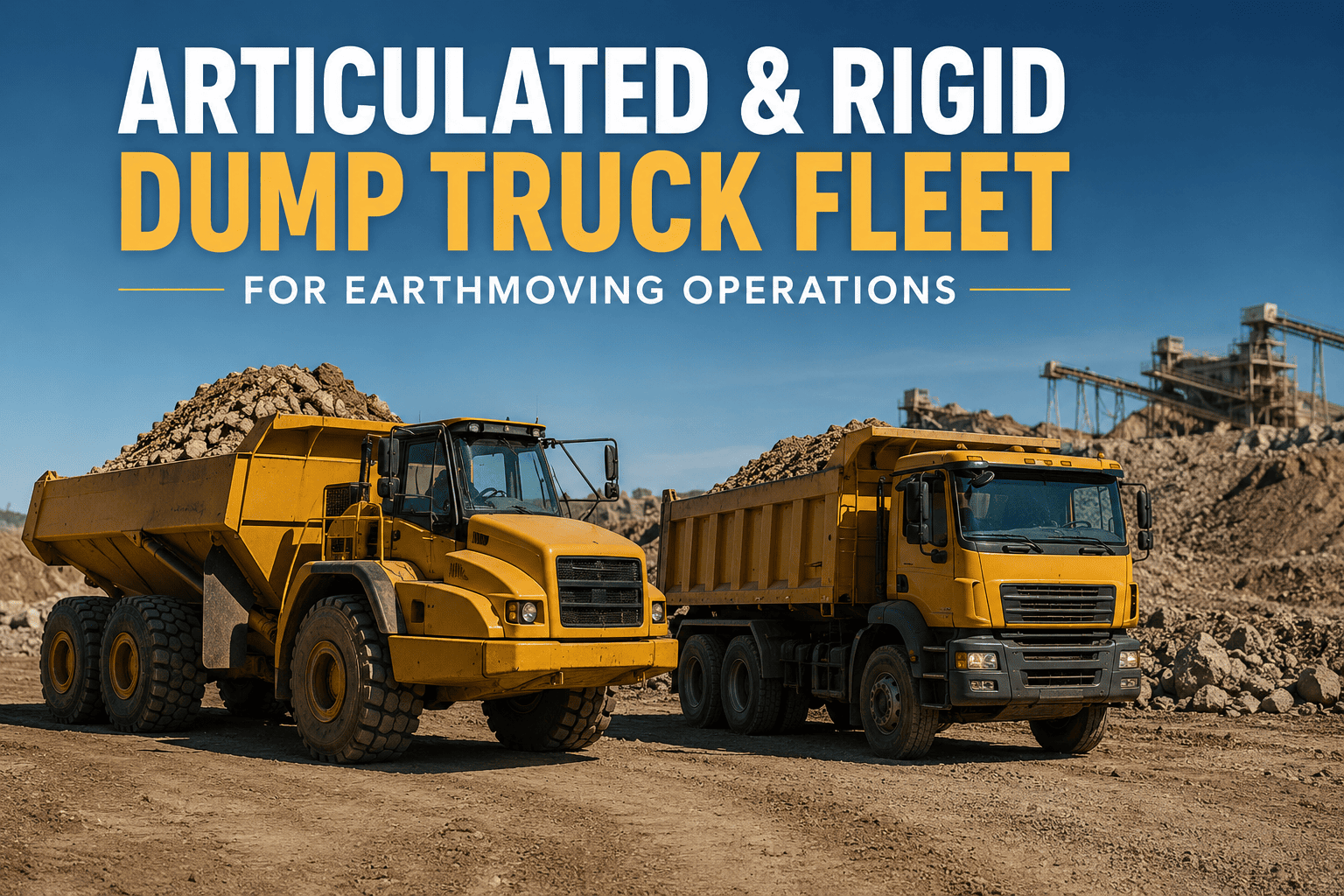
Articulated dump trucks (ADTs) use a pivot joint and six-wheel drive to keep traction on soft, steep, or muddy haul roads, typically hauling 25 to 60 tons. Rigid dump trucks (RDTs) use a single fixed frame for higher capacity, up to 100 tons on the largest models, but need firm, well-built haul roads. On public roads, dump trucks fall under FMCSA rules; on the jobsite, OSHA governs loading, maintenance, and yard work. FleetRabbit tracks both rule sets alongside payload and cycle time in one dashboard.
Two Regulators, One Truck
A dump truck fleet is unusual in fleet management because a single vehicle answers to two different regulators depending on where it happens to be standing. Get this boundary wrong and you either under-comply on the road or over-manage the pit, and both mistakes cost money.
OSHA Owns The Jobsite
The instant a truck leaves the public road and enters a pit, quarry, or active construction zone, OSHA jurisdiction takes over. Loading and unloading, backing near an excavator, maintenance in the yard, and fueling all fall under OSHA's workplace safety rules, regardless of whether a commercial vehicle is involved. Serious injuries that happen inside the site trigger OSHA's reporting clock, separate from any DOT paperwork.
FMCSA Owns The Haul Road
Once that same truck crosses onto a public road, driver qualification, hours of service, brake condition, and load securement fall under FMCSA. Any truck with a GVWR of 26,001 pounds or more generally needs a CDL-licensed driver, and roadside inspections routinely flag brake and tire defects as the leading out-of-service violations nationwide. A fleet that only tracks OSHA-style site safety and ignores FMCSA driver files is exposed the second an inspector waves a truck onto the scale.
On The Site
OSHA governs loading, spotting, maintenance bays, and yard traffic, no matter the truck size.
On The Road
FMCSA governs hours of service, CDL status, brakes, and load securement the moment wheels touch pavement.
At The Boundary
Fueling, hazmat, and hazard reporting can trigger both agencies on the same incident, so records need to cover each.
Fleets that treat this as one blended compliance workflow, rather than two separate binders, catch fewer violations at the scale house and spend less time reconstructing records after an incident. FleetRabbit keeps driver qualification files, brake and tire inspection history, and jobsite maintenance logs in a single record per vehicle, so nothing falls into the gap between the two agencies. If you would like to see how that dual-jurisdiction dashboard works on your own fleet data, you can book a live demo or go ahead and sign up free to try it with a few trucks first.
Stop juggling two binders for one truck. FleetRabbit tracks jobsite inspections and on-road compliance side by side, flags expiring CDLs and overdue brake checks automatically, and keeps every dump truck audit-ready.
Articulated Or Rigid: Let The Haul Road Decide
Long before compliance ever enters the picture, the biggest cost decision in earthmoving is which truck body style you put on the ground. The pivot joint on an articulated dump truck is the whole story: it lets the front and rear frames move independently, keeping all six wheels planted on uneven, soft, or sloped ground. A rigid dump truck skips that joint entirely, carrying its cab and body on one fixed chassis built for a much higher payload on firm, engineered roads.
Where Articulated Trucks Win
On grades beyond roughly 10 to 15 percent, or on soft clay, loose fill, and unformed ground, ADTs hold a stable loaded cycle speed that rigid trucks cannot match without cutting payload. That traction advantage can shave real time off the cycle: on rough terrain, articulated fleets have been measured completing haul cycles 5 to 10 percent faster than rigid trucks covering the same rough ground, simply because they are not slowing to protect the chassis.
Where Rigid Trucks Win
Give a rigid truck an engineered, compacted haul road and the equation flips. The largest RDTs haul roughly double the payload of a comparable articulated model, which means fewer trips per thousand tons moved and a lower cost per ton over a long, well-maintained haul. The tradeoff is the standing investment: haul road construction and upkeep is the ongoing cost that makes rigid fleets pay off.
| Decision Factor | Articulated (ADT) | Rigid (RDT) |
|---|---|---|
| Typical Payload | 25 to 60 tons | Up to roughly 100 tons on the largest models |
| Haul Road Condition | Soft, muddy, steep, or unformed ground | Compacted, engineered, well-maintained roads |
| Grade Handling | Stable well beyond 10 to 15 percent grades | Needs payload reduction on steep sustained grades |
| Turning Radius | Tighter, suited to confined sites | Wider, needs more site footprint |
| Annual Maintenance | Roughly 10000 dollars more per year on average | Lower routine cost, but heavier damage on rough ground |
| Best Fit | Infrastructure, logging, small to mid mining, wet sites | Long haul, high tonnage, established quarry or mine roads |
The Split-Fleet Reality
Most large earthmoving contractors do not pick one type and stop. If the worst segment of the haul cycle sits on soft or unformed ground, an all-rigid fleet gets bogged down or tears up the road, so many operations run ADTs on the variable ground and RDTs on the finished sections. Others phase it: articulated trucks handle the first months of a project while haul roads are still being built, then rigid trucks take over once the road standard is met. Either way, the decision should follow the terrain, not the other way around.
A Fast Terrain Checklist
Sustained grades over 10 to 15 percent, soft or waterlogged ground, narrow or unformed access, and a site footprint that keeps shifting all point toward articulated trucks. Compacted engineered roads, long haul distances, dense high-impact material like blasted rock, and a confirmed haul road budget all point toward rigid trucks.
Cycle Time And Payload: The Two Numbers That Actually Matter
Whichever body style you run, the same two metrics decide whether the fleet is making money on any given day: cycle time and payload utilization. A truck that is 10 percent underloaded on every pass is quietly losing 10 percent of your production without a single mechanical fault appearing anywhere.
Cycle Time
Load, haul, dump, and return, timed end to end. Tighter cycles on rough ground usually point to an ADT advantage worth tracking per route.
Payload Per Pass
Onboard weighing flags underloaded and overloaded passes in real time, before a citation or a wasted trip happens.
Trips Per Shift
Multiply cycle time and payload together and you get the number that actually shows up on the invoice: tons moved per shift.
FleetRabbit pulls cycle time and payload data straight from telematics and pairs it with maintenance history, so a fleet manager can see in one screen whether a slow cycle is a terrain problem, a loading problem, or a truck that needs a shop visit. Fleets that actively manage both numbers routinely find 10 to 15 percent of production sitting in gaps nobody was measuring. To see what that looks like against your own haul data, sign up for a free trial or book a 30-minute demo and bring a week of cycle logs.
Benchmarks Worth Comparing Against
Frequently Asked Questions
Compliance on the road, safety on the site, and the payload and cycle time data that decides whether your haul cycle is actually profitable. FleetRabbit brings it all into one dashboard built for earthmoving fleets.