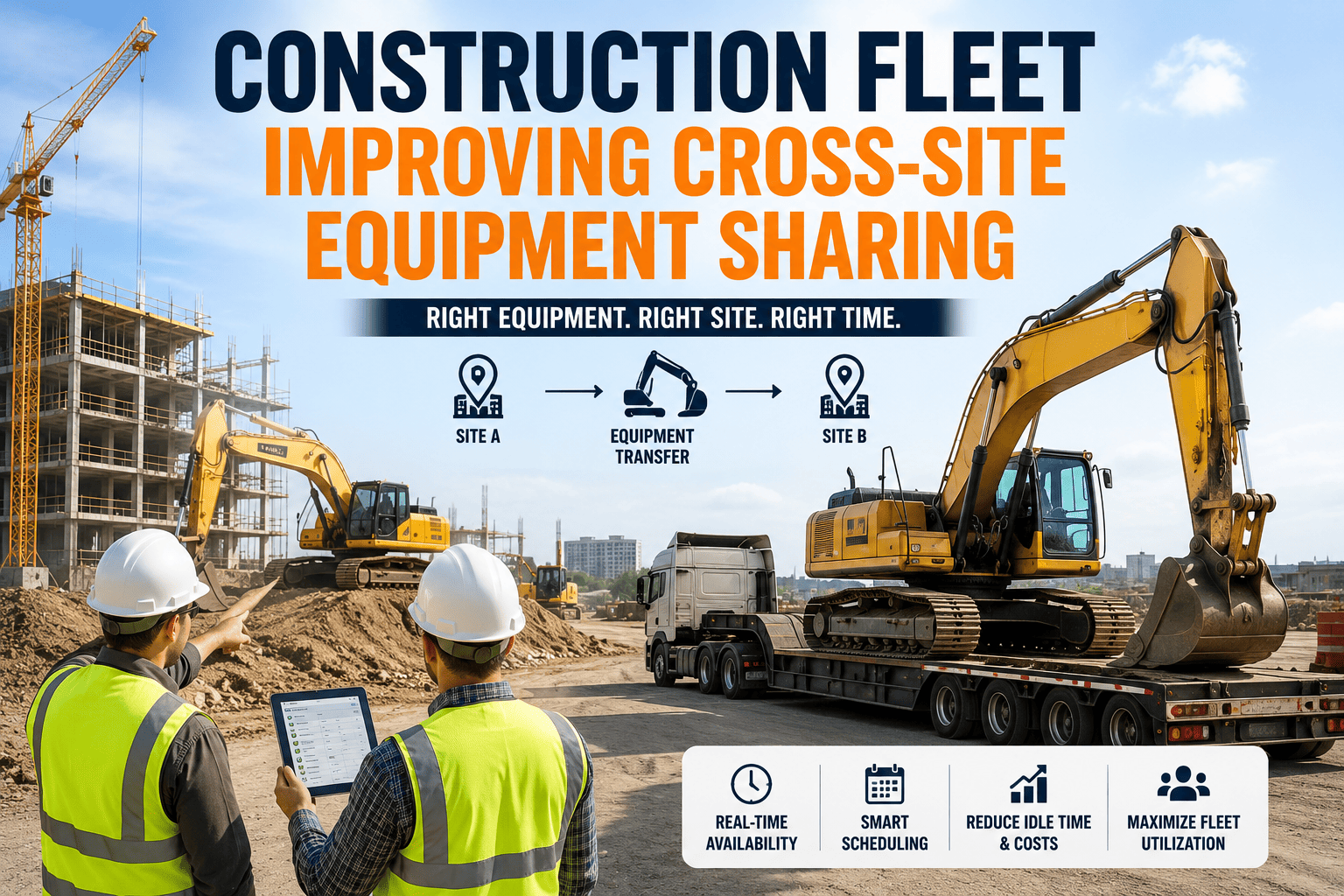
Picture two job sites run by the same company, fifteen miles apart. Site A has an excavator sitting parked for the third straight day. Site B just approved a rental for the exact same machine because nobody at Site B knew Site A's was free. This happens more often than most fleet managers would like to admit, and it is rarely a planning failure. It is a visibility failure. Without a shared, real-time view of where every asset is and how hard it is working, equipment sharing across sites is nearly impossible, and the rental invoices keep adding up for capacity you already own.
Cross-site equipment sharing fails when fleet managers cannot see where every asset is or how much it is being used in real time. Construction companies relying on phone calls to locate idle equipment lose an average of 45 minutes per redeployment decision, and multi-site fleets without unified tracking can lose 180,000 to 420,000 dollars annually in unnecessary rentals and underused assets. Real-time location and utilization data closes that gap and lets you redeploy equipment before a new rental is ever approved.
The Hidden Cost Of Not Sharing Equipment Across Sites
Every site foreman has an incentive to hold onto equipment a little longer than they actually need it, just in case. Multiply that instinct across ten or twenty active sites and you get a fleet that looks fully deployed on paper but is actually sitting idle in dozens of small pockets nobody can see. The numbers below reflect what construction companies typically discover once they start measuring utilization across sites instead of within them.
Three Warning Signs Your Sites Are Hoarding Equipment
FleetRabbit gives every project a live view of equipment location and utilization across your entire portfolio, so redeployment happens in minutes instead of a chain of phone calls. Sign up free and connect your first site today.
Renting Again vs Redeploying What You Already Own
Before signing off on the next rental request, it is worth comparing what that decision actually costs against the alternative sitting quietly at another one of your sites.
| Decision Factor | Renting A New Machine | Redeploying An Owned Asset |
|---|---|---|
| Cost | Ongoing rental rate plus delivery fees, every rental cycle | Only the cost of transporting equipment you already own |
| Time To Get Equipment On Site | Depends on rental company availability and delivery scheduling | As fast as your own transport can move it, often same day |
| Fleet Utilization Impact | Owned equipment stays idle elsewhere, utilization drops further | Idle asset goes back to work, utilization rate improves fleet-wide |
| Visibility Needed To Decide | None, rentals are easy to approve without checking anything | Real-time location and status data across every active site |
How To Actually Share Equipment Across Sites
Sharing equipment across sites is not a policy you announce, it is a workflow you build. The construction companies who do this well follow roughly the same sequence, whether they manage five sites or fifty.
Step 1: Put Every Asset On One Live Map
Location tracking across your entire fleet, not just one project, is the foundation. If a fleet manager cannot see all sites on a single screen, every other step below is guesswork.
Step 2: Track Utilization, Not Just Location
Knowing where a machine is only tells half the story. You also need to know whether it is actively working, idle, or has not moved in weeks, so redeployment decisions are based on real usage instead of a guess.
The Metric That Matters Most
Utilization rate, actual hours used against available hours, is the number that turns "this machine is at Site A" into "this machine should move to Site B." Fleets that track this at the asset level consistently catch chronic underperformers long before a quarterly audit would.
Step 3: Set Alerts For Equipment That Has Gone Quiet
An automatic flag on any asset that has not moved in 15 or 30 days turns a hidden problem into an active decision, instead of waiting for an end-of-year count to discover machines nobody remembered.
Step 4: Make Availability Visible Before A Rental Gets Approved
The single highest-impact change is simple: check fleet-wide availability as a required step before any new rental request is signed off. When that visibility already exists, this step takes seconds.
| Before Sharing | After Cross-Site Visibility |
|---|---|
| Utilization | 18 percent average across underused units |
| Utilization | 64 percent after data-driven reallocation |
| Monthly Rental Spend | 42,000 dollars across equivalent equipment |
| Monthly Rental Spend | 14,000 dollars after reallocation |
What Real-Time Sharing Looks Like In Practice
One multi-site fleet running 85 units across 12 locations found eight machines that had not moved in over 30 days within the first 48 hours of turning on live tracking. That single discovery alone reshaped how the operations team approved every rental request going forward. Instead of a dispatcher spending 45 minutes calling around, the answer to "is anything available" became a five-second look at a shared dashboard.
If your team is still coordinating equipment across sites by phone, the fastest way to see what cross-site visibility would uncover in your own fleet is to book a demo and walk through a live map of your actual assets.
FleetRabbit puts every asset across every job site on one live map, so idle equipment gets found and redeployed before a new rental is ever approved. Try it free on your fleet today, no credit card required.