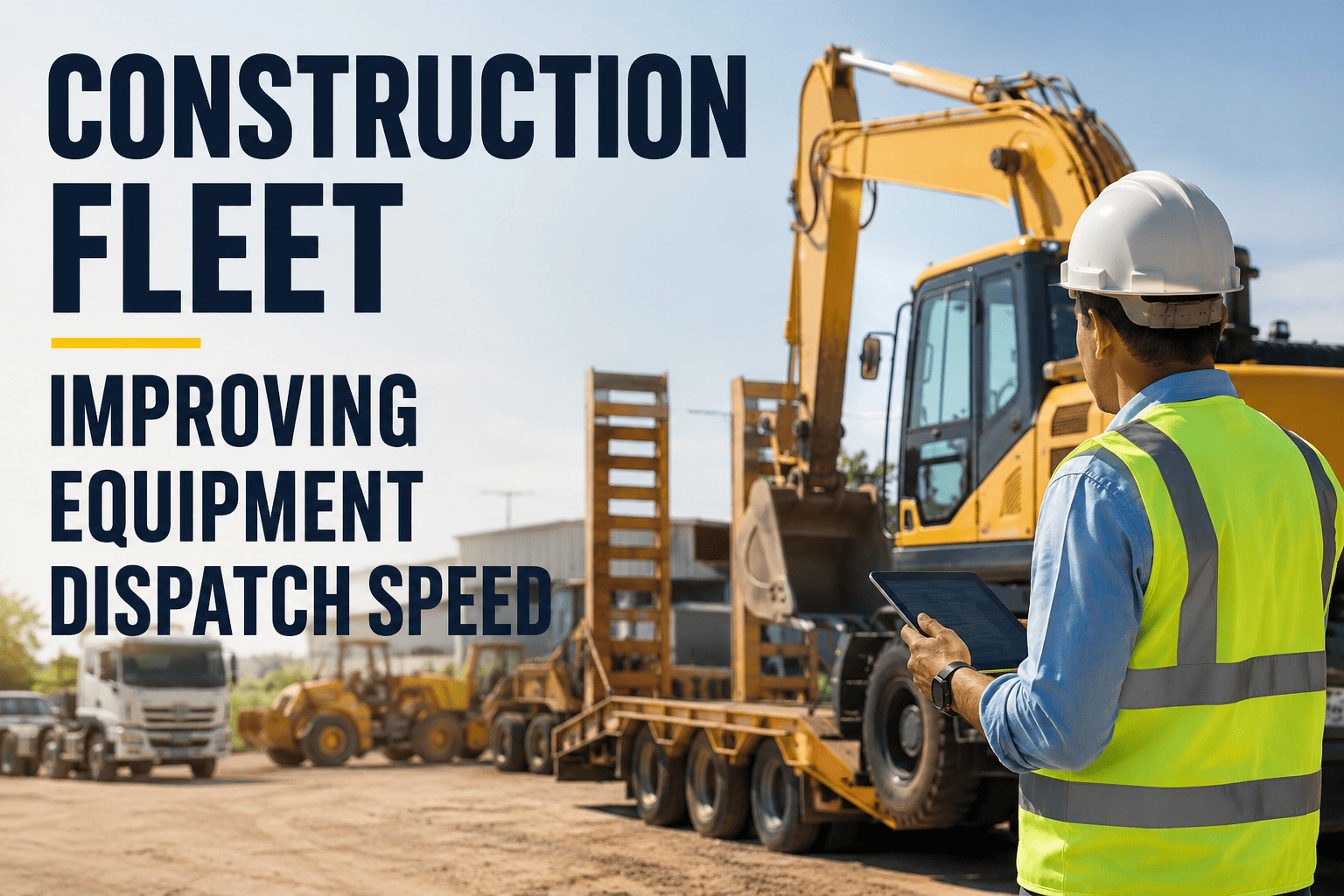
It's 6:45 AM and a dispatcher is staring at a whiteboard, a radio, and three open phone calls, trying to figure out which excavator is actually free and which one just got promised to two different sites by two different people. That scramble repeats every morning on fleets running spreadsheets and sticky notes instead of real-time data, and every minute it eats isn't just an inconvenience. It's a crew standing around, a machine burning fuel in transit to the wrong location, and a schedule that was already tight getting tighter before the first bucket even moves dirt.
Construction companies lose an estimated 18,000 to 52,000 dollars a month to dispatch inefficiency, from equipment sent to the wrong site to operators waiting idle for an assignment. Fleets that switch to real-time dispatch typically see equipment deployed 34 percent faster and idle time drop by 41 percent, recovering 14,000 to 38,000 dollars a month in the process.
What's Actually Slowing Dispatch Down
Dispatch delays rarely come from one dramatic failure. They build up from small, repeated communication gaps that manual systems simply can't close fast enough once a fleet spans multiple active sites at the same time.
The Manual Dispatch Bottleneck
When a fleet spans dozens of machines across a dozen or more job sites, a whiteboard and a radio become a bottleneck almost immediately. Every schedule change has to be communicated by phone, every equipment location has to be confirmed by someone physically checking, and every assignment depends on the dispatcher's memory being perfect at 6 AM.
Where the Minutes Actually Disappear
A dispatcher guessing at which machine is free spends time confirming location by phone call. An operator arriving at the wrong site spends time driving back. A supervisor discovering a certification gap at 7:30 AM spends two hours finding and transporting a qualified replacement. None of these delays show up as one big number on a report, but stacked across a week of assignments, they quietly consume hours that should have gone straight into productive work.
FleetRabbit gives dispatchers a real-time view of every machine's location, availability, and operator match across every site. Sign up to see live fleet availability, or book a demo to walk through how dispatch decisions get faster with our team.
What Slow Dispatch Actually Costs You
Dispatch inefficiency doesn't show up as a single line item on a budget report, which is exactly why it survives so long unaddressed. It hides inside labor hours, fuel spend, and schedule slippage until someone finally adds up the pattern across a full month.
| Delay Type | Typical Cost | Root Cause | Fix |
|---|---|---|---|
| Certification Mismatch | 1,500 to 4,000 dollars per incident | No real-time link between operator credentials and equipment assignment | Digital certification tracking matched automatically at dispatch time |
| Inefficient Routing | 3,200 to 8,500 dollars per month | Dump trucks and hauls dispatched without route optimization | GPS-based routing that assigns the nearest available equipment |
| Idle Waiting Time | Compounding daily labor cost | Operators and crews waiting on an assignment that hasn't been confirmed | Live availability dashboard visible to every dispatcher at once |
| Overall Dispatch Inefficiency | 18,000 to 52,000 dollars per month | Manual, phone-based coordination across a growing fleet | Centralized real-time dispatch platform |
Building a Faster Dispatch Process
Speeding up dispatch isn't about working faster on the same broken process. It's about removing the guesswork that slows every assignment down in the first place.
Four Changes That Compress Dispatch Time
Put Fleet Availability on One Shared Screen
Every dispatcher, on every shift, needs to see the same live view of which machines are available, in transit, or already committed. A single source of truth eliminates the double-booking that phone-based coordination almost guarantees.
Match Operator Certification Automatically
Linking operator credentials directly to equipment type at the moment of assignment catches a mismatch before a crane sits idle waiting for a qualified operator to be located and transported from another site.
Assign by Location, Not Habit
Dispatching the nearest available machine instead of the one that's simply top of mind cuts transit time and fuel waste, especially across fleets spread over eight or more active sites at once.
Track Every Load Until Confirmed
Without GPS-verified delivery confirmation, dispatchers often don't know a load reached the wrong site until someone calls to complain. Confirming arrival automatically closes that gap the moment it happens.
FleetRabbit centralizes equipment location, operator certifications, and site requirements into one real-time dispatch view. Book a demo to see how much faster your dispatch process could run, or sign up and start dispatching with live data today.
Key Takeaways
Dispatch speed is one of the highest-leverage fixes available to a construction fleet, precisely because the losses are so easy to miss day to day. Manual coordination across multiple sites quietly costs 18,000 to 52,000 dollars a month, while fleets that switch to real-time, centralized dispatch see equipment deployed 34 percent faster and idle time drop by 41 percent. The fix isn't a bigger dispatch team, it's giving the team you already have one accurate, shared view of the fleet instead of a whiteboard, a radio, and a lot of guessing.
Stop losing thousands a month to misrouted equipment, idle operators, and double-booked machines. FleetRabbit gives your dispatch team one real-time view of the entire fleet, so every assignment is fast and accurate. Start your free trial today with no credit card required.