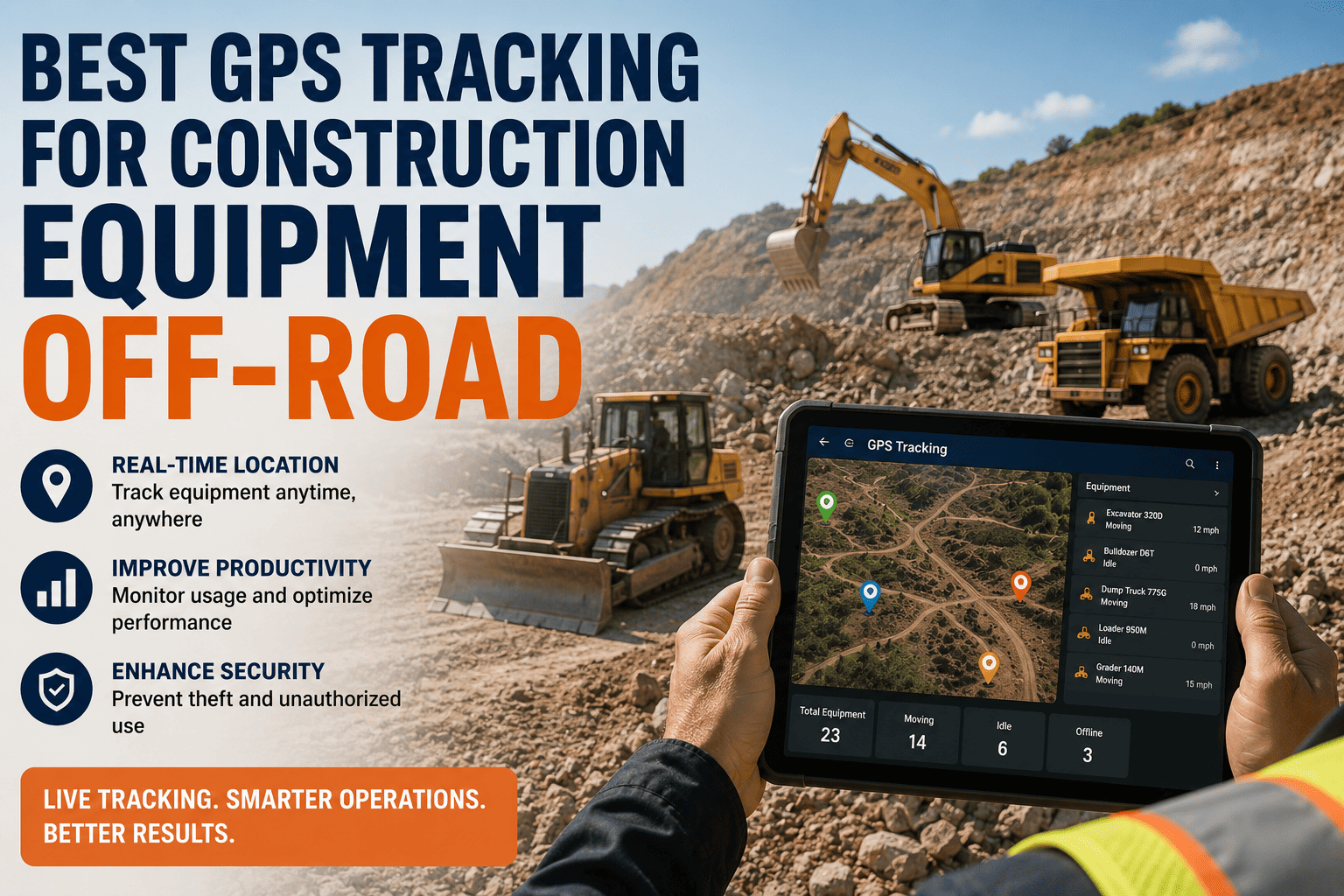
A grading crew tucked behind a ridge, forty minutes from the nearest cell tower, watches their dozer's location freeze on the map at 4 p.m. and never move again, at least on screen. The machine kept working fine. The tracker just stopped talking. This is the quiet failure point of off-road GPS tracking: consumer-grade devices built for parking lots and delivery routes simply were not designed for mud, vibration, dead zones, and equipment that spends its life somewhere a cell signal barely reaches.
The best GPS tracking for off-road construction equipment combines rugged, waterproof hardware with store-and-forward technology that keeps recording location data through cellular dead zones and uploads it the moment signal returns. For truly remote sites, hybrid cellular-satellite devices remove blind spots entirely. GPS tracking also lifts stolen equipment recovery rates from roughly 22 percent to 70 to 80 percent when paired with geofencing and hidden backup trackers. FleetRabbit brings all of this into one dashboard built for job sites, not warehouses.
Why Off-Road Job Sites Break Standard GPS Trackers
Construction is not logistics. Equipment sits in mud, gets pressure washed at the end of a shift, vibrates constantly during operation, and frequently works in locations where cellular towers simply do not reach. A consumer-grade tracking device pulled from a vehicle fleet catalog was never built for that environment, and it tends to show its limits fast, either through failed housings or through location data that quietly stops updating the moment a machine rolls behind a ridge or into a valley.
Cellular Dead Zones and Store-and-Forward Technology
Most GPS trackers rely on cellular networks to transmit data, which works well for the majority of active job sites but breaks down completely on remote grading, pipeline, or quarry projects. The fix that separates real off-road tracking from a repackaged consumer device is store-and-forward technology: the tracker keeps recording location points locally, sometimes thousands of them, and automatically uploads the full history the instant the machine returns to coverage. Nothing gets lost, it just arrives a little later.
Why IP67 and IP68 Ratings Are Non-Negotiable
Waterproof and dust-tight housings are not a nice-to-have for off-road equipment, they are the baseline. A tracker rated IP67 or higher can survive being submerged briefly, coated in dust, or blasted with a pressure washer without losing accuracy, which matters enormously when the device is bolted to an excavator that spends its life in exactly those conditions.
FleetRabbit pairs waterproof, dust-tight hardware with store-and-forward technology, so your dozer's location keeps recording even miles from the nearest cell tower, then syncs automatically the moment signal returns.
Cellular, Satellite, or Hybrid: Choosing the Right Connection
Not every job site has the same connectivity problem, so the right tracking technology depends heavily on how remote your work actually is.
| Connection Type | Best For | Trade-Off |
|---|---|---|
| Cellular (LTE) | Urban and suburban sites with normal coverage | Most cost-effective option, but drops out completely in dead zones |
| Satellite | Pipeline, quarry, mountain, and off-grid remote projects | Higher cost per device and slower updates, but works anywhere on earth |
| Hybrid Cellular/Satellite | Mixed fleets working both accessible and remote sites | Defaults to affordable cellular and automatically switches to satellite when signal drops |
| Store-and-Forward | Any equipment that regularly passes through short dead zones | No live updates during the gap, but zero data loss once reconnected |
Ping Rate: The Setting Most Fleets Get Wrong
How often a device reports its position matters as much as the connection type. Active equipment being moved between tasks benefits from frequent updates every few minutes, while a dozer sitting idle overnight does not need to burn battery reporting every thirty seconds. The best platforms let you adjust this by asset type, so a machine gets detailed tracking when it is working and conserves power when it is not.
Battery Life Depends on How You Configure It
A tracker set to check in once a day can run for years on a single charge, while one set to real-time reporting during an active theft recovery will drain far faster. Being able to change that frequency remotely, without pulling the device off the machine, is what makes long-term off-road deployment practical.
Stopping Theft on Unsecured Remote Sites
Remote job sites are exactly what equipment thieves look for: minimal lighting, minimal fencing, and machinery that sits unattended for days at a time. Construction equipment theft costs the industry more than a billion dollars annually, and without any tracking in place, recovery rates hover around 21 to 22 percent. Real-time GPS with geofencing changes that math dramatically, with recovery rates climbing into the 70 to 80 percent range once alerts and location data are in play.
The Ghost Tracker Strategy
Experienced thieves know to disable the visible tracking unit first. That is exactly why a hidden, battery-powered backup tracker, often called a ghost tracker, has become standard practice for high-value machines. If the primary unit goes dark, the hidden device wakes up and starts reporting frequently enough to lead recovery efforts straight to the equipment.
FleetRabbit alerts your team the instant a machine crosses a job site boundary after hours, and supports layered ghost tracking so disabling one device does not mean losing the asset.
Frequently Asked Questions
Bringing It All Together
Off-road tracking is a different problem than tracking a delivery van, and treating it like the same problem is exactly why so many contractors end up with a map full of frozen dots. Rugged, waterproof hardware, store-and-forward data capture, and the right mix of cellular and satellite connectivity turn a remote job site from a blind spot into fully visible territory. Layer in geofencing and a hidden backup tracker, and equipment that used to disappear without a trace becomes equipment you can actually get back.
FleetRabbit combines rugged hardware, store-and-forward tracking, and geofenced theft alerts to keep your equipment visible on the toughest, most remote job sites. Get started today, no credit card required.