Ask most construction fleet managers how many screens they check before 8 a.m. and the answer is rarely one. A GPS telematics dashboard for the trucks, a separate OEM portal for the excavators, a maintenance spreadsheet nobody trusts, and an ERP system that only gets updated once a week. Each tool works fine on its own, but none of them talk to each other, and that silence is expensive. Industry research shows 87 percent of construction operators already use fleet technology, yet 74 percent still name data accessibility as their single biggest barrier to efficiency. The technology isn't the problem. The disconnection between systems is. This guide walks through why fleet data integration has become a 2026 priority, what a properly connected system actually looks like, and how to get there without ripping out everything you already own. If you'd rather see it than read about it, you can start a free trial or book a live demo whenever you're ready.
When fleet, telematics, ERP, and project data live in separate systems, equipment sits idle up to 50 percent of the time simply because nobody can see it's available. Fleets that connect their systems into one platform report 81 percent data accuracy, compared to the manual, error-prone reconciliation that 75 percent of construction fleets still rely on today.
Where Construction Fleet Data Actually Gets Stuck
Most construction operations don't lack data. They lack a single place to see it. A typical mid-size contractor is pulling location and fault-code data from CAT Product Link, Komatsu KOMTRAX, John Deere, and a separate GPS provider for trucks, while job costing lives in Procore, Viewpoint, or Sage, and maintenance gets tracked on a whiteboard or spreadsheet. Each system is accurate on its own. The moment someone needs to answer a cross-system question, like which idle excavator could move to a job site without blowing the maintenance budget, the answer takes a phone call, not a dashboard.
The Hidden Cost of Disconnected Fleet Data
Disconnected data doesn't just create annoying extra logins. It creates real financial drag. When systems are siloed, assets sit idle roughly half the time because the insight needed to redeploy them never reaches the person making the decision. Manual data entry compounds the problem: 75 percent of fleets are still reconciling telematics, maintenance, and accounting records by hand, which introduces errors and delays that ripple into job costing and equipment purchasing decisions.
Why the Manual Bridge Never Quite Works
Spreadsheets and manual exports feel like a reasonable stopgap, but they age badly. A number pulled from a telematics export on Monday is already outdated by Wednesday, and every manual transfer between systems is a chance for a typo or a missed row. Contractors who have tried to bridge the gap this way describe checking four different portals every morning just to confirm where equipment is and whether any fault codes appeared overnight, which is a full-time job layered on top of an already full-time job.
The Market Is Moving Toward Connected Platforms
This isn't a niche concern. The construction telematics market is expanding from roughly 676 million dollars in 2021 to an estimated 1.5 billion dollars in 2026, growing at about 17 percent annually, largely because contractors are demanding systems that plug into the rest of their technology stack instead of standing alone.
FleetRabbit unifies OEM telematics, job costing, and maintenance data into a single real-time view, so equipment utilization decisions take seconds instead of phone calls. Start your free trial and see your whole fleet on one screen today.
Before and After: What Integration Actually Changes
The clearest way to see the value of integration is to compare how the same question gets answered with and without it. The gap isn't cosmetic. It's the difference between a manager guessing and a manager knowing.
| Common Question | Disconnected Systems | Integrated Platform |
|---|---|---|
| Which machines are idle right now? | Call each site or check four separate OEM portals | One dashboard shows live status across every asset and brand |
| What did this job actually cost in equipment hours? | Wait for manual entry into the ERP, often days late | Hours and fuel sync automatically into job costing in real time |
| Is a maintenance issue about to cause downtime? | Fault codes sit in an OEM portal nobody checks daily | Alerts route directly to the maintenance team the moment they appear |
| Should we rent or redeploy an owned machine? | Scheduling built without visibility into fleet availability | Project scheduling tools see real equipment availability automatically |
What a Truly Integrated Fleet Platform Connects
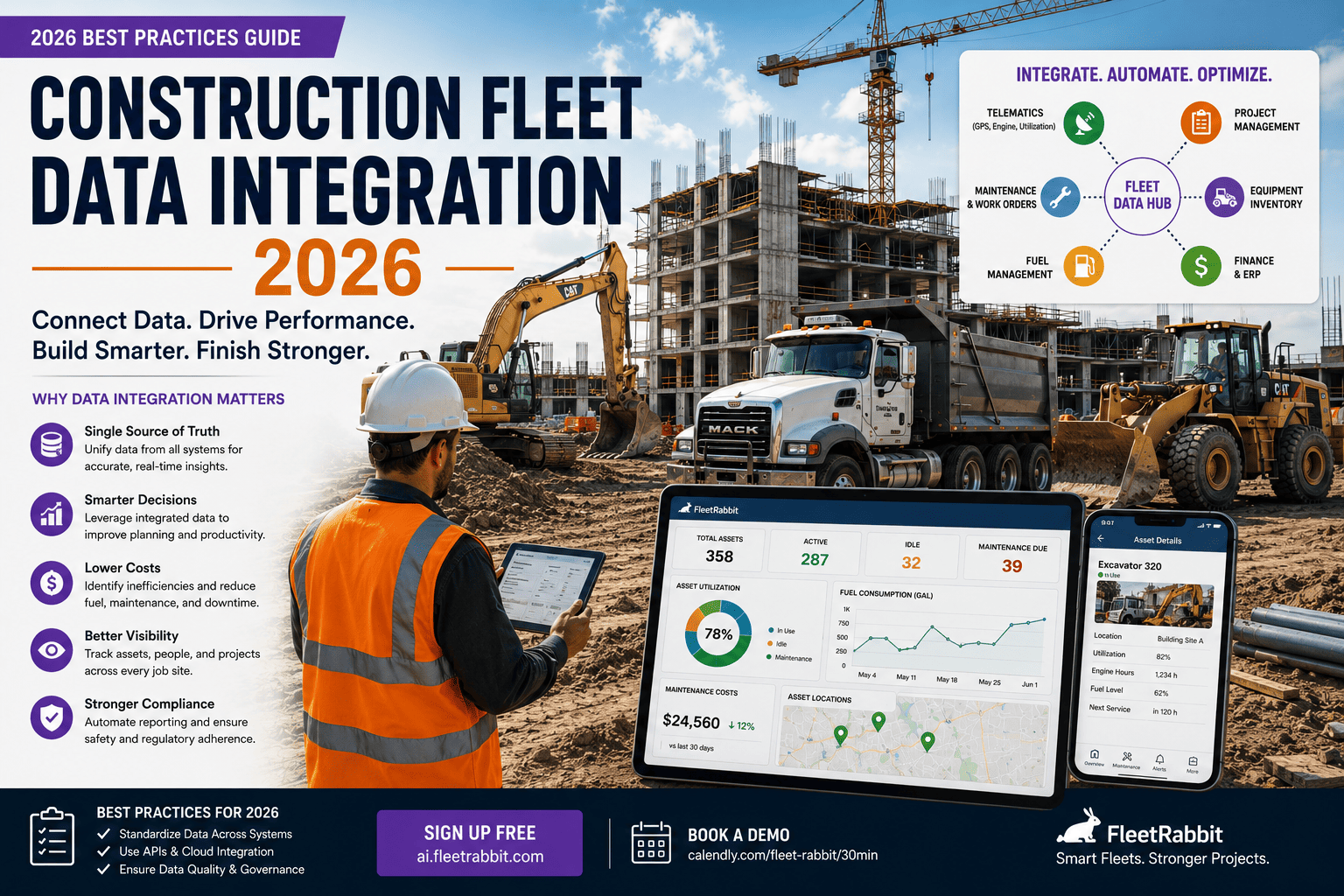
Integration isn't about replacing every tool a contractor already owns. It's about making those tools share one source of truth. A well-integrated construction fleet platform typically pulls together four categories of data that used to live apart.
Telematics and OEM Equipment Data
GPS location, engine hours, fuel burn, and fault codes from every manufacturer portal flow into one place, so equipment health doesn't depend on which brand built the machine.
ERP and Accounting Systems
Platforms like Viewpoint, Sage, Foundation, or QuickBooks receive equipment cost and utilization data automatically, eliminating the manual double entry that delays accurate job costing.
Project Management and Scheduling Tools
Systems like Procore, Buildertrend, and PlanGrid gain real-time equipment availability, so project timelines are built against what's actually free rather than what a spreadsheet says should be free.
Maintenance and Compliance Records
Work orders, inspection results, and compliance documentation sync with telematics fault data, so a fault code can trigger a scheduled repair instead of an emergency one.
Many platforms charge 200 to 1,000 dollars a month just for API access to your own equipment data. FleetRabbit includes open API access and pre-built integrations with major ERP and project management platforms in every plan. Book your demo to map out your specific integration needs.
Building Your Integration Roadmap
Contractors don't need to solve every connection at once. A staged approach gets the highest-value links working first while the rest of the stack catches up.
| Stage | Focus | Typical Outcome |
|---|---|---|
| Stage 1 | Centralize telematics from every OEM portal into one dashboard | Single source of truth for location, hours, and fault codes |
| Stage 2 | Connect maintenance workflows to fault code alerts | Fewer emergency repairs, more scheduled ones |
| Stage 3 | Sync utilization and cost data into ERP and job costing | Real-time, accurate job cost reporting instead of week-old estimates |
| Stage 4 | Feed equipment availability into project scheduling tools | Fewer unnecessary rentals and better utilization of owned assets |
What to Ask Before You Commit to a Platform
Not every fleet platform that claims integration actually delivers it. Ask whether API access is included or sold as a premium add-on, whether pre-built connectors exist for your specific ERP and project management tools, and how quickly new fault codes or job cost changes actually reach the other systems. A platform that syncs once a day still leaves you making decisions on stale information.
Frequently Asked Questions
Stop logging into separate telematics portals, chasing manual ERP updates, and scheduling around guesswork. FleetRabbit connects telematics, maintenance, ERP, and project management into a single real-time platform built for construction fleets.