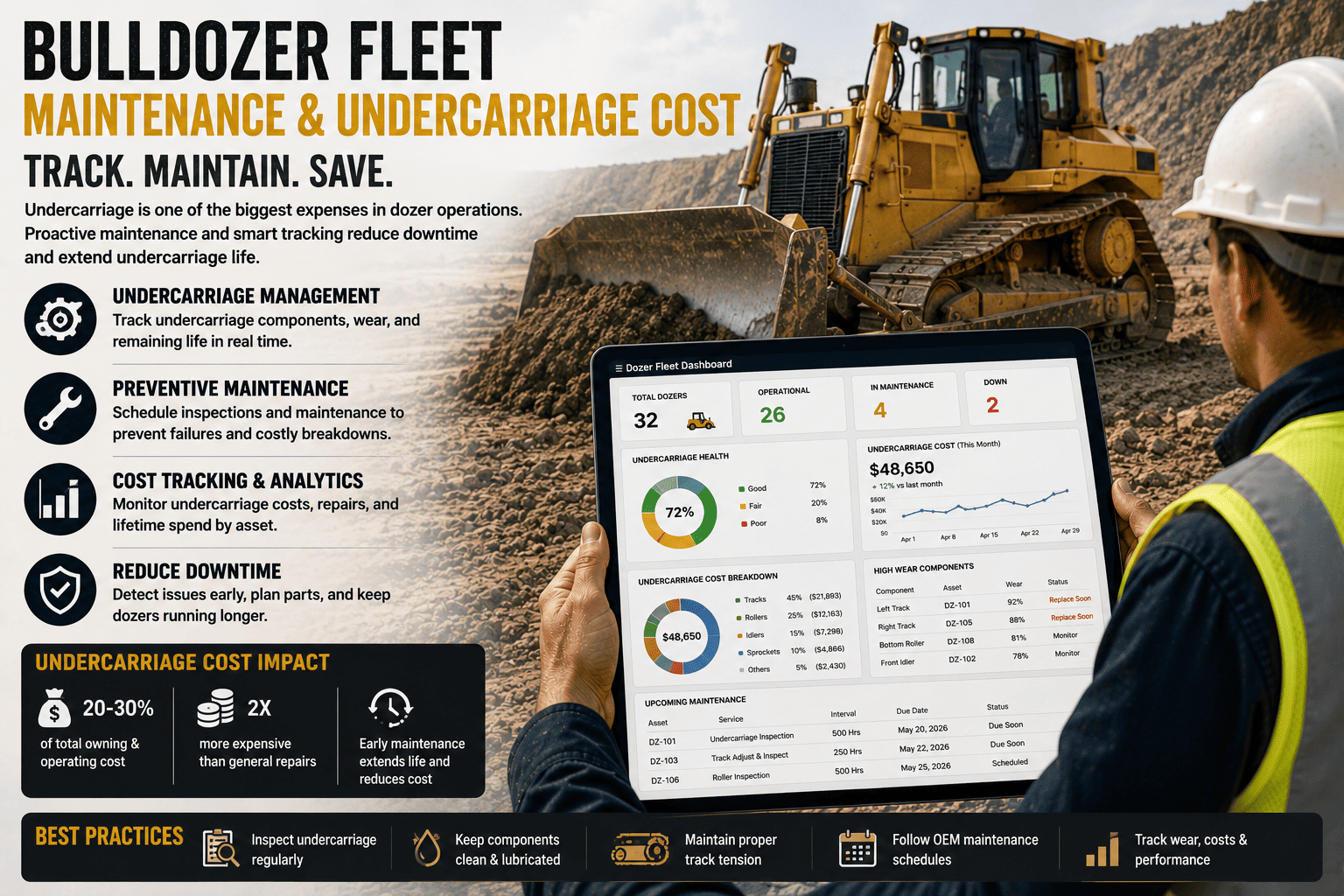
Ask any dealer what actually drives the lifetime cost of owning a bulldozer, and the answer is almost never the engine. It's the undercarriage — the tracks, rollers, idlers, and sprockets grinding against dirt, rock, and debris all day, every day. That system makes up only about a fifth of what you paid for the machine, yet it quietly consumes half of everything you'll ever spend keeping that dozer running.
A dozer's undercarriage accounts for roughly 20 percent of the machine's purchase price but up to 50 percent of its total lifetime repair cost. Improper track tension alone causes an estimated 85 percent of undercarriage wear problems, while poorly maintained dozers run 45 percent higher operating costs and 35 percent more unplanned downtime than systematically serviced machines. Sign up for FleetRabbit to track undercarriage wear and hours across your entire dozer fleet automatically.
The Cost Gap Nobody Budgets For
Every fleet manager knows the purchase price of a dozer. Far fewer have internalized just how lopsided the ongoing cost really is once that machine starts working.
What Happens When It's Ignored
The undercarriage is an integrated system, which means a single neglected roller can shave years off components that were otherwise fine. A neglected undercarriage rebuild commonly runs $65,000 or more, and once emergency repairs and project delays are added in, the average dozer breakdown costs around $150,000. Disciplined daily attention, by contrast, can roughly double the undercarriage's usable life.
Track Tension: The 30-Second Check That Prevents Most of the Damage
If a fleet manager has time for exactly one undercarriage habit, this is it. Track tension is named as the single leading cause of crawler-tractor downtime, and getting it right prevents an estimated 85 percent of undercarriage wear problems on its own.
Too Tight
Accelerates wear on rollers, idlers, and bushings, and wastes horsepower fighting the tension instead of moving material.
Too Loose
Causes bounce, vibration, and chain snaking, and raises the risk of the track derailing entirely on rough ground.
The Two-Dip Rule of Thumb
Caterpillar's general guidance is to look for roughly two dips of sag between the sprocket and idler, which works out to about two inches on many conventional crawlers. Always confirm the exact figure in your specific model's operation manual, since machines with carrier rollers measure differently. Daily cleaning matters just as much: packed debris keeps components from moving freely and quietly accelerates wear that a clean undercarriage would never have shown.
Track Undercarriage Wear Trends Across Every Dozer
FleetRabbit turns every wear measurement into trend data, so you replace at the right threshold instead of guessing or running to failure.
The Wear Thresholds That Decide Replace vs. Wait
Formal wear measurement, ideally every 500 to 1,000 hours, tells you exactly where each component sits against the OEM wear chart. What you do with that number matters just as much as taking it.
Continue routine monitoring. No action needed beyond the next scheduled measurement.
Schedule replacement in the next planned maintenance window and order parts now, before the component forces an unplanned stop.
Replacement is required immediately. Inspect sprockets and rollers at the same time, since running components to failure often damages the parts around them too.
Matched-Set Replacement Isn't Optional
Installing new track on a worn sprocket wastes the investment, since the sprocket's hooked teeth rapidly damage the new bushings and can void the warranty. When several components approach their limits together, coordinated replacement is more economical than chasing each one separately over several shop visits.
A Maintenance Rhythm Built Around Hours
Dozers follow a tiered PM schedule based on engine hours, and the tiers stack cleanly on top of the daily walkaround every operator should already be doing.
Walkaround & Cleaning
Undercarriage debris clearing, track tension check, visual inspection of shoes, rollers, and idlers.
PM1 Service
Engine oil and filters, fuel and hydraulic filters, belt tension, battery, final-drive oil level.
PM2 Service
Undercarriage wear measurement, hydraulic oil sampling, ROPS bolt torque, turbocharger inspection.
Midlife Tune-Up
Pin and bushing turn to restore track pitch, plus sprocket replacement if wear is already close to the limit.
Why This Is Hard to Track With Sensors Alone
Most of a dozer's systems can be monitored remotely through telematics, but undercarriage wear is different. It's measured with calipers, straightedges, and trained eyes, not sensor feeds, which means the discipline lives or dies on whether someone actually records the measurement and someone else actually acts on the number weeks later. That's exactly the gap a digital tracking system is built to close: capturing every measurement against the OEM wear chart, trending it over time, and flagging the exact hour a component crosses into its replacement window.
FleetRabbit pairs engine-hour tracking with digital undercarriage wear logs for every dozer in your fleet, so PM1, PM2, and the midlife tune-up all fire automatically and every wear measurement builds a trend line instead of sitting on a clipboard. Start a free trial to connect your first dozer in minutes, or book a demo to see undercarriage tracking set up around your fleet's actual hours.
Frequently Asked Questions
Give Every Dozer an Undercarriage Program That Actually Gets Tracked
See engine hours, wear thresholds, and PM tiers for your whole dozer fleet in one dashboard.