Condition-Based Maintenance vs Time-Based — Which Wins for Construction?
Construction fleets across California, Nevada, Arizona, Oregon, and Washington are caught between two maintenance philosophies — one driven by the calendar, one driven by the machine itself. Choosing wrong costs Western US contractors $80,000–$160,000 per year. Fleet Rabbit's IoT platform gives operators the sensor data to implement the hybrid approach that wins in 2026. Book a demo to see how Fleet Rabbit enables condition-based maintenance across your fleet.
Quick Answer
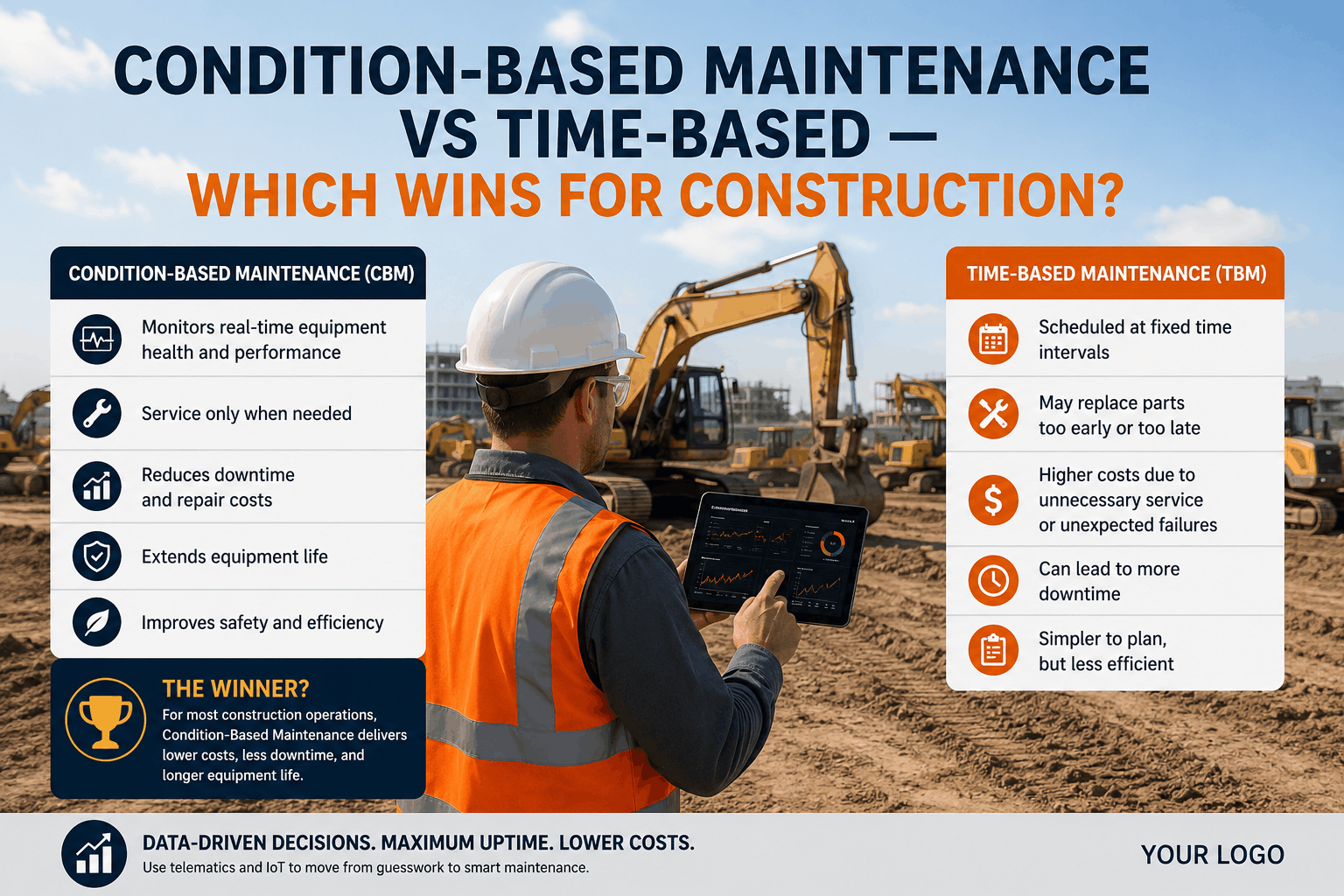
Condition-based maintenance (CBM) uses real-time sensor data — vibration, hydraulic pressure, temperature, fuel burn — to trigger service only when machines need it. Time-based maintenance (TBM) schedules service at fixed intervals regardless of machine state. For Western US construction fleets in 2026, a hybrid approach wins: TBM for safety-critical items, CBM for high-cost components. Fleet Rabbit's IoT platform delivers the sensor layer that makes CBM possible across any OEM mix.
The Core Difference: Clock vs. Condition
Time-based maintenance is simple: change the oil every 250 hours, replace filters every 500 hours — regardless of what sensors say. Condition-based maintenance flips that logic: service the machine when data says it needs attention. The cost difference for a 20-unit Western US construction fleet is $60,000–$120,000 annually in recovered maintenance budget, reduced rental exposure, and eliminated project delay penalties.
Time-Based (TBM)
Trigger: Fixed hour/calendar interval
Over-maintenance risk: High — 30–40% premature
Setup cost: Low — no sensors needed
Annual waste (20 units): $55K–$90K
Condition-Based (CBM)
Trigger: Real-time sensor threshold breach
Over-maintenance risk: Low — data-driven service only
Setup cost: Medium — IoT platform required
Annual savings (20 units): $60K–$120K vs. TBM
Why TBM Fails Western US Fleets
A Cat 336 working 12-hour shifts in Las Vegas accumulates stress at a fundamentally different rate than the same machine doing 6-hour utility work in Portland. Fixed-interval maintenance treats them identically — over-servicing the light-duty machine and under-protecting the high-stress unit. Extreme heat in Arizona and Nevada accelerates hydraulic fluid degradation, while fine particulate dust in California's Central Valley loads air filters 2–3x faster than coastal sites. TBM cannot account for any of this.
Premature Service
$38K
avg annual waste on parts with life remaining
Interval Failures
$52K
breakdowns between fixed service intervals
Downtime Cost
$68K
rental + delay penalties from breakdowns
Missed Wear
$29K
degradation undetected between intervals
Cost Comparison: TBM vs. CBM vs. Hybrid
Annual Maintenance Cost — 20-Unit Mixed Fleet, Western US (2024–2025)
Reactive Only
$214K+
Time-Based Only
$187K
CBM Only
$138K
Hybrid TBM+CBM
$102K
Includes parts, labor, rental replacement, and delay penalties. Fleet Rabbit platform data, Western US construction fleets 2024–2025.
The Sensors That Make CBM Work
Vibration Analysis
Triaxial accelerometers on swing bearings and travel motors detect bearing wear 2–3 weeks before failure. Fleet Rabbit's edge AI builds per-machine baselines, eliminating false positives from terrain and load variation on remote Western US sites.
Hydraulic Pressure & Temp
Inline pressure transducers flag seal degradation before cylinder drift or pump cavitation. In Arizona and Nevada where temps exceed 115°F, hydraulic fluid degrades 3x faster than TBM intervals assume — CBM catches this continuously.
Engine Fault Codes
Fleet Rabbit reads J1939 and CAN bus fault codes across Caterpillar, Komatsu, Volvo, Deere, and 40+ OEMs — surfacing pending codes 48–96 hours before failure and eliminating breakdown events for monitored fault categories.
Oil Quality Sensing
Inline sensors measure dielectric constant and particle count — replacing fixed oil intervals with data-driven triggers. Hard-rock excavation in Nevada may need service at 180 hours; light grading holds past 250 hours. CBM captures both without over-servicing either.
The Hybrid Approach: Why It Wins in 2026
1
TBM Zone: Safety-Critical & Regulatory Items
Brake inspections, fire suppression checks, ROPS integrity, and Cal/OSHA-mandated pre-shift inspections stay on fixed intervals regardless of sensor data. Compliance failure costs $15,000–$45,000 in fines plus project shutdown. These items are ~15–20% of total maintenance budget but carry 80% of regulatory exposure.
Fleet Rabbit logs TBM compliance automatically — generating audit-ready documentation for Cal/OSHA crane inspections without manual recordkeeping.
2
CBM Zone: High-Cost Drivetrain & Hydraulics
Final drives, swing bearings, hydraulic pumps, cylinders, and main control valves move to condition-based triggers. These components represent 60–70% of total maintenance spend — where premature TBM replacement destroys budget and late replacement causes catastrophic failure.
Vibration thresholdsHydraulic pressure trendOil quality index
3
Predictive Layer: Multi-Sensor AI Catches What Single Sensors Miss
Fleet Rabbit's edge AI combines vibration trend, temperature deviation, and fuel efficiency shift into a composite health score per machine — identifying degradation patterns 2–3 weeks before failure that threshold-based CBM alone cannot detect.
Nevada highway contractor, 18 machines: hybrid TBM/CBM via Fleet Rabbit reduced annual maintenance cost from $193K to $98K — full ROI in 47 days.
Condition-Based Maintenance Platform
Enable CBM Across Your Construction Fleet — Free Trial, No Hardware Commitment
OEM-agnostic IoT sensors on any excavator, loader, or crane. Real-time vibration, hydraulic, temperature, and fault code data from one dashboard — any brand, any Western US site.
QCan we implement CBM without replacing existing equipment?
Yes. Fleet Rabbit's edge sensors retrofit via CAN bus ports on virtually all equipment built after 1998. A 20-unit mixed fleet is fully equipped in 4–5 days by Fleet Rabbit's Western US teams covering California, Nevada, Arizona, Oregon, Washington, and Colorado — with zero machine downtime during installation.
QHow does CBM work on remote Nevada or Oregon sites without connectivity?
Fleet Rabbit's edge AI processes sensor data locally when cellular is unavailable — queueing alerts for delivery when connectivity returns. For permanently remote sites, Fleet Rabbit supports Iridium satellite modem integration. No data gaps means no CBM blind spots — the fundamental requirement for remote Western US operations.
QWhat's the ROI timeline for implementing CBM?
Western US fleets typically recover full platform investment within 60 days. A single avoided final drive failure on a Cat 336 ($28,000–$45,000 in repair plus rental and delay) pays the annual platform cost for a 20-unit fleet. Ongoing savings from reduced premature part replacement accumulate at $38,000–$55,000 annually.
QDoes Fleet Rabbit support on-premise deployment for government contractors?
Yes. Fleet Rabbit runs on-premise on customer-owned servers for federal contractors under CMMC compliance — common for operators on California military base or Nevada federal land projects. Commercial operators in California, Oregon, and Washington use cloud deployment via AWS US-West regions for lower setup overhead and automatic updates.
The four AI capabilities transforming fleet operations — real-time GPS, predictive health monitoring, dynamic route optimization, and delivery performance analytics — with ROI data for each.
AI-driven fault prediction and automated maintenance scheduling that prevents mid-project breakdowns — the reliability layer IoT sensor data powers across excavators, loaders, and cranes.
Real-time utilization tracking, idle reduction analytics, and fleet right-sizing data that reduce total heavy equipment operating cost for Western US contractors.
How GPS hardware, IoT sensors, and cloud analytics combine to deliver real-time heavy equipment visibility, predictive maintenance, and operational intelligence.
Move Beyond TBM — Enable Condition-Based Maintenance Across Your Western US Fleet
Fleet Rabbit's OEM-agnostic IoT platform delivers the sensor layer, edge AI, and hybrid maintenance workflows that cut construction fleet maintenance cost 45% — on-premise or cloud, any brand, full ROI in 60 days.