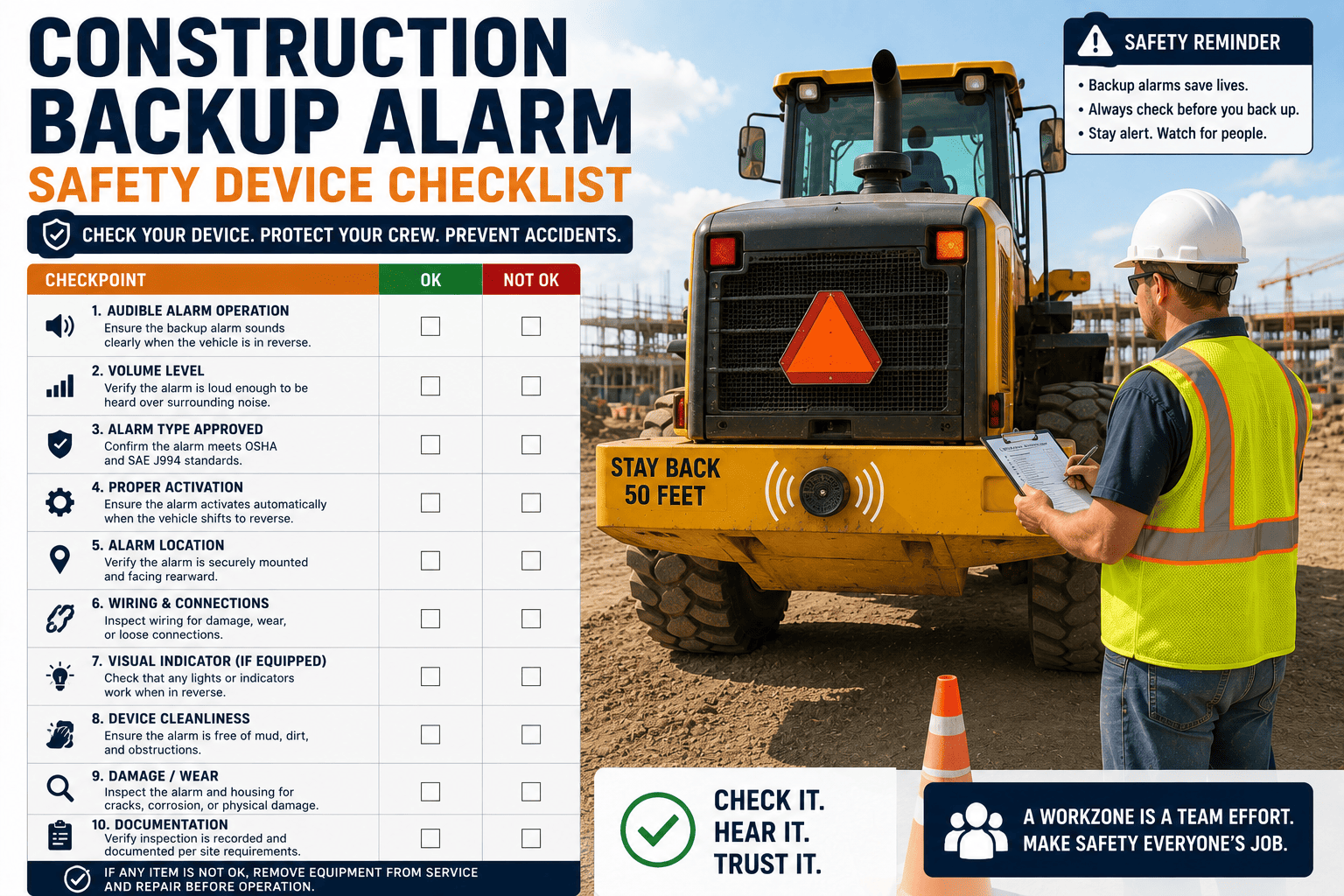
A dump truck backs up with its alarm sounding exactly as it should. A worker nearby doesn't react, because on a busy site, alarms sound constantly and it's easy to stop hearing them as a warning meant for you specifically. That's not a hypothetical. It's the exact pattern behind real backover fatalities investigated by OSHA, where the alarm was working perfectly and a worker was struck anyway. Backup alarms, seat belts, cameras, and interlocks are supposed to be the last line of defense on a job site. The problem is that they fail silently, and a silent failure looks identical to a normal, safe day right up until it isn't.
Construction equipment safety devices, backup alarms, seat belts, cameras, and operator interlocks, are required under OSHA standards including 29 CFR 1926.601 and 1926.602, but a device being installed doesn't mean it's actually working. Struck-by incidents are one of construction's "fatal four" causes of death, and the Bureau of Labor Statistics recorded over 70 worker deaths from backover incidents in a single recent year, several involving vehicles where the backup alarm was confirmed working at the time. Verifying every safety device before each shift, not just confirming it exists, is what actually prevents the incident.
Why "It's Installed" Is Not the Same as "It Works"
Every piece of equipment on a compliant site technically has its required safety devices. The gap that actually causes incidents is between a device being present and a device being confirmed functional on that specific shift. A backup alarm with a corroded connection can go silent for days before anyone notices, a seat belt buckle can wear out quietly, and a backup camera can go dark from a cracked lens or a loose connector, none of which show up unless someone actually tests it.
Why Alarm Fatigue Makes This Worse, Not Better
Workers on foot become accustomed to frequent backup alarm sounds from equipment around them, and can become complacent or confused about which alarm applies to them. That means a working alarm is a necessary safeguard, but never a complete one on its own, which is exactly why OSHA gives employers the option of pairing alarms with a trained spotter rather than relying on sound alone.
What This Looks Like in Real Incidents
In documented OSHA investigations, a dump truck backing up in a work zone struck and killed a worker in reflective safety gear, and the truck's alarm was confirmed to be audible and its lights operating at the time. The equipment did what it was supposed to do. The gap was in visibility, awareness, and site procedure around it, not in the device itself.
The Safety Devices That Get Checked and the Ones That Get Skipped
Some devices get a quick glance every shift because they're obvious. Others get skipped because a failure isn't visible from the cab.
Backup Alarm
Required under OSHA 29 CFR 1926.601(b)(4) and 1926.602(a)(9) whenever rearward visibility is obstructed. Must be audible above surrounding site noise, not just technically functioning.
Seat Belt & Restraint
Required under OSHA 29 CFR 1926.601(b)(9) on equipment with a rollover protective structure. A worn buckle or frayed webbing can look fine and still fail under load.
Backup Camera
Increasingly used alongside or in place of a spotter for obstructed rear visibility. A cracked lens, loose connector, or dead monitor defeats the purpose without an obvious warning sign.
Operator Interlocks
Prevents the machine from moving unless the operator is seated and the safety bar or restraint is properly engaged. A failed interlock is invisible until the exact moment it matters.
Why a Spotter Still Matters Even With Working Alarms and Cameras
OSHA standard 29 CFR 1926.601(b)(4) requires either an audible backup alarm or an observer who signals it's safe to reverse. Despite how it reads, the two options are not equally effective in every situation. When rearward visibility is genuinely obstructed, proper use of a trained spotter is a meaningfully safer choice than relying on an alarm alone, because a spotter can actually confirm the path is clear rather than simply warning that the vehicle is moving.
Combining Technology With Procedure
Backup alarms and cameras reduce risk. They don't eliminate it on their own. The strongest safety programs pair working devices with clear site procedures: designated spotters for blind maneuvers, established traffic patterns, and consistent enforcement so devices and people are backing each other up, not standing in for one another.
Verify Every Safety Device Before Equipment Moves
FleetRabbit's digital safety inspection checklist confirms backup alarms, seat belts, cameras, and interlocks are functioning, not just present, with photo documentation on every flagged item. Sign up to build your inspection workflow in minutes, or book a demo to see it in action first.
What a Proper Safety Device Check Actually Verifies
Confirming a device exists takes a glance. Confirming it works takes an actual test, and that difference is where most gaps in a site safety program live.
| Safety Device | Common Silent Failure | How to Actually Verify It | Governing Standard |
|---|---|---|---|
| Backup alarm | Corroded wiring or a cracked speaker cone reduces volume below audible threshold | Test in the yard at the start of shift, confirm audible above ambient noise | 29 CFR 1926.601(b)(4), 1926.602(a)(9) |
| Seat belt | Frayed webbing or a worn buckle that looks intact but fails under load | Physically pull and latch the belt, check webbing along its full length | 29 CFR 1926.601(b)(9) |
| Backup camera | Cracked lens, loose cable, or a monitor that's dim in daylight | View the monitor in daylight conditions, confirm image clarity, not just power | Site policy, often paired with alarm requirements |
| Operator interlock | Worn switch allows movement even with the restraint bar raised | Raise the bar and confirm the machine will not engage before lowering it again | Manufacturer safety system, verified during pre-start check |
Building a Safety Device Check Into Every Shift
The equipment inspection that matters most is the one that happens the same way, every day, before the machine ever moves.
Test It, Don't Just Look at It
Sound the backup alarm in the yard before pulling out, physically latch the seat belt rather than just glancing at it, and confirm the interlock genuinely stops the machine when the restraint is raised. A device that's present but untested tells you nothing about whether it will work when it's needed.
Document the Result, Not Just the Intention
A verbal confirmation that "the alarm's fine" disappears the moment the shift ends. A logged check, with a timestamp and the operator's name attached, is what turns a good habit into an auditable record that protects the worker, the operator, and the company if an incident is ever reviewed.
Making Verification a Habit Across a Whole Fleet
Getting every operator to actually test devices instead of assuming they work usually comes down to how easy the check is to complete and how visible completion is to a supervisor. A standardized digital checklist that prompts each device test in the same order, every shift, on every machine, removes the guesswork and gives supervisors a simple view of which equipment has been verified for the day and which hasn't. If you want to see that kind of standardized check running before rolling it out to your crew, booking a demo is the quickest way to judge the fit.
Frequently Asked Questions
Don't Let a Silent Failure Become a Serious Incident
A backup alarm, seat belt, or interlock that isn't actually tested can look perfectly fine right up until it fails. FleetRabbit's digital safety checklist verifies every critical device before equipment operates, with a full audit trail behind it. Sign up for a free trial or book your demo today.