Heavy equipment fleets in U.S. and European construction are the most capital-intensive assets on any job site — and the most expensive to have sitting idle. A grounded excavator on a highway project, a broken paver on a commercial build, or an offline crane on a high-rise doesn't just cost repair time: it delays subcontractors, triggers liquidated damages clauses, and cascades into project overruns that dwarf the original maintenance cost. Most western construction fleets still manage maintenance on paper logs, shared spreadsheets, and phone calls between field techs and shop supervisors. Fleet Rabbit's construction CMMS gives heavy equipment fleets mobile work orders, automated PM scheduling, parts inventory control, and fault code tracking in one platform — built for the field conditions and compliance demands of U.S. and European construction operations. Book a demo to see Fleet Rabbit's construction CMMS applied to your fleet.
Quick Answer
A construction CMMS (Computerized Maintenance Management System) for heavy equipment fleets centralizes PM scheduling, mobile work orders, parts inventory, fault code tracking, and compliance documentation in one platform. U.S. and European construction fleets using a dedicated CMMS reduce unplanned equipment downtime 30–45%, cut maintenance admin labor 55–65%, and extend average equipment service life 15–20% through systematic preventive maintenance. Fleet Rabbit's construction CMMS is built for the field — mobile-first, offline-capable, and integrated with telematics fault codes so technicians have everything they need without returning to the office.
Why Generic CMMS Platforms Fail Heavy Equipment Fleets
Construction maintenance is fundamentally different from facility maintenance or light vehicle fleets — the environment most CMMS platforms were designed for. Heavy equipment operates in harsh conditions, tracks maintenance by engine hours not calendar days, and moves between job sites constantly. A CMMS built for HVAC systems or delivery vans doesn't map to the reality of excavators, motor graders, and articulated dump trucks operating across multiple active sites in the U.S. Southwest or Northern Europe.
Hour-Based vs. Calendar-Based Maintenance
Heavy equipment PM intervals are defined by engine hours, not days or weeks. An excavator working 12-hour shifts on a highway project accumulates 250-hour service intervals in 20 days — or 90 days on a light-duty municipal project. A CMMS that schedules by calendar date will either over-maintain or critically under-maintain depending on utilization. Construction CMMS platforms track engine hours from telematics and trigger PM alerts at actual threshold intervals.
Multi-Site Asset Tracking
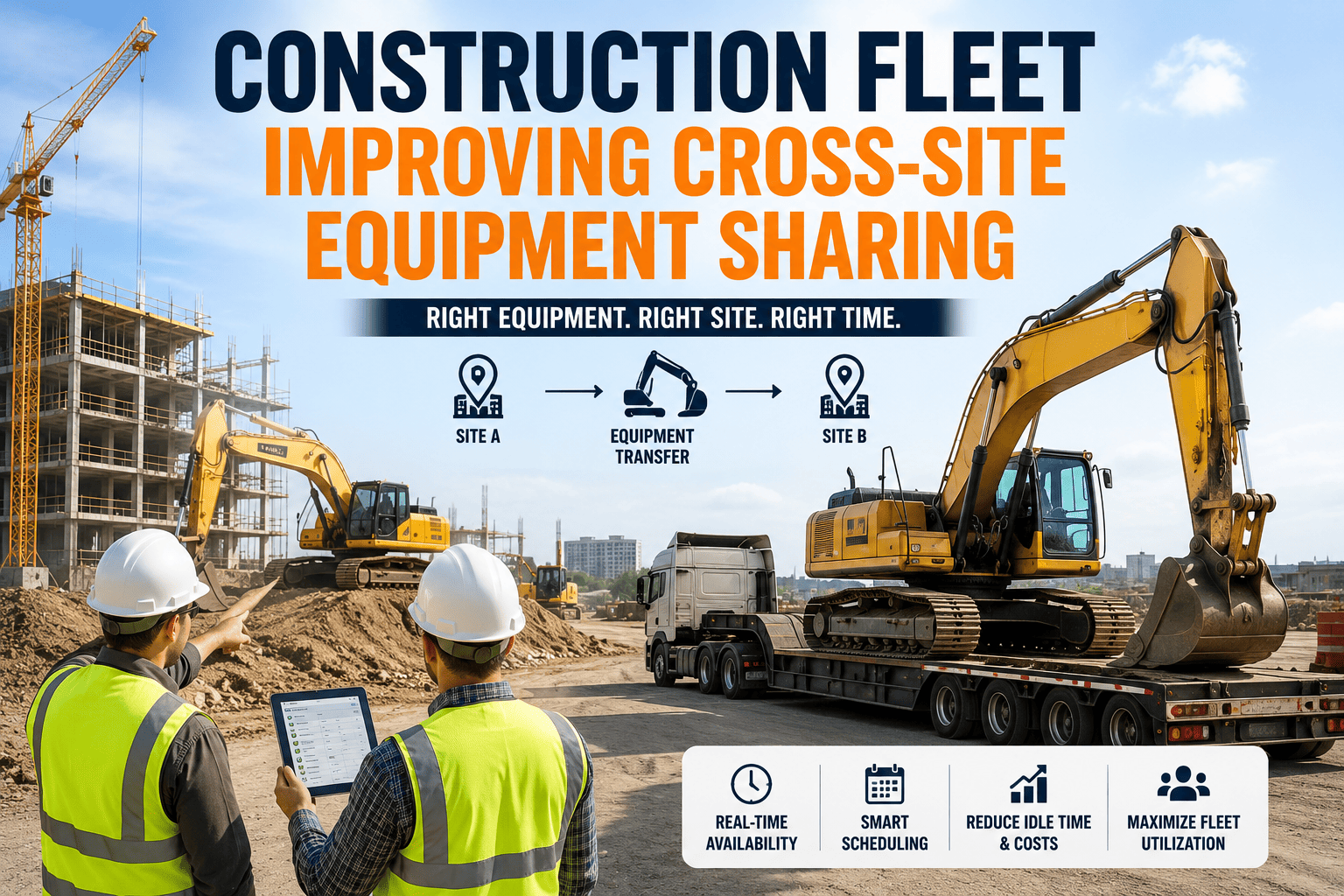
Construction fleets don't operate from a fixed depot. Equipment moves between active job sites, laydown yards, and shop facilities — sometimes weekly. Knowing which machine is where, what its current hour meter reads, and when its next PM is due requires asset tracking that moves with the equipment. Most generic CMMS platforms assume assets stay in one location. Construction CMMS platforms track assets across sites with GPS integration and field-updated hour meters.
Compliance and Inspection Documentation
U.S. OSHA and European CE/EN standards require documented inspection and maintenance records for heavy equipment operating on regulated job sites. Contractors with federal, state, or municipal contracts face audit requirements that paper logs and spreadsheets routinely fail. A construction CMMS generates audit-ready maintenance histories automatically — protecting operators from compliance penalties that can reach $15,000+ per violation in U.S. federal job sites.
Construction CMMS Benchmarks: Western Fleet Standards by Equipment Type
PM compliance rates and equipment availability benchmarks vary significantly by fleet size, equipment class, and operating region. The table below reflects 2025 competitive standards for heavy equipment fleets in U.S. and European construction markets.
Equipment Class
PM Interval
Target Availability
Max Downtime
PM Compliance
Excavators (20–80 ton)
250 hrs
88–92%
3–5 days/yr
95%+
Wheel Loaders / Dozers
250 hrs
87–91%
4–6 days/yr
95%+
Articulated Dump Trucks
500 hrs
85–90%
5–7 days/yr
93%+
Pavers / Compactors
250 hrs
90–94%
2–4 days/yr
96%+
Cranes (mobile / tower)
100–250 hrs
92–96%
2–3 days/yr
98%+
Construction fleets benchmarking PM compliance against their own historical rates — rather than industry standards — consistently underestimate competitive and contractual exposure. A U.S. fleet running 78% PM compliance may face equipment warranty voidance, insurance premium increases, and contract default risk without realizing it.
The 5 Maintenance Failures That Ground Heavy Equipment
Unplanned downtime on construction sites in the U.S. and Europe concentrates around five systematic failures that a construction CMMS directly prevents.
1
Missed PM Intervals Due to Hour Tracking Gaps
When PM scheduling relies on operators manually reporting hour meter readings — or supervisors estimating utilization — intervals drift. A 250-hour oil and filter service missed at 265 hours isn't a crisis. Missed at 310 hours on a Tier 4 diesel, it risks DPF damage that costs $8,000–$22,000 to repair and grounds the machine for 3–7 days. Telematics-connected hour tracking triggers PM alerts automatically at actual threshold, not estimated intervals.
Fleet Rabbit telematics integration on a 22-machine Texas highway fleet: missed PM events reduced from 14/quarter (manual tracking) to 1/quarter (automated hour-based triggers). Unplanned engine-related downtime dropped 62% over 6 months.
2
Fault Codes Ignored or Unlogged in the Field
Modern heavy equipment generates dozens of diagnostic fault codes daily. Operators who dismiss warning lights, or report faults verbally without documentation, allow developing issues to escalate from minor faults into catastrophic failures. A hydraulic pressure warning code ignored for 40 operating hours can progress from a $300 seal replacement to a $14,000 pump failure. Mobile CMMS apps that let operators log fault codes at the machine — with photos and GPS location — eliminate the documentation gap that turns warnings into breakdowns.
Undocumented faults: 35–55% of field eventsEscalation cost multiplier: 5–20×Prevention: mobile fault logging
3
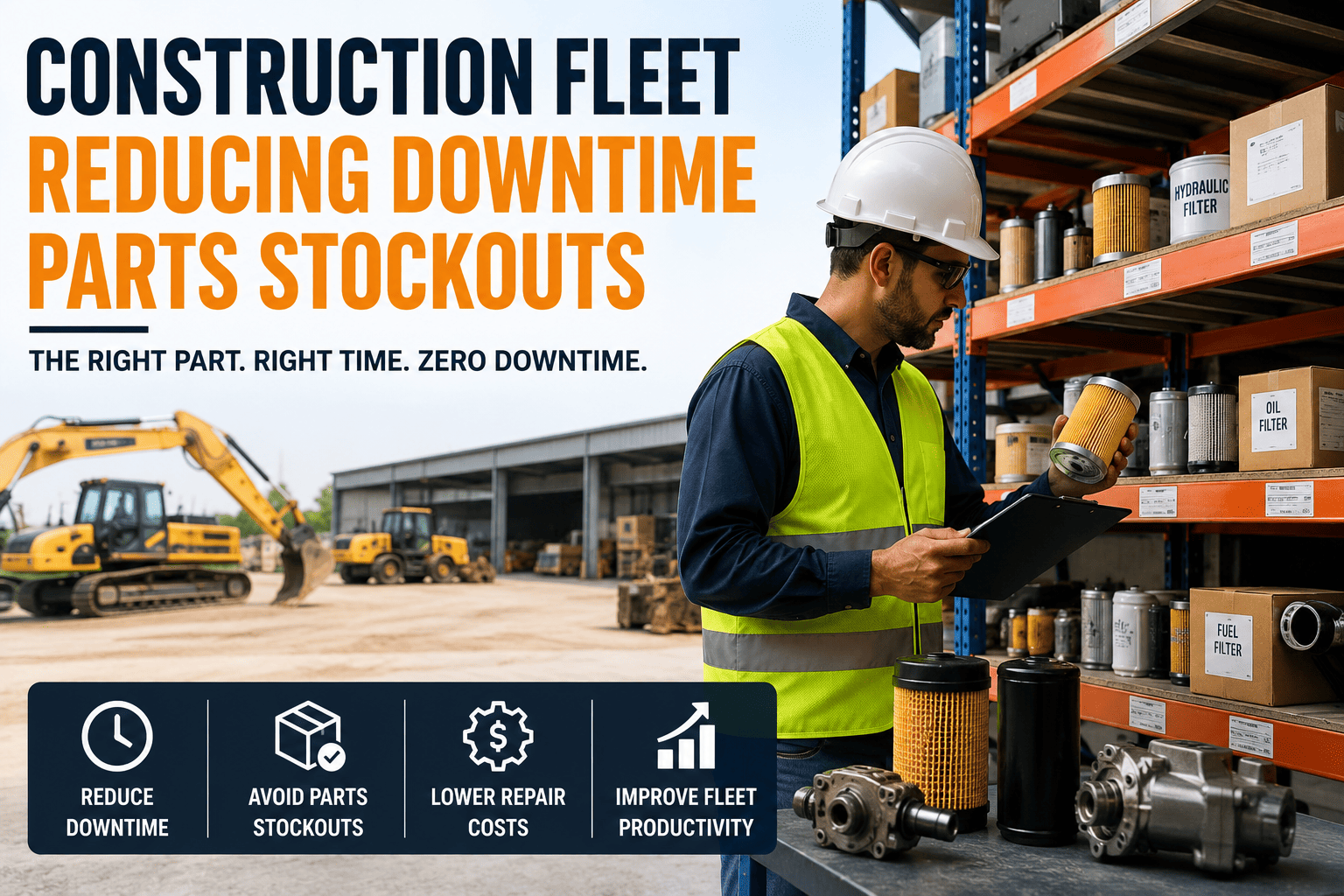
Parts Stockouts on Active Job Sites
A technician dispatched to perform a 250-hour service on a remote job site who arrives without the correct filters, fluids, or seals loses 4–8 hours of productive maintenance time and leaves the machine at risk for another shift. Parts inventory managed separately from work orders — in a parts room spreadsheet that shop staff update irregularly — produces stockout rates of 20–35% on first-visit service attempts for U.S. construction fleets. CMMS-integrated parts management links work order creation to inventory reservation automatically.
Integrated parts management reduces first-visit repair completion failures by 55–65% — keeping equipment in service rather than waiting for a second technician dispatch with the right parts.
4
No Maintenance History at Point of Repair
A field technician arriving at a machine on a job site 80 miles from the shop has no access to paper maintenance logs stored in a binder at the office. Without repair history, technicians repeat diagnostics already performed, miss pattern failures that require component replacement rather than repair, and can't confirm warranty status for parts that should be covered. Mobile CMMS platforms deliver complete machine history to the technician's phone or tablet before they arrive at the equipment.
5
Compliance Documentation Gaps Under Audit
U.S. OSHA citations for inadequate equipment maintenance records average $4,500–$15,625 per violation, with willful violations reaching $156,259. European construction sites operating under EN ISO 9001 or project-specific quality management requirements face contract penalties for documentation failures. Paper-based maintenance records that are incomplete, illegible, or simply missing when an auditor arrives create liability exposure that automated CMMS documentation eliminates entirely.
Automated maintenance documentation in Fleet Rabbit generates audit-ready records for every work order — signed, timestamped, and accessible for any inspection without manual preparation.
Construction CMMS + Mobile Work Orders
Reduce Equipment Downtime 30–45% — From the First PM Cycle
Fleet Rabbit's construction CMMS connects telematics-triggered PM scheduling, mobile work orders, parts inventory, and compliance documentation in one platform built for heavy equipment in the field.
30–45%
Less Unplanned Downtime
6 Core CMMS Capabilities for Heavy Equipment Fleets
A construction CMMS that reduces unplanned downtime and maintains compliance must address the specific operational realities of heavy equipment — not generic asset management. These six capabilities define a platform built for construction.
Hour-Based PM Scheduling with Telematics Triggers
PM schedules built on real engine hours from telematics — not calendar estimates — generate work orders automatically when equipment approaches service thresholds. 250-hour alerts fire 20 hours in advance, giving shop supervisors time to stage parts and schedule technician dispatch before the interval is reached. Fleets using automated hour-based scheduling improve PM compliance from typical rates of 72–78% to 94–97% within the first quarter.
Mobile-First Work Orders with Offline Capability
Field technicians on job sites in rural Texas, the U.S. Mountain West, or remote European construction zones can't rely on consistent cellular coverage. Mobile work order apps that function offline — syncing when connectivity returns — ensure technicians can open, complete, and close work orders at the machine regardless of signal. Parts used, labor time, fault codes, and photos attach to the work order in the field, eliminating office data entry entirely.
Integrated Parts Inventory and Auto-Reorder
Parts inventory linked directly to work order creation reserves components when a work order is opened — before the technician is dispatched. Minimum stock thresholds trigger automatic reorder requests for high-usage consumables (filters, fluids, belts, seals) before stockouts occur. For U.S. construction fleets operating in regions with 2–4 day parts lead times, automated reorder prevents the first-visit failures that add 4–8 hours of unnecessary downtime per service event.
OEM Fault Code Integration and Escalation
Telematics fault codes from Caterpillar, Komatsu, Deere, Volvo CE, and other major OEMs feed directly into the CMMS — creating work orders automatically for critical fault levels and logging informational codes for pattern analysis. Fleet managers see active fault codes across all machines and sites in a single dashboard, enabling proactive intervention before warning codes become breakdown events. Pattern analysis surfaces recurring fault codes that indicate systematic component issues.
Multi-Site Asset Location and Status
GPS-integrated asset tracking shows the current location, operational status, and maintenance status of every machine across all active job sites — on a single map view. Equipment reassignment between sites automatically transfers open work orders and PM schedules. Fleet managers know instantly which machines are operational, which are awaiting parts, and which are in scheduled PM — without calling site supervisors for status updates.
Automated Compliance and Inspection Records
Every completed work order generates a timestamped, technician-signed maintenance record stored in the cloud and accessible for OSHA inspections, insurance audits, warranty claims, and project quality management reviews. Pre-shift inspection checklists completed on mobile devices create OSHA-compliant operator inspection records automatically — eliminating the paper forms that get lost, damaged, or never completed on active job sites.
Implementing a Construction CMMS: A Practical Framework
Construction CMMS implementations that fail do so for predictable reasons: incomplete asset data at launch, technician adoption gaps, and PM schedules copied from OEM manuals without adjustment for actual operating conditions. A phased approach that addresses each prevents the most common failure modes.
Build Accurate Asset Records Before Launching PM Schedules
The most common CMMS implementation failure is launching PM schedules against incomplete asset records — wrong hour meter readings, missing OEM specs, or assets not yet in the system. Start by importing or entering accurate current hour meters, last service dates, and OEM PM intervals for every machine. Fleet Rabbit's onboarding team assists with bulk asset import and telematics connection to establish verified starting points before the first automated work order fires.
Drive Technician Adoption with Mobile-First Tools
A CMMS that technicians don't use in the field produces no data and no improvement. Field adoption depends on the mobile experience being faster and simpler than the existing paper or verbal workflow. Work order completion on mobile should take under 3 minutes for a standard service — with voice-to-text notes, photo attachment, and one-tap parts selection. Train on actual job sites, not in offices, so technicians see the workflow in their real operating context.
Adjust PM Intervals to Actual Operating Conditions
OEM PM intervals are baseline recommendations for standard operating conditions. Equipment running in dusty quarry environments, extreme heat in the U.S. Southwest, or the cold and salt exposure of Northern European winter operations may require shortened intervals for air filters, hydraulic fluid, and undercarriage components. After 60–90 days of CMMS data, failure pattern analysis reveals which machines and components need adjusted intervals — reducing both premature failures and over-maintenance costs.
Construction CMMS Results: What Heavy Equipment Fleets Achieve
30–45%
Unplanned Downtime Reduction
15–20%
Equipment Life Extension
55–65%
Fewer Parts Stockout Failures
45–75 days
Typical Full ROI Timeline
Frequently Asked Questions: Construction CMMS for Heavy Equipment
QWhat makes a construction CMMS different from a general fleet management system?
Construction CMMS platforms are built around the specific requirements of heavy equipment: hour-based PM scheduling tied to engine hours rather than calendar intervals, multi-site asset tracking for equipment that moves between job sites, OEM fault code integration for construction equipment brands (Caterpillar, Komatsu, Deere, Volvo CE, Liebherr), mobile-first work orders designed for field use with offline capability, and compliance documentation for OSHA and European regulatory standards. General fleet management systems designed for light vehicle fleets or facility assets don't address these requirements — producing PM schedules that drift, compliance records that fail audits, and field workflows that technicians bypass.
QHow quickly does a construction CMMS reduce equipment downtime?
Fleets see measurable downtime reduction within the first PM cycle after implementing automated hour-based scheduling — typically 30–60 days. The most immediate gains come from eliminating missed PM intervals: machines that were routinely serviced 30–50 hours past interval return to on-time service, and the component failures those overdue intervals were producing stop occurring. Full downtime reduction — including the benefits of fault code pattern analysis and parts inventory optimization — typically reaches its 30–45% improvement range within 90–120 days of complete deployment.
QDoes Fleet Rabbit's construction CMMS work for fleets that operate across multiple U.S. states or European countries?
Fleet Rabbit's platform is built for multi-site, multi-region operations. Asset tracking, work order management, and parts inventory function across unlimited sites and geographies from a single account. For U.S. fleets operating across state lines, compliance documentation is configurable for state-specific OSHA requirements. For European fleets, the platform supports EN-standard inspection documentation and is available in English, German, French, and Spanish. Regional parts suppliers can be configured per site, with procurement workflows that respect local supplier relationships and lead times.
Reduce Equipment Downtime 30–45% — See Fleet Rabbit's Construction CMMS in Action
Fleet Rabbit's construction CMMS combines hour-based PM scheduling, mobile work orders, integrated parts inventory, fault code tracking, and automated compliance documentation in one platform — built for heavy equipment fleets operating across U.S. and European construction sites. Most fleets achieve full ROI within 45–75 days.
30–45% Less Downtime
Hour-Based PM Scheduling
Mobile Work Orders
Parts Inventory Control
OSHA-Ready Documentation
May 27, 2026
By John Mark
All Posts