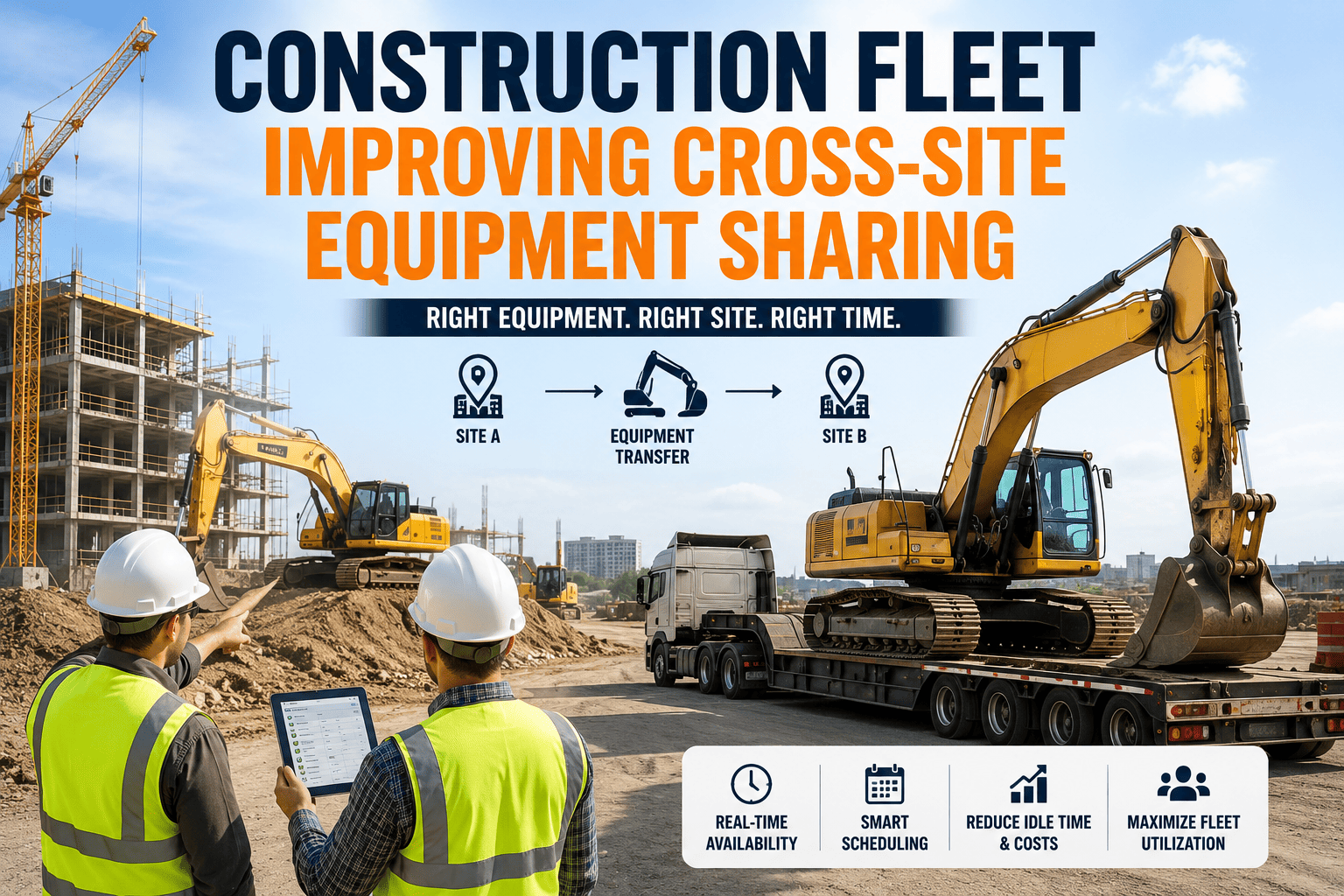
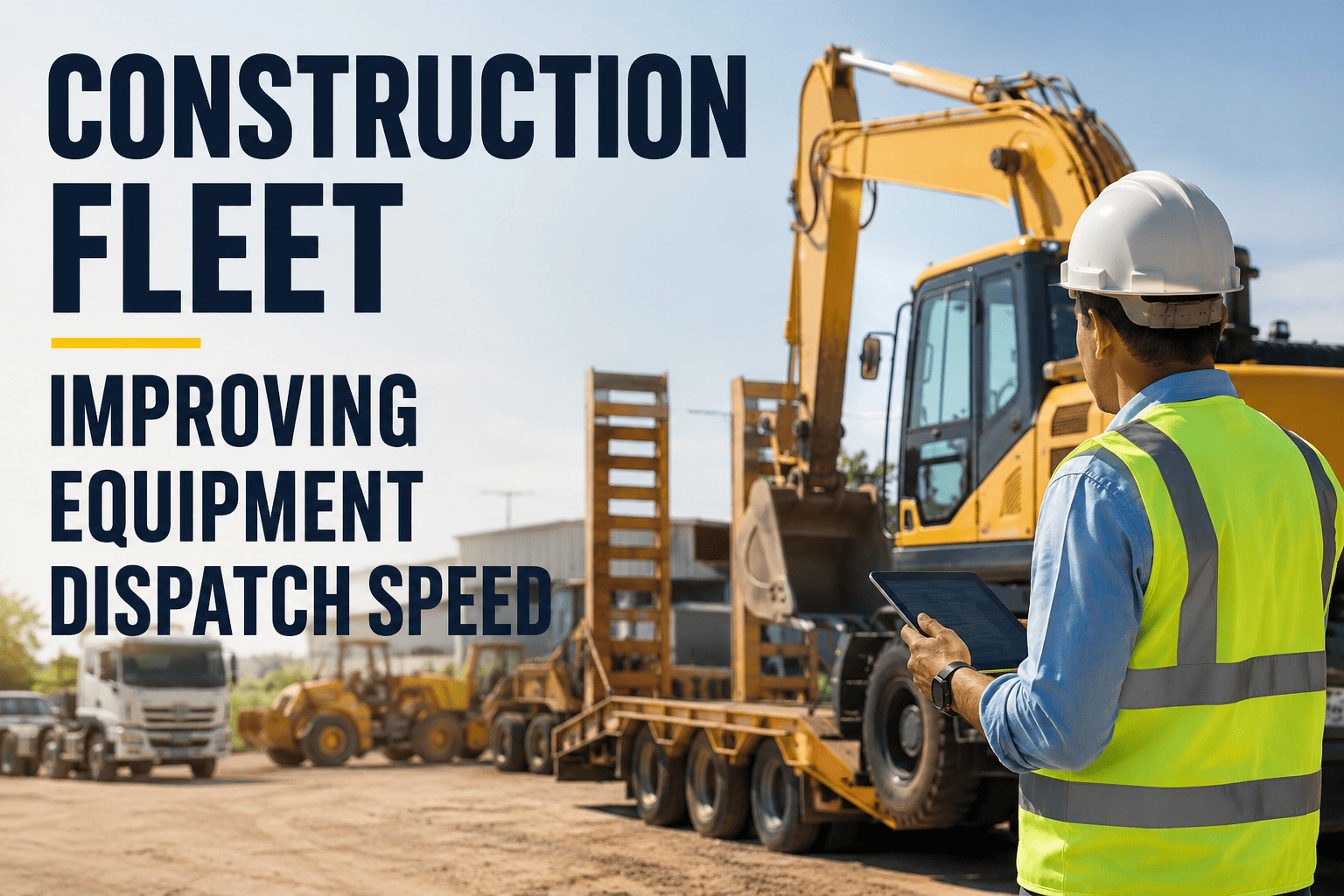
Construction companies lose $18,000–$52,000 monthly to dispatch inefficiency — equipment arriving at wrong sites, operators waiting idle for assignments, duplicate dispatches creating conflicts, and last-minute schedule changes communicated through phone calls that nobody tracks. When your fleet spans 40–120 pieces of equipment across 8–20 active job sites, manual dispatch through spreadsheets, whiteboards, and radio calls creates a bottleneck that cascades into delayed project timelines, wasted labor hours, and equipment sitting idle while another site desperately needs it. Fleet Rabbit's construction dispatch software eliminates these failures by centralizing equipment assignments, operator coordination, and load scheduling into a single real-time platform — giving dispatch managers complete visibility into fleet availability, operator certifications, site requirements, and transit logistics from one screen. The result: 34% faster equipment deployment, 41% reduction in idle time, and $14,000–$38,000 monthly savings from eliminated dispatch errors and optimized asset utilization. Book a demo to see dispatch automation in action.
Quick Answer
Fleet Rabbit's dispatch module replaces manual spreadsheets, whiteboards, and phone-based coordination with automated equipment assignment, real-time operator availability tracking, load scheduling with GPS-verified delivery confirmation, and conflict detection that prevents double-booking. Construction fleets deploying Fleet Rabbit's dispatch system report 34% faster equipment deployment to job sites, 41% reduction in equipment idle time, and complete elimination of dispatch conflicts — saving $14,000–$38,000 monthly across multi-site operations within 60 days of implementation.
"Before Fleet Rabbit, our dispatch was a disaster — two whiteboards, 40 phone calls a day, and at least 3 double-bookings per week. We'd send an excavator to Site C when Site D had been waiting since 6 AM, because the morning dispatcher didn't know about the afternoon schedule change. Within 45 days of deploying Fleet Rabbit's dispatch module, we eliminated every double-booking, reduced equipment deployment time from 4.2 hours to 1.8 hours, and cut $22,000/month in idle equipment costs. Our superintendents stopped calling the office every 30 minutes because they can see the dispatch board on their phones. That alone saved us 15 hours of management time per week."
VP of Operations
Multi-Site General Contractor — 78 Equipment Units — Southeast US
Intelligent Dispatch Automation
Assign the Right Equipment to the Right Site — In Minutes, Not Hours
Fleet Rabbit's dispatch module gives dispatchers, fleet managers, and superintendents real-time visibility into equipment availability, operator schedules, and site requirements — eliminating phone tag, double-bookings, and idle equipment across your entire operation.
34%
Faster Equipment Deployment
The Dispatch Problems Destroying Construction Productivity
Manual dispatch workflows — built on spreadsheets, whiteboards, and phone calls — create six cascading failures that compound across every job site. Each one silently drains productivity until a centralized dispatch platform replaces guesswork with real-time fleet intelligence.
01
Double-Booking & Assignment Conflicts
Two superintendents request the same excavator for the same morning. Without real-time availability, the dispatcher confirms both — creating a conflict discovered only when the machine arrives at Site A and Site B calls asking where their equipment is. Average resolution time: 3.5 hours of scrambling, phone calls, and rescheduling.
Cost: $2,800–$6,200/incident in delayed work + idle labor
02
Slow Equipment Deployment
Dispatch requests made by phone at 6 AM get processed by 9 AM — 3 hours of idle crews waiting for equipment that should have been staged overnight. Manual dispatch averaging 4.2 hours from request to equipment arrival while neighboring sites have identical machines sitting unused because nobody checked fleet-wide availability.
Cost: $1,200–$3,400/day in idle labor per delayed deployment
03
No Visibility Into Fleet Availability
Dispatchers rely on yesterday's whiteboard and memory to determine which equipment is available, in transit, under maintenance, or committed to a job. A loader completing work at Site B at 2 PM sits idle until Thursday because the dispatcher doesn't know it's available until the foreman mentions it during the next morning's call.
Cost: $800–$1,800/day per underutilized machine
04
Operator-Equipment Certification Mismatches
Dispatcher assigns a crane to Site D but the only available operator lacks the required rigging certification. Discovered on-site at 7:30 AM, creating a 2-hour delay while a certified operator is located and transported from another site. Paper-based certification tracking makes real-time matching impossible across a 60+ operator roster.
Cost: $1,500–$4,000/incident + OSHA compliance risk
05
Load Scheduling & Hauling Chaos
Dump trucks dispatched without optimized routing make 6 trips when 4 would suffice. Material deliveries arrive at sites not ready to receive them, blocking equipment and creating storage problems. Without GPS-verified delivery confirmation, dispatchers don't know if a load reached the right site until someone calls to complain — or doesn't.
Cost: $3,200–$8,500/month in wasted fuel + labor
06
Zero Dispatch Analytics & Accountability
No record of who requested what equipment, when dispatch was confirmed, what time equipment arrived, or how long it operated. When projects run over budget, nobody can trace dispatch decisions back to root causes. Fleet managers rely on disputed phone records and operator memory to reconstruct timelines during post-project analysis.
Cost: Unquantifiable margin erosion on every project
How Fleet Rabbit's Dispatch Module Works
Fleet Rabbit replaces fragmented dispatch workflows with a five-stage automated system that transforms equipment requests into confirmed, tracked assignments — with real-time visibility, conflict prevention, and GPS-verified completion at every stage.
1
Digital Dispatch Request
Superintendents and project managers submit equipment requests through the Fleet Rabbit app — specifying equipment type, site location, required dates/times, operator certification requirements, and job specifications. Requests appear instantly on the dispatch board with priority ranking based on project deadline, site criticality, and equipment availability. No more phone calls, no more voicemails.
Request: CAT 320 Excavator
Site: Highway 290 Extension
Priority: High — Morning Start
2
Intelligent Availability Matching
System scans fleet-wide equipment availability — identifying machines that match the request specifications, are not committed to other jobs during the requested timeframe, have completed required maintenance, and are located within efficient transport distance. Conflict detection prevents double-booking before it happens. Dispatcher sees ranked options with transport time estimates.
3 Units Available
Nearest: Unit #847 — 12 miles
Transport: 45 min
3
Operator Assignment & Certification Verification
Fleet Rabbit matches available operators with required certifications — verifying licenses, training completions, and medical clearances before assignment. System checks operator availability, overtime status, and proximity to the dispatch site. Operator receives mobile notification with assignment details, site directions, and reporting time. Certification mismatches blocked automatically.
Assigned: Operator Martinez — CAT 320 certified, 8.2 miles from site, available 6:00 AM. Certification valid through 09/2026.
4
Real-Time Transit & Arrival Tracking
GPS tracking shows equipment and operator en route to the dispatch site. Estimated arrival time updates dynamically based on traffic and route conditions. Superintendent receives push notification when equipment is 15 minutes away. Arrival confirmed automatically via geofence when equipment enters the job site boundary. Late arrivals flagged with reason codes for dispatch optimization.
Status: In Transit
ETA: 6:42 AM
Geofence: Site boundary set
5
Completion Logging & Performance Analytics
When the dispatch assignment ends, system logs total equipment hours, operator performance, fuel consumption, and task completion status. Data feeds into dispatch analytics — showing average deployment time, utilization by site, operator efficiency scores, and cost-per-dispatch metrics. Fleet managers use this data to optimize future dispatch decisions and identify chronic bottlenecks.
Dispatch #4872 Complete: CAT 320 Unit #847, 8.4 hours on-site, Operator Martinez scored 91/100. Request-to-arrival: 1.6 hours (fleet avg: 4.2 hours). Cost: $2,940 vs. $4,680 estimated with previous dispatch method.
Fleet Rabbit Dispatch Features That Save Hours Daily
The dispatch module includes six integrated capabilities that replace every manual workflow in your current dispatch process — from request intake to GPS-verified completion with full analytics and operator accountability.
Core Feature
Real-Time Dispatch Board
Live dashboard showing all equipment positions, current assignments, availability windows, and pending requests. Drag-and-drop assignment interface lets dispatchers assign equipment and operators in seconds. Color-coded status indicators show available (green), assigned (purple), in-transit (blue), and under maintenance (orange) at a glance.
85%
Faster than whiteboard dispatch
Core Feature
Conflict Prevention Engine
Automated double-booking detection checks every new assignment against existing commitments — blocking conflicts before they're confirmed. System identifies overlapping time windows, equipment already committed to other sites, and operators assigned to multiple jobs simultaneously. Dispatchers receive alternative suggestions when conflicts are detected.
100%
Double-bookings eliminated
Automation
Operator Certification Matching
System maintains digital certification records for every operator — licenses, equipment-specific training, safety certifications, medical clearances, and expiration dates. When dispatchers assign operators, the system automatically verifies certification validity for the specific equipment type. Non-certified operators blocked from assignment with clear notification of which certifications are missing.
0
Certification mismatches per quarter
Automation
Load Scheduling & Route Optimization
Automated load scheduling for dump trucks, material deliveries, and equipment transport — with optimized routing that minimizes fuel consumption and maximizes trips per day. GPS-verified delivery confirmation ensures loads reach the correct site. System tracks load counts, tonnage, and cycle times for billing and productivity analysis.
28%
Reduction in hauling costs
Intelligence
GPS Transit & Geofence Verification
Real-time GPS tracking of all dispatched equipment with dynamic ETA updates. Geofence-based arrival confirmation eliminates manual check-in calls. Superintendents see equipment approaching on their mobile app with countdown to arrival. Late dispatch alerts trigger escalation workflows. Complete transit history maintained for every assignment.
1.8 hr
Avg request-to-arrival (vs. 4.2 hr manual)
Intelligence
Dispatch Analytics & ROI Reporting
Executive dashboard showing dispatch volume, average deployment time, utilization rates by equipment and site, operator efficiency scores, conflict frequency, and cost-per-dispatch metrics. Month-over-month trend analysis identifies improvement areas. Exportable reports for project accounting, stakeholder presentations, and continuous improvement tracking.
$38K
Avg monthly savings documented
34%
Faster Equipment Deployment to Sites
41%
Equipment Idle Time Reduction
$38K
Monthly Savings From Dispatch Optimization
100%
Double-Booking Conflicts Eliminated
1.8 hr
Avg Request-to-Arrival Time
15 hr
Management Time Saved Weekly
Deployment: Live Dispatch in 10 Days
Fleet Rabbit's dispatch module deploys in three accelerated phases — with dispatchers using the digital board from Day 1, conflict prevention active by Day 4, and full analytics reporting operational by Day 10. No hardware installation required for dispatch functionality.
Phase 1
Day 1–3
Dispatch Board Setup & Fleet Configuration
All equipment registered with specifications, maintenance schedules, and current site assignments. Operator roster imported with certification records and availability calendars. Dispatch board configured with site locations, geofence boundaries, and priority rules. Dispatcher training completed in under 2 hours — interface designed for construction workflows, not IT specialists.
Outcome: Digital dispatch board live, dispatchers assigning equipment through the platform from Day 1
Phase 2
Day 4–7
Conflict Prevention & Operator Matching Active
Double-booking detection activated using fleet availability data from first 3 days. Certification verification enabled — system blocks uncertified operator assignments automatically. GPS transit tracking connected for real-time equipment position monitoring. Mobile app deployed to superintendents and project managers for dispatch request submission and arrival tracking.
Outcome: Zero double-bookings, certified-only assignments, GPS tracking operational across all dispatches
Phase 3
Day 8–10
Analytics, Load Scheduling & Full Optimization
Dispatch analytics dashboard configured with KPIs — deployment time, utilization rates, operator scores, conflict frequency. Load scheduling module activated for dump trucks and material deliveries with route optimization. Geofence-based arrival confirmation enabled. Executive reports scheduled for weekly and monthly delivery. Cost savings tracking begins against pre-deployment baseline.
Outcome: Full dispatch automation active, analytics reporting operational, ROI tracking begins
Proven Dispatch Automation
Stop Losing $18K–$52K Monthly to Dispatch Chaos
Fleet Rabbit's dispatch module replaces whiteboards, phone calls, and spreadsheets with automated equipment assignment, conflict prevention, operator certification matching, and GPS-verified completion tracking — delivering 34% faster deployment and $38K monthly savings within 60 days.
100%
Conflicts Eliminated
10 days
To Full Deployment
Frequently Asked Questions
QHow does Fleet Rabbit prevent double-booking when multiple dispatchers work simultaneously?
Fleet Rabbit's dispatch module operates on a real-time shared database — when Dispatcher A assigns equipment to a job, the availability update appears instantly for Dispatcher B. If two dispatchers attempt to assign the same equipment within seconds, the system locks the resource for the first confirmed assignment and immediately notifies the second dispatcher with alternative equipment suggestions. In practice, this eliminates 100% of double-booking incidents compared to whiteboard and phone-based systems where conflicts are discovered only when equipment fails to arrive at a site.
See conflict prevention in a live demo.
QCan superintendents and project managers submit dispatch requests from the field?
Yes. The Fleet Rabbit mobile app allows superintendents, project managers, and foremen to submit dispatch requests directly from job sites — specifying equipment type, required dates/times, operator needs, and job specifications. Requests appear instantly on the dispatcher's board with priority ranking. Requesters receive real-time status updates: request received, equipment assigned, operator confirmed, in-transit with ETA, and arrival confirmed via geofence. No more phone calls to the office or waiting for callbacks.
QHow does the system handle last-minute dispatch changes and emergency requests?
Emergency dispatch requests are flagged as high-priority and appear at the top of the dispatch board with visual and audio alerts. The system immediately identifies the nearest available equipment matching the emergency specification — showing distance, transport time, and current assignment status. If the best-fit equipment is currently assigned to a lower-priority job, the system suggests reassignment with automatic notification to the affected superintendent. Emergency dispatch resolution time averages 12 minutes vs. 2.5 hours with manual processes.
QWhat integrations does Fleet Rabbit dispatch support with existing construction software?
Fleet Rabbit integrates with major construction management platforms (Procore, Buildertrend, PlanGrid), accounting systems (QuickBooks, Sage), telematics providers (Geotab, Samsara, Verizon Connect), and fuel card providers (WEX, Fuelman). Equipment data, operator records, and project schedules sync bidirectionally — so dispatch assignments automatically reflect in project timelines and cost tracking. API access available for custom integrations with proprietary systems.
Start a free trial to test integrations.
QWhat is the typical ROI timeline for Fleet Rabbit's dispatch module?
Most construction fleets see measurable ROI within 21–30 days of deployment. First-week savings come from eliminating double-bookings and reducing dispatch phone calls (typically $2,000–$5,000 in recovered labor and equipment costs). Week 2–4 savings compound as utilization improves through fleet-wide visibility — underutilized equipment gets redeployed rather than sitting idle while rentals are ordered. By Day 60, typical fleets report $14,000–$38,000 monthly savings from combined dispatch efficiency, idle time reduction, hauling optimization, and elimination of unnecessary equipment rentals.
Stop Dispatching by Phone — Start Dispatching by Intelligence
Fleet Rabbit's construction dispatch software replaces the chaos of whiteboards, phone calls, and spreadsheets with automated equipment assignment, real-time fleet visibility, conflict prevention, and GPS-verified completion — delivering $14K–$38K monthly savings within 60 days of deployment.
Real-Time Dispatch Board
Conflict Prevention
Operator Cert Matching
GPS Transit Tracking
Load Scheduling
34% Faster Deployment
April 14, 2026
By Michael
All Posts