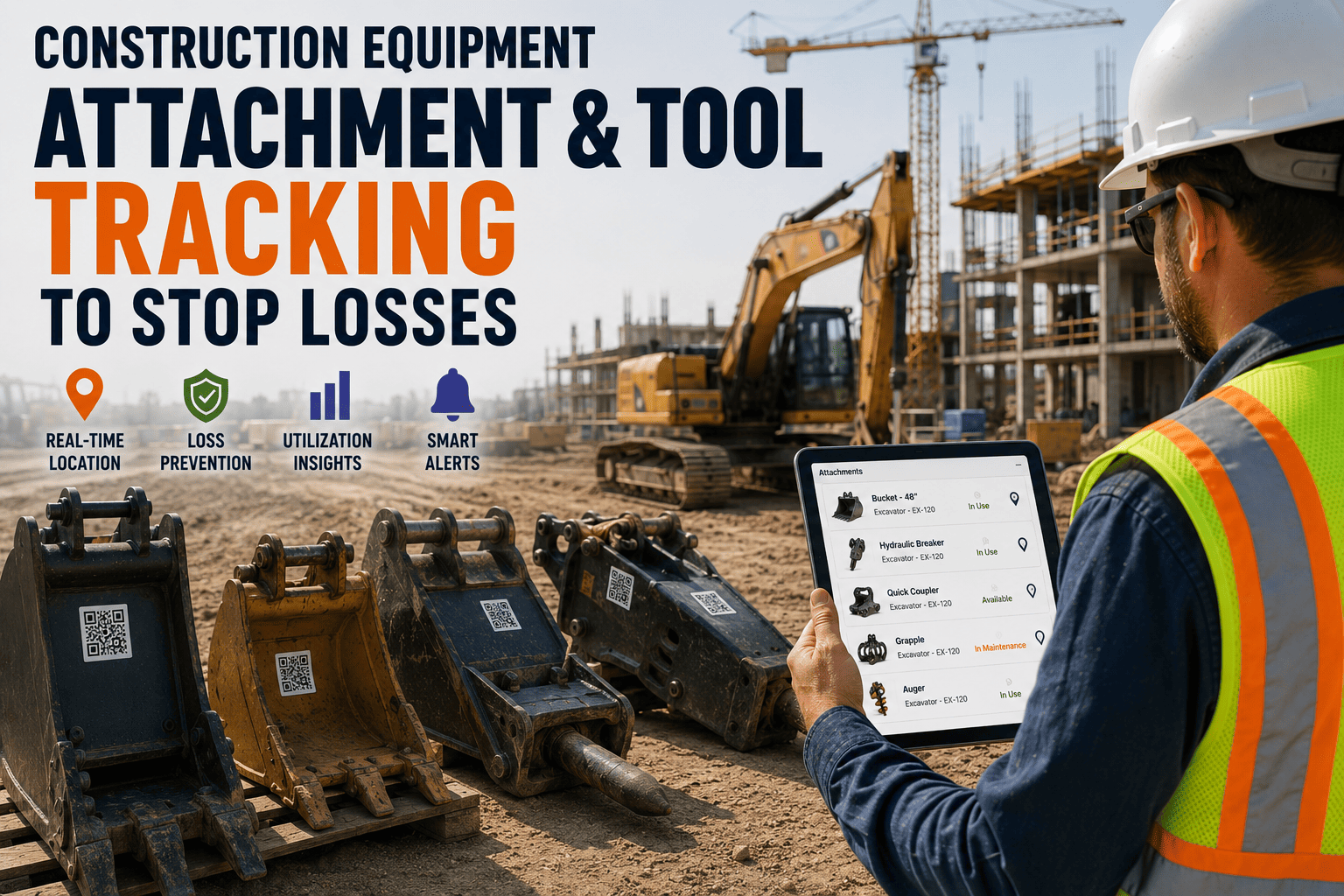
The breaker attachment was on the truck Tuesday. By Friday, nobody can say where it went. It wasn't stolen in any dramatic sense, it just moved from one job site to another with a different crew, got left in a yard corner, and quietly stopped being anyone's responsibility. Multiply that story across buckets, hammers, augers, and hand tools moving between a dozen active sites, and you get the quiet drain that never shows up as a single dramatic loss, just a replacement order every few weeks that adds up to a real line item nobody budgeted for.
Attachment and tool tracking means giving every bucket, breaker, hammer, auger, and portable tool a trackable identity so its location and usage stay visible as it moves between job sites and equipment. Industry surveys show construction and trade companies lose 5 to 10 percent of their portable tool inventory every year to theft, misplacement, and damage, with replacement costs typically running $500 to $3,000 per tool. Attachments are especially vulnerable because, unlike a titled machine, they have no VIN, move independently of any single operator, and are easy to swap between job sites without anyone logging the transfer.
Watching a Year's Worth of Inventory Quietly Shrink
Nobody loses 8 percent of their attachment inventory in one incident. It happens in small, disconnected moments across the year, and by the time anyone adds it up, the fleet has quietly shrunk without a single theft report to explain it.
That last bar is the one that matters, and it's almost never visible until someone tries to do a physical count and comes up short. Without a system tracking each attachment's location, that 9 percent doesn't get discovered until the next big job needs a specific bucket or breaker and nobody can find it anywhere in the fleet.
FleetRabbit tracks the location and usage of every attachment and tool across your job sites, so nothing quietly disappears between one project and the next. Sign up free and start tracking your inventory today.
Why Attachments Disappear More Easily Than Machines
A skid steer or excavator has a title, a VIN, and one operator responsible for it on any given day. A bucket or a breaker has none of that. It gets swapped between machines, handed off between crews, and moved between sites without the same paper trail a titled machine automatically generates. That structural difference is exactly why attachments and tools slip through the cracks that heavy equipment mostly doesn't.
| Factor | Titled Machines | Attachments and Tools |
|---|---|---|
| Unique identifier | VIN and title tied to the asset permanently | Often no serial tracking beyond the manufacturer tag |
| Assigned responsibility | One operator typically responsible per shift | Passed between multiple operators and crews casually |
| Movement between sites | Transport is planned and usually logged | Frequently moved informally in truck beds and trailers |
| Value per unit | High enough that loss triggers immediate attention | Individually lower value, so loss often goes unreported |
| Recovery odds if stolen | Around 20 to 25 percent recovered | Often below 10 percent recovered |
The Real Cost Isn't Just Replacement
Replacing a missing bucket or breaker is only the most visible part of the cost. The bigger hit often comes from the crew standing around waiting for a replacement to arrive, the rental fee paid to cover the gap in the meantime, and the duplicate purchases made because nobody realized the fleet already owned three of the same attachment scattered across different job sites. Attachment loss rarely shows up as one number on a report, it shows up as a dozen smaller inefficiencies that all trace back to the same root problem: not knowing where everything actually is.
Signs Your Fleet Has an Attachment Tracking Problem
- Duplicate purchases of attachments that turn out to already exist somewhere else in the fleet
- Crews searching multiple sites by phone call to locate a specific bucket or breaker before a job can start
- No clear record of which site or truck an attachment was last seen on
- Frequent rental costs for equipment types the company technically already owns
- Year-end inventory counts that consistently come up short compared to purchase records
Building an Attachment Tracking System That Sticks
Fixing attachment loss doesn't require replacing how your crews work day to day. It requires giving every attachment a simple, trackable identity and making it just as easy to log a transfer as it is to skip logging one.
How FleetRabbit Keeps Every Attachment and Tool Visible
Manually keeping track of dozens of attachments and hundreds of small tools moving across multiple active job sites is exactly the kind of task that falls apart under real-world pace, which is how a fleet ends up quietly missing 5 to 10 percent of its inventory without anyone noticing until a count comes up short. FleetRabbit gives every attachment and tool a trackable identity, logging location and transfer history automatically so fleet managers can see exactly where everything is without relying on phone calls between sites.
Utilization data tied to that same tracking also shows which attachments are sitting idle at one site while another site is renting the same equipment type, turning a hidden loss problem into a visible reallocation opportunity. Fleets using this kind of visibility routinely find they own more of what they need than they realized, they simply couldn't locate it before. If you'd like to see how this looks against your own attachment and tool inventory, you can book a demo and walk through it with our team.
Get real-time location and transfer history for every attachment across your job sites. Create your free account or talk it through with our team first.
Frequently Asked Questions
An attachment rarely disappears all at once. It moves from a truck bed to a yard corner to a different job site, one small handoff at a time, until nobody can say where it ended up or whose responsibility it was along the way. Giving every bucket, breaker, and hand tool a trackable identity turns that slow, invisible drain into something you can actually see and stop, before a missing attachment becomes a duplicate purchase, a rental bill, or a crew standing idle waiting for equipment the fleet already owns.
FleetRabbit tracks every attachment and tool across your job sites in real time, cutting losses and showing you exactly what you already own before you buy or rent more. Get started free, no credit card required, or book a demo to see your fleet's attachment inventory first.