It always seems to happen on the busiest morning. The operator turns the key, the dash lights flicker, and the excavator that was supposed to be moving dirt by 7 a.m. is instead sitting silent while the crew stands around waiting. A dead battery feels like a small thing, until you count what it actually costs: a stalled crew, a pushed-back schedule, and a service call that could have been avoided with a five-minute check two weeks earlier. Battery and charging system failures are among the most common, most preventable causes of construction equipment downtime, yet most fleets still treat them as a surprise instead of a pattern.
Construction equipment batteries typically last 3 to 5 years, but heat, vibration, and deep discharge cycles common on job sites can cut that lifespan significantly. A weak battery or failing alternator rarely fails without warning signs first, including slow cranking, dimming lights, and repeated jump-starts. Fleets that track battery age and charging system health alongside maintenance history catch failing units before they strand equipment mid-shift, avoiding the crew downtime and emergency service calls that a dead battery triggers.
Why Battery Problems Cost More Than a Replacement Part
A battery itself is a small, inexpensive component. The real cost shows up around it. When a loader or generator won't start, the crew scheduled to use it is idle until someone finds a jump box, a mechanic, or a replacement unit. On a job site with interdependent tasks, that delay doesn't stay contained to one machine. Excavation waits, the concrete pour that depends on it slides, and a subcontractor scheduled for the afternoon shows up to a site that isn't ready for them.
Charging system problems make the pattern worse because they hide in plain sight. An alternator that's slowly losing output doesn't cause an immediate failure. It causes a battery that seems to drain a little faster every week, until one cold morning it doesn't have enough left to turn the engine over. By the time the symptom is obvious, the part that actually failed weeks earlier is the alternator, not the battery that gets blamed and swapped.
Where the Hidden Costs Actually Land
Every dead-battery call carries costs that rarely show up on the repair invoice. Understanding where they land is the first step toward budgeting for prevention instead of absorbing surprises.
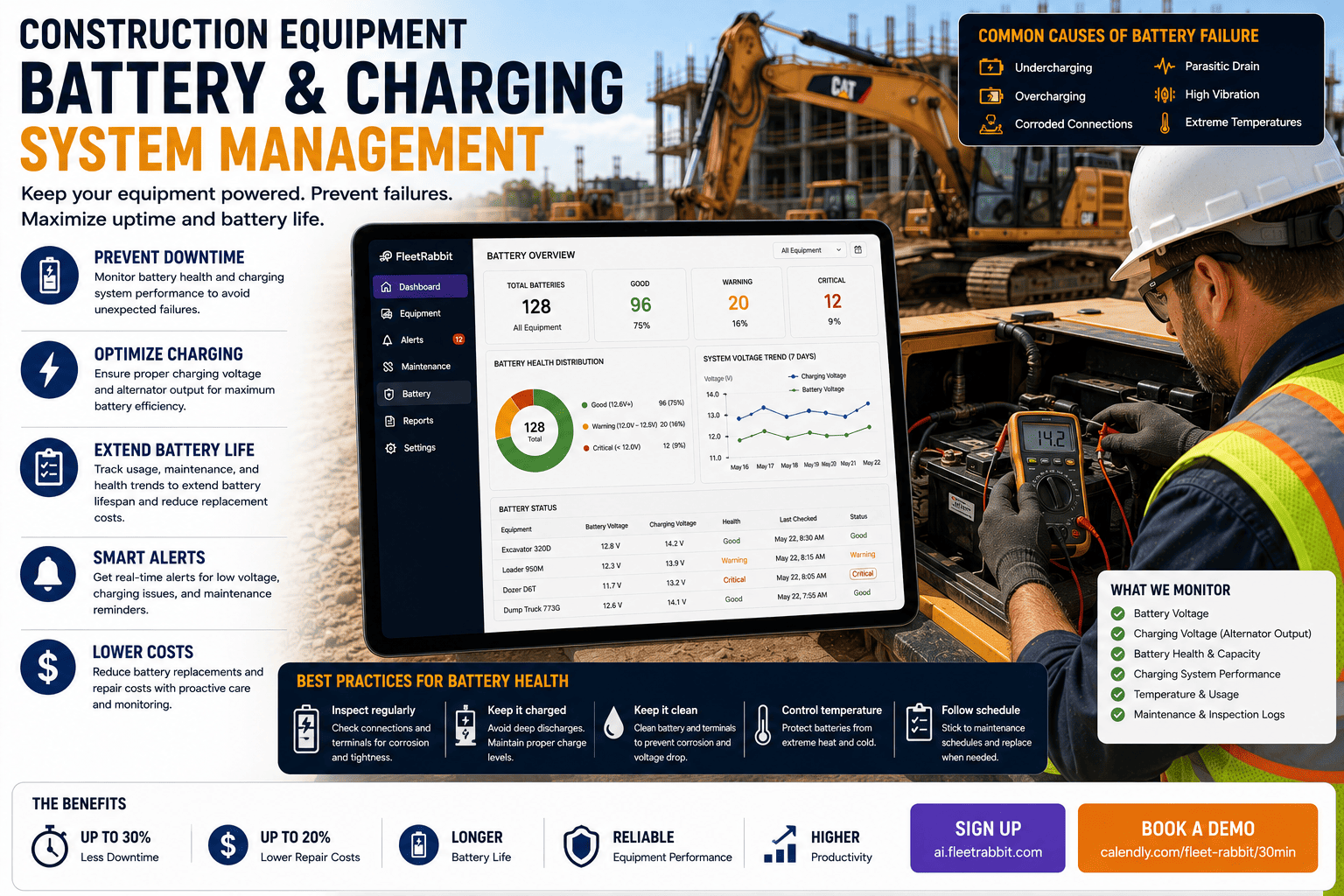
FleetRabbit monitors battery age, voltage trends, and charging system health across your equipment, flagging units heading toward failure while there's still time to schedule a replacement. Sign up free and see it running on your fleet today.
Battery Trouble or Charging System Trouble? Know the Difference
A dying battery and a failing alternator can look almost identical from the operator's seat, but treating one like the other wastes money and guarantees a repeat breakdown. The table below lays out how to tell them apart before calling for service.
| What You Notice | Likely Battery Issue | Likely Charging System Issue |
|---|---|---|
| Slow or no crank on start-up | Battery is aging or discharged and can't deliver enough current | Alternator isn't recharging the battery fully between uses |
| Dash lights dim while idling | Less common on its own | Classic sign the alternator can't keep up with electrical load |
| Machine restarts fine after a jump, then dies again in days | Battery may simply be worn out | Strong signal the alternator isn't recharging it properly |
| Battery warning light stays on while running | Not typically a battery-only symptom | Direct indicator of a charging system fault |
| Corrosion or looseness at terminals | Reduces battery performance and can mimic a dying unit | Rarely the root cause, but worth ruling out first |
Why Heat, Cold, and Vibration Speed Up Failure
Job site conditions are harder on batteries and charging systems than almost any other operating environment. Heat accelerates the internal chemical breakdown inside a battery, shortening its usable life. Cold does the opposite kind of damage: it thickens engine oil and slows the chemical reaction inside the battery right when the starter needs the most current to turn a cold engine over. Constant vibration from rough terrain and heavy digging loosens terminal connections and can physically damage internal battery plates over time. Add long idle periods between shifts, and a battery that never gets a full recharge cycle wears down faster than the calendar alone would suggest.
Conditions That Shorten Battery and Alternator Life
A handful of everyday job site realities do most of the damage over time, often without anyone noticing until a machine won't start.
- Extended idle stretches between shifts or seasons that leave a battery sitting at a low state of charge
- High under-hood temperatures from engine heat and summer conditions that speed up internal wear
- Sub-freezing mornings that demand far more starting current than the same battery needed in summer
- Constant vibration from rough terrain that loosens terminals and stresses internal components
- Add-on electrical loads like lighting or telematics hardware that draw power the original charging system wasn't sized for
Building a Battery and Charging Maintenance Routine That Actually Works
Most fleets don't need a complicated program to cut battery-related downtime dramatically. They need a routine that gets followed consistently, backed by data that tells technicians which units need attention before a crew is standing around waiting.
How FleetRabbit Keeps Batteries and Charging Systems Ahead of Failure
Manually tracking battery age and charging health across a growing equipment list is easy to fall behind on, especially when maintenance records live across spreadsheets and paper logs. FleetRabbit centralizes that information so nothing slips through. Battery install dates, service history, and charging system checks are logged against each machine, and units approaching typical end-of-life get flagged automatically so replacements happen on your schedule instead of the battery's.
The same platform ties battery and charging alerts into the maintenance schedule you already run, so a technician replacing a battery during a planned service visit isn't guessing whether the alternator needs attention too. Fleets that put this kind of visibility in place stop treating dead batteries as a surprise and start treating them as a routine, predictable part of maintenance. If you want to see how this looks against your own equipment list, you can book a demo and walk through it with our team.
Get age tracking, voltage history, and charging system alerts for your whole fleet in one place. Create your free account or talk it through with our team first.
Frequently Asked Questions
A dead battery on a job site is rarely bad luck. It's almost always the end of a pattern that started weeks earlier with a slightly slower crank, a dimmer headlight, or one more jump-start than usual. Fleets that track that pattern instead of ignoring it turn an unpredictable morning scramble into a routine line item on a maintenance schedule, keeping crews working instead of waiting.
FleetRabbit tracks battery age, charging system health, and maintenance history across your entire fleet, so failing units get replaced on your timeline instead of stranding a crew mid-shift. Get started free, no credit card required, or book a demo to see it in action first.