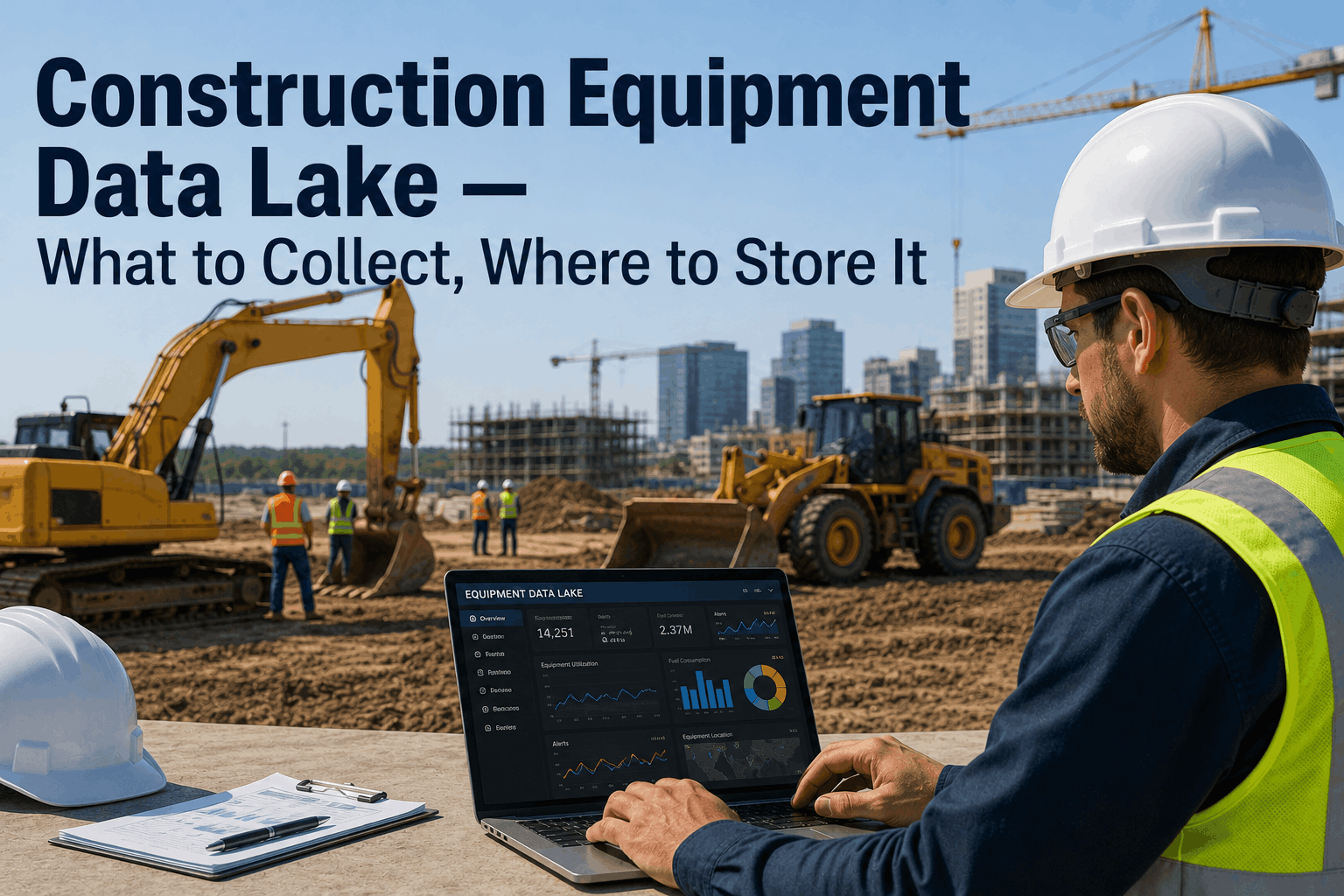
Construction fleets across California, Nevada, Arizona, Oregon, and Washington generate millions of sensor events daily — GPS pings, CAN bus readings, fuel flow data, idle timers, fault codes. Without a structured data lake, that telemetry evaporates in OEM portals with 30–90 day retention limits and no cross-brand query capability. This guide covers what to collect, how to schema it, where to store it, and how Western US contractors are using unified equipment data lakes to drive predictive maintenance, fuel accountability, and utilization intelligence. Book a demo to see Fleet Rabbit's telematics data platform applied to your construction fleet.
Quick Answer
A construction equipment data lake centralizes GPS, CAN bus, fuel sensor, idle, and fault code telemetry from excavators, loaders, dozers, and cranes into a queryable schema. Western US fleets use on-prem edge nodes for remote Nevada and Arizona sites, cloud ingestion for California multi-site operations, and a hybrid model for Oregon and Washington contractors. Retention tiers, OEM-agnostic ingestion, and role-based access are the three decisions that determine long-term ROI.
Why Western US Fleets Need a Data Lake — Not Just OEM Portals
A 25-unit mixed fleet across California, Nevada, and Arizona generates 180–400 MB of raw telemetry daily. Cat Connect, Komatsu KOMTRAX, and Volvo CareTrack each store data in proprietary schemas with 30–90 day retention and no cross-fleet query. A Phoenix contractor running all three brands has three disconnected silos, zero unified fault correlation, and no historical baseline for predictive maintenance.
OEM Brands Unified
40+
in one schema
Events/Day
2.4M
per 25-unit fleet
OEM Retention
90 days
vs 5-year data lake
Query Latency
<2s
cross-fleet history
What Telemetry to Collect — The Full Signal Inventory
Position & Motion
GPS at 1–5s intervals, heading, speed, geofence events, site boundary crossings. Collect at 1Hz for excavators and dozers, 5Hz for haul trucks. Critical for Nevada and Arizona remote sites where equipment moves between permitted zones.
CAN Bus Engine Signals
RPM, coolant temp, oil pressure, throttle, engine load, DEF level, DPF regen, hours meter, J1939 fault codes. Cross-validating fuel burn against engine load detects ghost consumption — required for California prevailing wage audits.
Fuel Flow & Tank Sensors
Inline flow sensors log volume in/out per event. Tank ultrasonic sensors provide continuous fill-state monitoring. Flow sensor catches siphoning; tank sensor catches slow hydraulic leaks below theft thresholds on Oregon remote sites.
Utilization & Idle
Engine-on/off transitions, work vs idle classification, hydraulic pump engagement, attachment activity. A Sacramento grading contractor reduced idle costs 31% after data lake analysis showed 4 underutilized machines across 3 sites.
Fault Codes & Health
J1939 DTC, SPN/FMI pairs, freeze frame data, active vs inactive fault status. A 12-month fault sequence on a Cat 336 in Phoenix predicted hydraulic pump failure 18 days before manual inspection would have found it.
Operator & Credential Events
RFID/PIN login timestamps, operator ID linked to engine-on and refuel events, shift start/end. Required for California prevailing wage audits — closes the ghost refuel gap averaging $800–$1,400/month on 20-machine fleets.
Schema Design — Structuring Equipment Telemetry for Queries
Recommended Table Architecture — Construction Equipment Data Lake
asset_id (PK)vin / serialoem_brandmachine_typesite_assignmentfleet_id (FK)
Static master — update on reassignment
event_id (PK)asset_id (FK)event_ts (UTC)signal_typesignal_valuelat / lonsite_id
Partition by date + asset_id
fuel_event_id (PK)asset_id (FK)event_typevolume_gallonstank_pre / postoperator_idanomaly_flag
Write-once immutable for audit
fault_id (PK)asset_id (FK)spn / fmiseverityonset_tscleared_tsfreeze_frame
Foundation for predictive ML models
Partition telemetry_events by (site_id, DATE(event_ts)) — Western US multi-site query patterns are almost always site-scoped and time-bounded.
Ingestion Architecture — Edge vs Cloud for Western US Sites
1
Edge Node Ingestion — Nevada, Arizona, Eastern Oregon
Ruggedized edge compute nodes run a local MQTT broker receiving CAN bus, GPS, and sensor data from up to 50 machines. Edge AI classifies anomalies locally — fuel theft alerts fire in 30 seconds even with zero LTE coverage. 72-hour local buffer; syncs to cloud on reconnect with no data loss.
Nevada I-80 contractor: 14 machines, 3-day connectivity outage — 1.2M events buffered locally, synced to cloud data lake with zero loss on reconnect.
2
Cloud Ingestion — California Multi-Site Operations
California contractors running 5–15 simultaneous sites use direct cloud ingestion via HTTPS/MQTT over LTE or site WiFi. Managed Kafka or AWS Kinesis streams handle burst telemetry — 25 machines powering on in a 10-minute window generates 40,000+ events per minute that batch pipelines cannot absorb.
Kafka / Kinesis streamsLTE direct ingestAuto-scaling partitions
3
Hybrid Model — Oregon and Washington Civil Contractors
Pacific Northwest contractors spanning timber roads and urban Portland/Seattle sites need both. Edge nodes handle off-grid forest sites; cloud handles urban operations. Fleet Rabbit ingests both streams into the same schema — cross-site queries run against one endpoint regardless of data origin.
Oregon contractor, 8 sites coast to Portland metro: Hybrid ingestion eliminated 6 hours/week of data reconciliation labor — all sites queryable in one dashboard.
Construction Data Lake Platform
Unify Your Western US Fleet Telemetry — OEM-Agnostic, Edge + Cloud, Any Brand
Fleet Rabbit ingests CAN bus, GPS, fuel sensor, and fault data from 40+ OEMs into a single queryable data lake — on-premise, cloud, or hybrid. Full schema documentation and REST API from day one.
Retention, On-Prem vs Cloud, Access Control & API Layer
Tiered Storage — Hot, Warm, and Cold for Equipment Data
Hot (0–90 days): Full-resolution raw events, sub-second query latency for active maintenance and fuel audit queries.
Warm (90 days–2 years): 5-minute aggregates; fault codes and fuel events at full resolution for trend analysis.
Cold (2–5 years): Daily rollups; fault history and fuel audit trails at full resolution for insurance and compliance.
California compliance: CalTrans and prevailing wage requirements mandate 3-year retention on fuel and operator records — cold tier satisfies this automatically.
Deployment Decision Framework for Western US Fleets
On-prem wins when: Nevada/Arizona mining with strict data sovereignty, fleets entirely in cellular dead zones, operations with existing server infrastructure, or 30+ machines where cloud egress costs exceed hardware depreciation.
Cloud wins when: California multi-site contractors needing zero infrastructure management, fleets under 20 units, cross-state operations (CA + NV + AZ), or contractors without dedicated IT.
Hybrid recommendation: For most Western US contractors running 15–40 machines across mixed connectivity, edge + cloud aggregation delivers the best cost-to-capability ratio.
Role-Based Access Across Multi-Site Fleets
The problem: A California contractor with 8 job sites needs site supervisors to see only their site data, the fleet director to see everything, and external auditors to have read-only access — without manually managing 40+ OEM portal logins.
Fleet Rabbit implements: Site-scoped roles, fleet-wide director roles, read-only auditor access for insurance adjusters and CalTrans inspectors, and API tokens scoped to specific machine IDs for ERP integration.
Outcome: Role-based access eliminates data governance gaps and enables external audit access without exposing full fleet telemetry — critical for Nevada contractors with multiple subcontractor crews.
API & Integration Layer — Connecting the Data Lake to Operations
Isolated data lakes add labor: Without ERP and maintenance system integration, a 20-machine California fleet requires 4–8 hours/week of manual data bridging between the data lake, payroll, and maintenance scheduling.
Fleet Rabbit API provides: REST and webhook endpoints for real-time streaming, bulk Parquet/CSV export for BI tools (Tableau, Power BI), direct integration with Procore, Viewpoint, and CMiC ERPs, and Zapier connectivity for contractors without dedicated IT.
Insurance integration: Automated report export accepted by Zurich, AIG, and specialty construction underwriters — submitted directly from the dashboard.
Before vs. After — Data Lake vs OEM Portals, 20-Unit Western US Fleet
OEM Portals Only
Cross-brand queries: Impossible
Data retention: 30–90 days
Remote site coverage: Cellular only
Fault history: 30 days max
Insurance export: Manual PDF
Predictive ML: Not available
Fleet Rabbit Data Lake
Cross-brand queries: All 40+ OEMs unified
Data retention: 5-year tiered storage
Remote site coverage: Edge + satellite
Fault history: Full 5-year record
Insurance export: API-direct to carriers
Predictive ML: Full signal history
2.4M
Events/Day (25-unit)
Frequently Asked Questions: Construction Equipment Data Lakes
QWhat CAN bus signals are available on older Western US equipment without factory telematics?
Most equipment manufactured after 2005 exposes J1939 CAN bus on a standard 9-pin Deutsch connector regardless of factory telematics fitment. Fleet Rabbit's J1939 gateway reads RPM, engine load, fuel consumption, fault codes, and hours meter on pre-telematics Caterpillar, Komatsu, and John Deere equipment without OEM hardware. Equipment pre-2005 uses a standalone GPS and sensor array — fuel flow and location data are available even with no CAN bus access.
QHow does the data lake handle connectivity gaps on Nevada and Arizona remote sites?
Fleet Rabbit edge nodes buffer up to 72 hours of full-resolution telemetry locally when cellular is unavailable. On reconnect, the edge node syncs to the cloud data lake in chronological order with no gaps or duplicates. For permanently off-grid operations — deep Nevada mining sites, Eastern Oregon timber roads — Fleet Rabbit supports Iridium satellite modem integration for near-real-time event delivery.
QDoes the data lake satisfy California CalTrans and prevailing wage fuel documentation requirements?
Yes. Fleet Rabbit's fuel event table is write-once and immutable — each record carries a cryptographic timestamp, machine ID, GPS coordinate, operator credential, and sensor-verified volume. Records cannot be edited after write. The export format is accepted by CalTrans inspectors and California Labor Commissioner auditors. Retention defaults to 5 years, satisfying the 3-year California requirement with a 2-year buffer.
QHow long does data lake setup take for a mixed fleet across multiple California sites?
Fleet Rabbit installs sensors and connects telematics on 4–6 machines per day. A 20-unit mixed fleet is fully live in 4–5 days. The data lake schema is pre-configured — no database engineering required. Western US field teams cover California, Nevada, Arizona, Oregon, Washington, and Colorado with no equipment downtime during sensor mounting. API and dashboard access are provisioned on day one.
Related Fleet Rabbit Resources
The four AI capabilities transforming fleet operations — real-time GPS, predictive health monitoring, dynamic route optimization, and delivery performance analytics — with ROI data for each.
AI-driven fault prediction and automated maintenance scheduling that prevents mid-project breakdowns across excavators, loaders, and cranes.
Real-time utilization tracking, idle reduction analytics, and fleet right-sizing data that reduce total heavy equipment operating cost for Western US contractors.
How GPS hardware, IoT sensors, and cloud analytics combine to deliver real-time heavy equipment visibility, predictive maintenance, and operational intelligence.
Build Your Construction Equipment Data Lake — See Fleet Rabbit in Action
Fleet Rabbit's OEM-agnostic telematics platform unifies CAN bus, GPS, fuel sensor, and fault data from 40+ brands into a single queryable data lake — edge, cloud, or hybrid. Full schema access, REST API, and 5-year tiered retention from day one.
OEM-AgnosticEdge + Cloud5-Year RetentionREST API45-Day ROI
May 28, 2026
By John Mark
All Posts