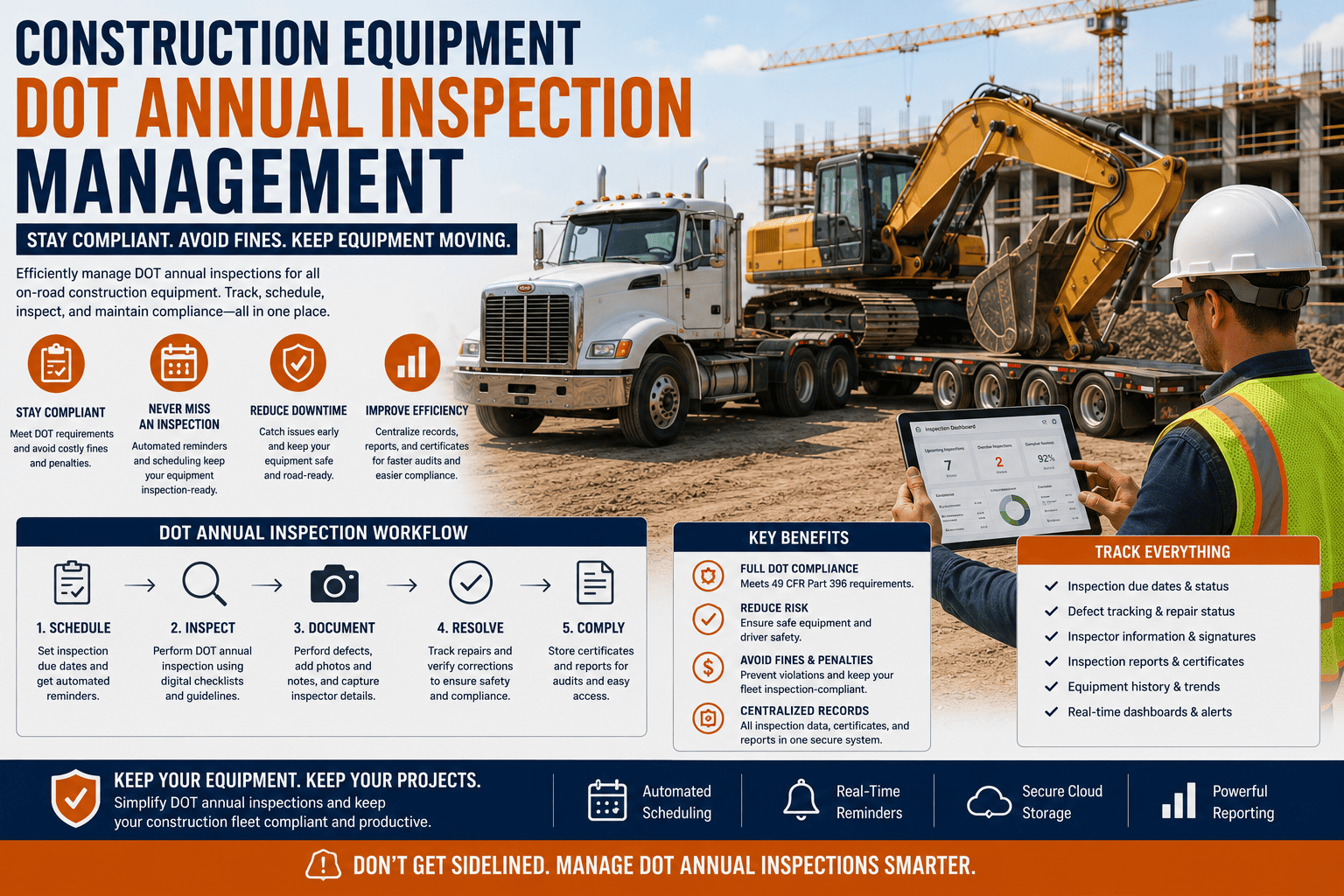
A dump truck without a valid annual inspection sticker doesn't get a warning. It gets parked. One roadside stop, one expired decal, and a loaded truck sits on the shoulder while your job site waits on material that isn't coming. For construction fleets, DOT annual inspection management isn't paperwork sitting in a filing cabinet. It's the difference between equipment rolling to the job and equipment rotting at a weigh station.
Any construction vehicle over 10,001 pounds that travels on public roads needs a DOT annual inspection under 49 CFR 396.17, renewed every 12 months, with proof kept on the vehicle at all times. Off-road-only equipment like excavators and skid steers that never touch a public road are typically exempt. Missing a valid inspection triggers an automatic out-of-service order and can bring CSA points plus fines running into the thousands. Sign up for FleetRabbit to track every annual inspection date in one place, or book a demo to see it in action.
Why Construction Fleets Get Caught Off Guard
Construction equipment operates differently from a long-haul trucking fleet, and that difference is exactly what trips people up. A concrete mixer, dump truck, or lowboy trailer spends part of its life on the job site and part of it on public roads hauling material between locations. The moment that vehicle crosses onto a public road and meets the weight threshold, it becomes a commercial motor vehicle in the eyes of the DOT, whether the owner thinks of it as "construction equipment" or not.
Because these vehicles cycle between site work and road travel, annual inspection dates often slip through the cracks. A mixer truck that spent six months parked on a single job site can have its sticker expire without anyone noticing, because nobody was watching it drive past a weigh station. The first place that gap shows up is a random roadside stop, and by then the truck is already sitting on the shoulder instead of moving material.
The Vehicles Most Fleets Miss
Dump trucks, water trucks, concrete mixers, lowboy and flatbed trailers, cranes traveling under their own power, and any support truck over the weight threshold all fall under the same annual inspection rule as a long-haul semi. Equipment that never leaves a fenced job site, like excavators, bulldozers, and skid steers, generally sits outside this requirement. The gray area is anything that occasionally makes a short road trip between sites. Occasional road use is still road use, and it still counts.
| Equipment Type | Typical Road Use | Annual Inspection Required |
|---|---|---|
| Dump trucks over 10,001 lbs | Frequent public road hauling | Yes |
| Concrete mixer trucks | Regular delivery routes | Yes |
| Lowboy and flatbed trailers | Equipment transport between sites | Yes |
| Water and fuel service trucks | Site-to-site travel on public roads | Yes |
| Excavators, loaders, dozers | Confined to job site | Typically exempt |
| Mobile cranes under 10,001 lbs | Rare or none | Case by case |
FleetRabbit keeps a running record of every vehicle's last annual inspection and calculates exactly when the next one is due, so nothing hides behind a job site fence. Sign up and load your fleet in minutes, or book a demo to walk through it with our team.
What the Inspection Actually Checks
A qualified inspector works through the vehicle systematically, and while the exact checklist varies by vehicle configuration, most inspections cover the same core areas that keep a heavy vehicle safe on the road. Expect the session to take somewhere between thirty minutes and an hour and a half depending on the vehicle and how many technicians are involved.
Who Is Allowed to Sign Off
Not just anyone can certify an annual inspection. Under 49 CFR 396.19, the inspector needs to understand the applicable federal criteria, know how to identify defective components, and either complete a recognized training program or have at least a year of relevant experience. Whether that person is on your payroll, at a commercial garage, or with a mobile inspection service, their qualifications need to be documented and kept on file.
What It Costs to Get This Wrong
The financial risk of a missed annual inspection stacks up quickly, and construction fleets often underestimate how fast a single gap turns expensive. An expired or missing sticker at a roadside stop results in an automatic out-of-service order, which means that truck and its load stop moving immediately. Beyond the lost production time, non-compliance carries direct financial penalties and a lasting mark on your safety record.
Records matter as much as the inspection itself. Inspection reports need to be retained for at least fourteen months, and proof of the current inspection, whether a sticker, decal, or report copy, needs to be accessible on the vehicle at all times. Fleets that pass the inspection but can't produce the paperwork during an audit face many of the same consequences as fleets that skipped the inspection entirely.
Building a System Instead of Chasing Dates
Most construction fleets don't fail at the inspection itself. They fail at knowing which vehicle is due next. Spreadsheets get out of date the moment a truck gets reassigned to a new site, and sticky notes on a dispatcher's monitor don't survive a busy week. A simple management routine closes that gap before it becomes a roadside surprise.
Four Steps That Keep Every Vehicle Current
Start with a master list of every vehicle over the weight threshold along with its last inspection date. Set reminders at sixty, thirty, and fourteen days before each expiration so nobody discovers a lapse at a weigh station. Run an internal pre-check two to four weeks ahead of the certified inspection to catch and fix defects before they cause a failed inspection. Finally, store every completed report digitally so proof of compliance is one click away during an audit or roadside stop.
This is exactly the workflow FleetRabbit was built to run automatically. Instead of a fleet manager tracking dozens of expiration dates by memory, the platform calculates every vehicle's next due date, sends alerts before it arrives, and keeps the certified report stored and searchable. Sign up for a free trial to load your fleet and see your compliance status at a glance, or book a demo to see how the alerts and recordkeeping work together.
Frequently Asked Questions
Stop tracking annual inspection dates by memory or spreadsheet. FleetRabbit schedules every annual inspection, sends alerts before expiration, and stores the certificate so your construction fleet stays road-ready and audit-ready.