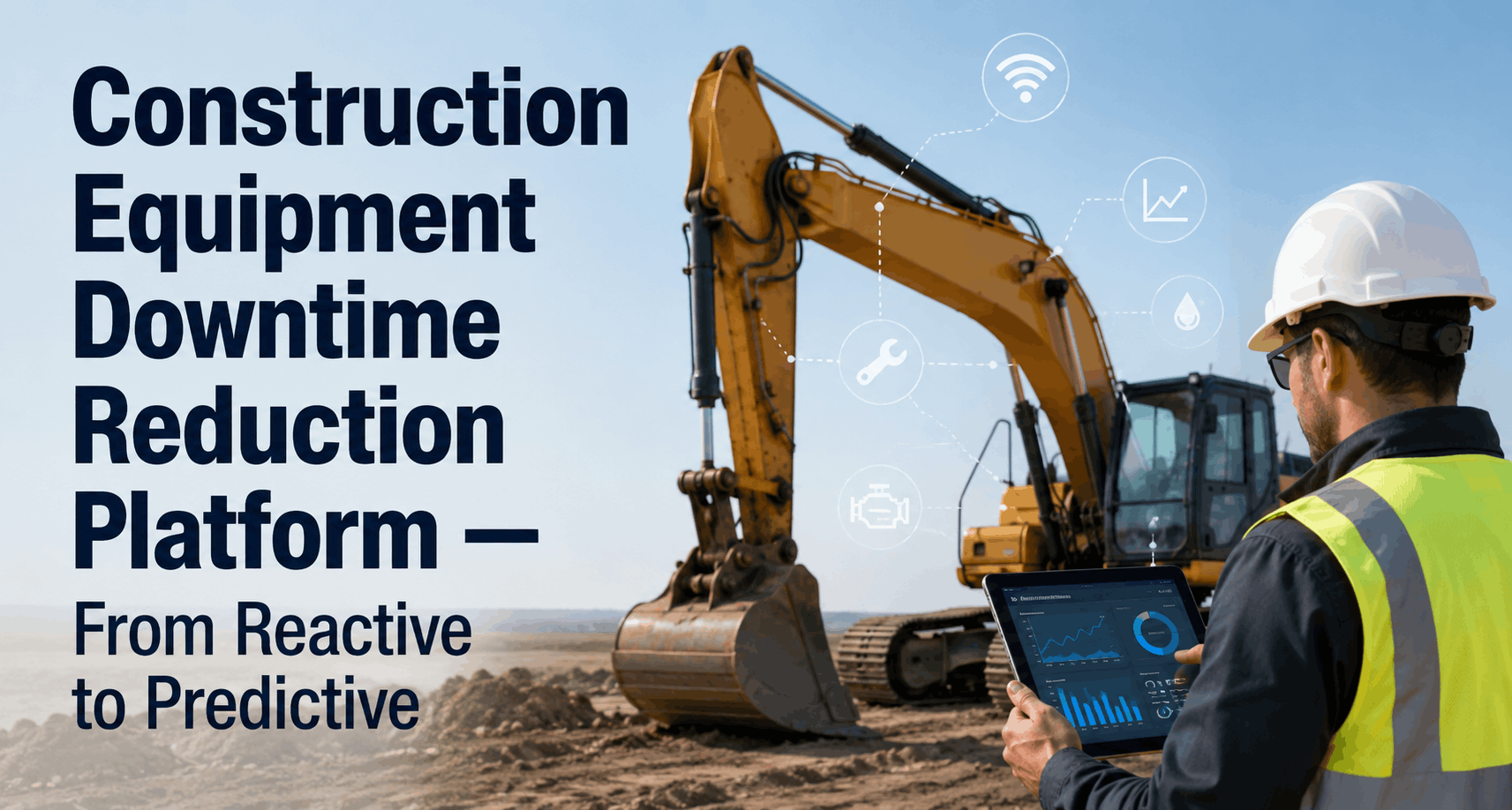
Unplanned equipment downtime is the single most expensive operational failure in construction — costing US and European contractors $1,000–$4,000 per idle machine per day in lost productivity, crew standby, and project delay penalties. For operators running excavators, cranes, and heavy haul fleets across Western job sites, the shift from reactive repair to predictive prevention is now the defining competitive advantage separating profitable contractors from break-even ones. Fleet Rabbit's predictive downtime platform gives construction operators real-time MTBF tracking, root-cause fault analytics, and automated work order generation — purpose-built to eliminate the equipment failures that kill project margins. Book a demo to see Fleet Rabbit's predictive platform applied to your equipment fleet.
Quick Answer
Construction equipment downtime reduction covers five core capabilities: real-time fault monitoring and MTBF tracking, predictive failure alerts before breakdowns occur, root-cause analytics by machine and failure type, automated work order generation, and utilization benchmarking by site and asset class. US and European construction operators using Fleet Rabbit reduce unplanned downtime 67%, cut emergency repair costs 40–55%, improve utilization 20–30%, and recover full ROI within 60–90 days.
The Downtime Cost Problem — What Reactive Maintenance Actually Costs
Most construction fleets operate reactively — equipment runs until it fails, then crews scramble to diagnose, source parts, and restore availability. This model is structurally incompatible with modern project timelines where a single excavator outage on a critical-path activity can trigger liquidated damages that dwarf the repair cost itself.
Emergency Repair Premium
Emergency parts sourcing costs 35–70% more than planned procurement — and mobile repair callouts on remote US or European job sites add $800–$2,200 in mobilization cost per incident. Reactive fleets pay this premium repeatedly on the same failure modes.
Crew Standby Cascade
A single excavator failure idles 4–8 downstream crew members at $45–$85/hr each. Over an 8-hour downtime event, standby alone costs $1,440–$5,440 before a single repair dollar is spent — making machine availability a labor cost multiplier, not just a maintenance metric.
Project Delay Exposure
European and US infrastructure contracts increasingly include liquidated damages clauses of $5,000–$25,000 per day for schedule overrun. Equipment downtime on critical-path activities converts directly into delay exposure — making the ROI case for predictive prevention straightforward at almost any platform cost.
Capability #1: Real-Time Fault Monitoring and MTBF Tracking
The foundation of downtime reduction is continuous visibility into equipment health — not weekly inspection reports, but live fault monitoring that captures degradation signals hours before a failure becomes a breakdown. Fleet Rabbit's telematics devices read OBD and CAN bus data from every machine, feeding a real-time dashboard that tracks fault history, MTBF by asset, and health trends across the entire fleet.
1
Live Fault Code Monitoring Across Every Asset
Fleet Rabbit monitors engine fault codes, hydraulic pressure anomalies, coolant temperature exceedances, and transmission error flags continuously — alerting site managers the moment a fault fires, not at the next scheduled inspection.
Colorado civil contractor, 44 machines. Pre-deployment downtime: 6.2 hrs per fault event. Post-deployment Month 2: 1.8 hrs — faults caught at alert stage, not failure stage. Annual saving: $310,000 in avoided emergency repair and standby cost.
2
MTBF Tracking by Asset and Equipment Class
Fleet Rabbit calculates Mean Time Between Failures by individual machine, equipment class, and site — identifying which excavators are underperforming their class average and require intervention before the next failure cycle repeats.
Excavators: 420–680 hr benchmarkCompactors: 380–540 hrsCranes: 290–420 hrs
3
Fleet Health Dashboard — Single View Across All Sites
Multi-site contractors operating across the US West or across European borders need consolidated visibility — not site-by-site spreadsheets. Fleet Rabbit surfaces the highest-risk machines fleet-wide so coordinators triage by actual failure probability, not geography or gut feel.
Target availability benchmark for US and European construction fleets: 92–95% mechanical availability. Fleets below 85% have a measurable reactive-maintenance problem solvable with Fleet Rabbit's predictive monitoring.
Predictive Monitoring + MTBF Analytics
Reduce Unplanned Downtime 67% — From the First Month of Deployment
Fleet Rabbit combines live fault monitoring, MTBF tracking, and root-cause analytics to eliminate the reactive maintenance cycle draining margin from US and European construction fleets.
40–55%
Emergency Repair Cost Cut
Capabilities #2–5: Predictive Alerts, Root-Cause, Work Orders & Utilization
Fault monitoring is the detection layer. The four capabilities that convert detection into downtime reduction are predictive failure forecasting, root-cause analytics, automated work order generation, and utilization benchmarking — together eliminating the delays between a fault signal and a resolved machine.
Capability #2: Predictive Failure Forecasting — Alert Before Breakdown
How prediction works: Fleet Rabbit's AI models analyze fault code patterns, operating hour trends, temperature exceedances, and load cycle data to forecast failure probability — flagging machines at elevated risk 24–96 hours before a likely breakdown event.
What it prevents: Hydraulic failures, which account for 28–34% of heavy equipment downtime on US and European sites, show consistent precursor signals — pressure fluctuation, fluid temperature drift, cycle time degradation — that predictive models catch before catastrophic failure.
Outcome: Contractors using Fleet Rabbit's predictive alerts convert 60–75% of what would have been emergency breakdowns into planned maintenance interventions — at 40–55% lower total cost with zero crew standby impact.
Capability #3: Root-Cause Analytics — Stop Fixing the Same Fault Twice
The repeat failure problem: US and European fleets report that 30–45% of equipment breakdowns are recurrences of the same fault — indicating root cause was never resolved, only the symptom. Fleet Rabbit's fault history analytics surface these repeat patterns by machine, fault code, and operating context.
How Fleet Rabbit identifies root cause: By correlating fault events with operating conditions — load, temperature, operator ID, terrain — the platform identifies whether a recurring hydraulic fault is a component defect, an operator behavior pattern, or a site overload requiring a different machine assignment.
European compliance context: EU machinery directive requirements for fault documentation are satisfied automatically through Fleet Rabbit's fault log export — reducing compliance audit preparation from days to minutes.
Capability #4: Automated Work Orders — Zero Gap Between Alert and Action
The execution gap: In reactive programs, average time between a fault identified and a work order created is 4–18 hours — driven by manual reporting chains, shift handovers, and dispatcher overload. Fleet Rabbit eliminates this gap by auto-generating work orders the moment a fault alert fires.
What auto-generation includes: Machine ID, site location, fault code with diagnostic context, recommended action, parts reference, and priority level — giving maintenance coordinators everything needed to dispatch without an additional diagnostic call.
Parts pre-positioning: For remote US Western or Alpine European sites, Fleet Rabbit's 24–96 hour predictive window gives the lead time to pre-position components — eliminating the 1–3 day parts-sourcing delay that extends most emergency repairs.
Capability #5: Utilization Benchmarking — Right Machine, Right Site
The underutilization drain: Industry data shows 35–45% of construction equipment sits idle on any given day across US and European fleets — generating ownership cost and depreciation with no productive output. Fleet Rabbit's analytics show actual productive hours by machine, site, and operator versus available hours.
Fleet right-sizing: Utilization data identifies machines consistently below 40% productive use — candidates for redeployment, short-term rental-out, or disposal. US contractors reducing fleet size 10–15% through utilization-driven right-sizing reduce annual ownership cost $180,000–$420,000 on a 50-machine fleet.
Rental optimization: Knowing which machines are consistently at capacity before a project spike enables data-driven rental decisions — supplementing owned assets at peak demand rather than carrying excess fleet at full ownership cost year-round.
Platform ROI: The Combined Downtime Reduction Impact
67%
Unplanned Downtime Reduction
40–55%
Emergency Repair Cost Cut
20–30%
Utilization Improvement
92–95%
Target Availability Rate
60–75%
Breakdowns → Planned Repairs
60–90
Days to Full Platform ROI
Frequently Asked Questions: Construction Equipment Downtime Reduction
QWhat equipment types does Fleet Rabbit's predictive platform support?
Fleet Rabbit supports the full range of construction equipment — excavators, wheel loaders, bulldozers, motor graders, compactors, cranes, aerial work platforms, and heavy haul trucks — across major OEMs including Caterpillar, Komatsu, Volvo CE, Liebherr, Hitachi, and John Deere. OBD and CAN bus telematics devices install without custom wiring on equipment manufactured after 2008, with adapter kits available for older machines common on legacy European fleets.
QHow does predictive maintenance work for remote US and European job sites?
Remote site operations are where predictive maintenance delivers its highest ROI — because emergency repair mobilization to a Montana mining site or an Alpine tunnel project costs 3–5x more than the same repair at an accessible location. Fleet Rabbit's predictive alerts provide 24–96 hours of advance warning on most failure modes, giving coordinators the window to pre-position parts before the repair is needed. For sites with intermittent connectivity, telematics devices store data locally and sync when connection is restored.
QHow long does it take to see downtime reduction after deployment?
Most fleets see measurable downtime reduction within the first 30 days — from fault alerts catching developing issues before they become breakdowns. The full 67% downtime reduction benchmark reflects 90-day performance, once predictive models have accumulated enough fleet-specific fault history to optimize failure probability scoring. Work order automation reduces diagnostic-to-dispatch time from the first week of deployment, regardless of predictive model maturity.
QDoes Fleet Rabbit integrate with existing ERP and maintenance management systems?
Fleet Rabbit integrates with major construction ERP and CMMS platforms including SAP, Oracle, Procore, Viewpoint, and Trimble — pushing fault alerts and auto-generated work orders directly into existing maintenance workflows. For European operators, Fleet Rabbit's API supports custom integration with standard REST endpoints, and fault log data exports in formats compatible with ISO 55001 asset management documentation requirements.
Related Fleet Rabbit Resources for Construction Fleet Operators
The four AI capabilities transforming construction fleet management — real-time GPS visibility, predictive health monitoring, dynamic dispatch optimization, and utilization analytics — with ROI data for each.
AI-driven fault prediction and automated maintenance scheduling that prevents mid-project breakdowns — the full technical breakdown of how Fleet Rabbit's predictive engine works across heavy equipment classes.
How real-time utilization tracking, idle reduction analytics, and fleet right-sizing data reduce total ownership cost — directly applicable to construction equipment downtime and asset optimization programs.
How GPS hardware, IoT sensors, and cloud analytics combine to deliver real-time equipment visibility, fault monitoring, and predictive maintenance — the technology stack behind Fleet Rabbit's downtime reduction platform.
Reduce Construction Equipment Downtime 67% — See Fleet Rabbit's Predictive Platform in Action
Fleet Rabbit delivers all five capabilities through one integrated system — real-time fault monitoring, MTBF tracking, predictive failure alerts, root-cause analytics, and automated work orders working simultaneously across your entire construction equipment fleet. US and European operators recover full platform investment within 60–90 days through avoided emergency repair and standby costs alone.
67% Downtime Reduction
40–55% Lower Emergency Repair Cost
Live Fault Monitoring
Auto Work Orders
60–90 Day ROI
May 27, 2026
By Lebron
All Posts