A bulldozer loses power mid-grade. An excavator's engine light comes on and nobody on site knows what it means. By the time a technician gets there, what could have been a $40 sensor replacement has become a derated engine, a stalled crew, and a job site standing still while the bill climbs. Construction equipment generates a constant stream of engine fault codes through its OEM telematics system, and most of that data sits unused until a machine actually breaks down. The fleets getting ahead of this in 2026 are not ignoring the noise, they are scoring it, routing it, and turning it into work orders before a fault ever becomes a failure.
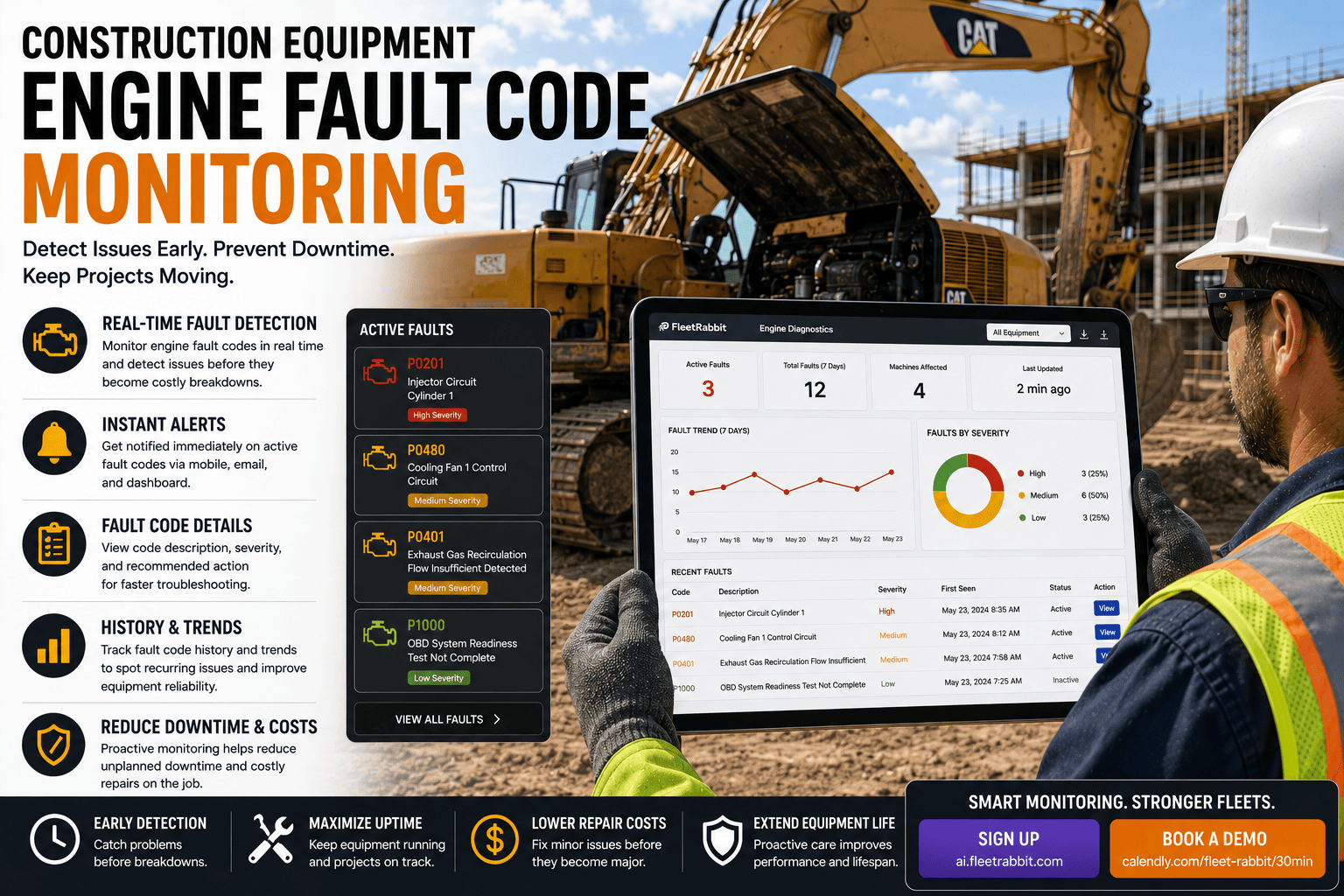
Engine fault code monitoring pulls diagnostic trouble codes directly from a machine's OEM telematics system in real time, scores them by severity, and alerts maintenance teams before a developing issue causes a breakdown or derate. Fleets doing this see fault notifications within minutes instead of days, gain a 5 to 7 day early warning on developing failures, and reduce catastrophic breakdowns by as much as 80 percent through proactive maintenance triggered by fault patterns.
How Engine Fault Codes Signal Trouble Before Failure
Modern construction equipment reports diagnostic trouble codes through standard protocols, most commonly J1939 SPN and FMI identifiers, straight from the engine control module to the OEM telematics platform. A well-configured monitoring system pulls these codes automatically, often every 15 minutes, alongside GPS location and utilization data, which means a fault can be seen and triaged long before an operator even notices something is wrong.
Not Every Code Deserves the Same Response
A raw feed of every fault code a machine generates is not useful on its own. Severity scoring is what separates a minor sensor drift that can wait for the next scheduled service from a critical fault that needs a technician on site today. Sign up to see how FleetRabbit turns hundreds of raw codes into a short list of items someone actually needs to act on.
| Severity Level | Example Trigger | Recommended Action |
|---|---|---|
| Critical | High engine temperature, low oil pressure | Immediate shutdown and technician dispatch to prevent major damage |
| Serious | NOx or DEF sensor fault, active for one drive cycle | Schedule repair within days to avoid an automatic derate |
| Moderate | Fuel efficiency drift, minor pressure anomaly | Flag for the next scheduled maintenance window |
| Informational | Routine operational codes, self-clearing faults | Log for pattern tracking, no immediate action needed |
FleetRabbit connects to your existing OEM telematics and scores every fault code automatically, so your team sees the handful that matter instead of a wall of noise. Sign up to see your fleet's fault code feed sorted by priority.
What Happens When Fault Codes Get Ignored
A construction firm once lost significant productivity to a bulldozer that kept losing power and running inefficiently on site. The cause traced back to a NOx sensor circuit fault that had been active for some time before anyone treated it as urgent, and by the time it was addressed, the machine had already been running derated and burning excess fuel for days.
The Two Drive Cycle Rule
Emission-focused engines are designed to protect themselves when certain sensor codes go unresolved. If a DEF level or NOx sensor fault remains active for two drive cycles, the engine control module can automatically derate the machine, sometimes cutting horsepower by as much as 60 percent. What started as a low-cost sensor issue turns into a machine that cannot do the job it was brought to the site for.
Fuel Efficiency Is an Early Casualty
Long before a derate kicks in, a developing fault already costs money quietly. A machine running with worn fuel injectors, a partially clogged filter, or an early-stage derate condition can burn 8 to 14 percent more fuel than a healthy unit doing the same work, and without a baseline to compare against, that extra cost simply looks like normal fuel usage.
Warranty Coverage Can Be at Risk Too
Some manufacturers can deny warranty claims if telematics data shows a machine ran repeatedly with an active severe fault code. Clearing a code without actually fixing the underlying issue does not just risk a breakdown, it can cost the fleet the warranty protection it was counting on.
Turning Fault Code Noise Into Action
The value of fault code monitoring is not in collecting more data, it is in closing the gap between a code appearing and a technician resolving it. That means routing critical and serious codes directly into a work order, without anyone manually transcribing a code number from a dashboard into a service ticket.
FleetRabbit integrates with major OEM telematics platforms across construction equipment brands, so critical faults are captured, scored, and routed without your team stitching data between spreadsheets. Book a demo to see it working with your equipment mix.
Why This Matters More on Mixed Equipment Fleets
Construction fleets rarely run a single brand of equipment. A job site might mix excavators, loaders, and dozers from several manufacturers, each reporting fault codes through its own telematics system with its own code definitions. Without a unified dashboard, maintenance teams end up checking multiple portals separately, missing patterns that would be obvious if the data lived in one place.
Cross-Brand Pattern Recognition
A code that looks like an isolated incident on one machine can be part of a recurring pattern across an entire equipment class once the data is pulled together. Recognizing that pattern early is what turns a reactive repair culture into a genuinely preventive maintenance program.
A fault code is not just a nuisance number on a dashboard, it is often the earliest and clearest signal a machine gives before something expensive goes wrong. Ignoring that signal because there are too many codes to read manually is how a $40 sensor issue turns into a derated machine, a stalled crew, and a repair bill nobody planned for. Construction fleets that connect their OEM telematics to a system built to score and route these codes automatically are catching problems days before they cost a job site its schedule.
FleetRabbit pulls fault codes directly from your equipment's OEM telematics, scores every code by severity, and routes critical issues into a work order automatically. See it running against your own fleet's data.