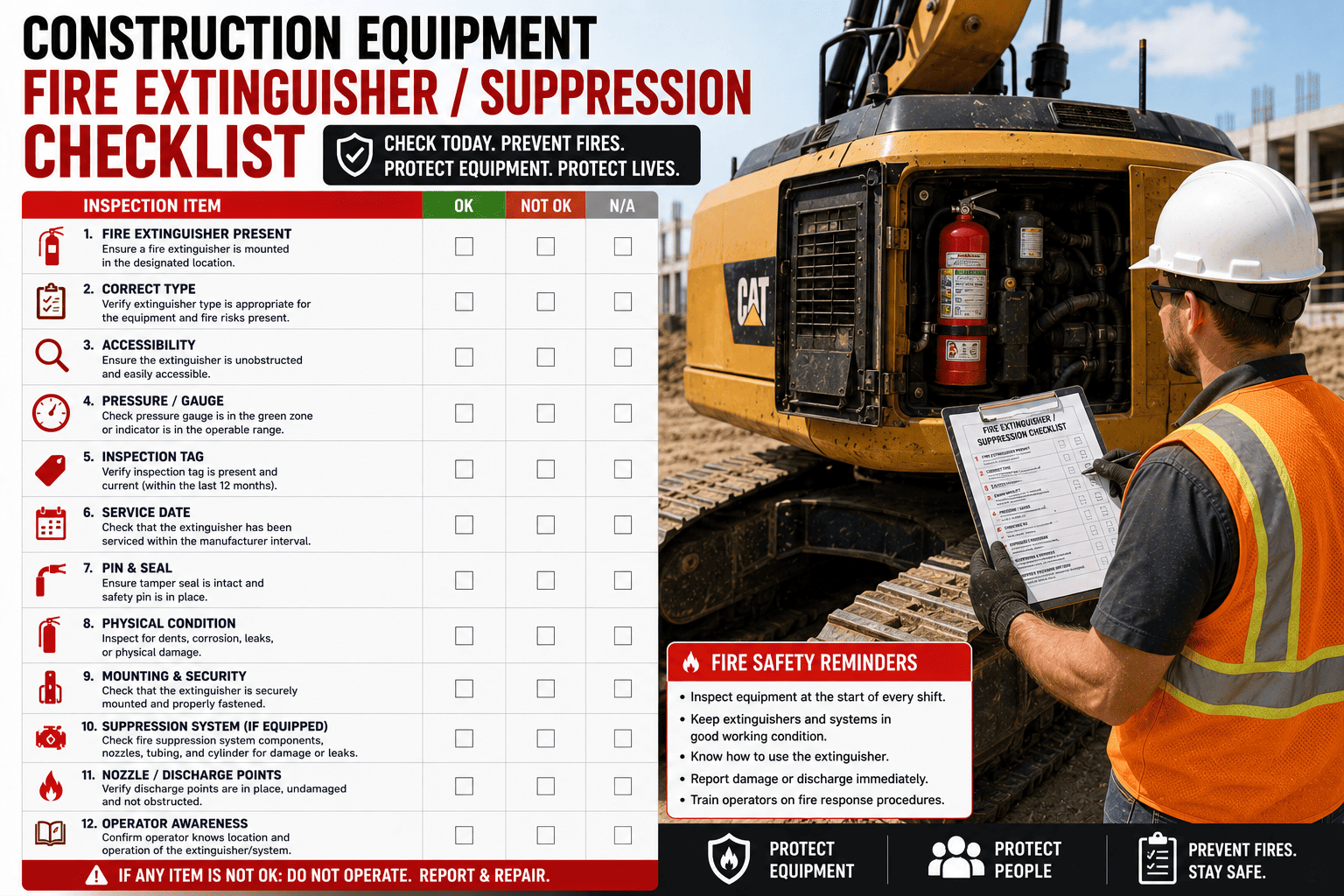
A grease fire under an excavator's engine cowling doesn't wait for permission. It takes about ninety seconds for a small hydraulic leak igniting on a hot manifold to turn into a total-loss fire that swallows a 300,000 dollar machine, and the only thing standing between that spark and a burned-out hull is a fire extinguisher that actually works when someone pulls the pin. Most jobsite fire losses trace back to the same root cause: an extinguisher that was present but expired, undercharged, or missing its inspection tag. This checklist walks through exactly what a compliant, effective fire suppression inspection looks like on a construction fleet, and how to stop finding out equipment failed only after the fire trucks arrive.
Every piece of construction equipment needs a monthly visual fire extinguisher check and an annual professional maintenance inspection, per OSHA 1926.150 and NFPA 10. On-board suppression systems on heavy machinery need pressure, nozzle, and detection checks on a similar cycle. Fleets that formalize this into a digital, scheduled inspection program cut equipment fire losses dramatically and stay audit-ready year-round.
Why Fire Suppression Inspections Belong On Your Maintenance Calendar
Construction equipment runs hot, dirty, and under constant vibration, which is exactly the environment fires love. Hydraulic fluid carries a flash point around 400 degrees Fahrenheit and an auto-ignition point near 650 degrees, well within reach of an engine compartment or turbocharger. Add in diesel fuel lines, accumulated debris, and loose electrical connections that arc under vibration, and it becomes clear why heavy equipment fires are common enough that entire forensic firms specialize in investigating them. The extinguisher or suppression system on that machine is the only thing standing between a contained flare-up and a total loss.
What A Compliant Inspection Actually Covers
OSHA 1926.150 requires that firefighting equipment on a construction site be periodically inspected and kept in operating condition, and NFPA 10 sets the technical bar for how that inspection is performed. In practice, that standard breaks into two distinct inspection tiers, each with its own frequency and its own responsible party.
Monthly Visual Inspection
Anyone trained to do so can perform this check, and it should take only a few minutes per unit. It confirms the extinguisher is in its designated bracket on the machine, that the pressure gauge needle sits in the green zone, that the pull pin and tamper seal are intact, and that the shell shows no dents, corrosion, or leakage. The inspector notes the date on the tag and moves to the next machine.
Annual Professional Maintenance
A certified technician performs a deeper examination once a year: verifying the extinguishing agent, testing mechanical parts, confirming correct weight, and replacing any unit that fails. Certain extinguisher types also require six-year internal exams and twelve-year hydrostatic testing, so tracking service life by unit, not just by site, keeps a fleet from missing a cycle.
On-Board Suppression System Checks
Larger machines, especially in mining, forestry, and waste operations, often run fixed automatic suppression systems in the engine bay. These need their own inspection routine covering detection wire integrity, nozzle positioning, agent tank pressure, and manual pull-station function, since a suppression system that discharges into an empty tank is worse than having no system at all.
FleetRabbit tracks every extinguisher and suppression system by unit, flags overdue inspections before they lapse, and keeps a digital record ready for any fire marshal or insurance audit. Sign up free and put your entire fleet's fire safety on one dashboard.
The Field Checklist: Point By Point
Print this or load it into a digital form, but either way run through every point in order on every unit. Skipping a line item is how a machine ends up carrying a discharged extinguisher for six months without anyone noticing.
| Checklist Item | What To Verify | Frequency | Fail Action |
|---|---|---|---|
| Location and mounting | Extinguisher is in its assigned bracket, not stowed loose or removed for another task | Monthly | Return to bracket, tag machine out of service if missing |
| Accessibility | Not blocked by tools, hoses, or cab clutter; reachable in seconds | Monthly | Clear obstruction immediately |
| Pressure gauge | Needle sits in the green zone, not yellow or red | Monthly | Remove unit, send for recharge |
| Pin and tamper seal | Pull pin present, seal unbroken | Monthly | Replace unit, investigate cause |
| Shell condition | No dents, corrosion, rust, or leakage around the base | Monthly | Condemn and replace unit |
| Agent verification and weight | Full charge confirmed by certified technician, including CO2 units that require weighing | Annual | Recharge or replace per technician findings |
| Suppression system detection line | Heat-sensitive tubing or wire runs intact, not chafed against sharp edges | Quarterly | Reroute or replace line before returning machine to service |
| Engine bay debris | No accumulated grease, sawdust, leaves, or oily rags near hot surfaces | Weekly | Clean before next shift |
Building This Into Your Fleet's Routine
Assign Ownership By Machine, Not By Site
When inspection responsibility is tied to a physical location rather than a specific machine, units that move between sites slip through the cracks. Attach the inspection record to the equipment's own identity so it follows the machine everywhere it works.
Pair It With Existing Preventive Maintenance Stops
Fire suppression checks take a few extra minutes and fit naturally into a technician's existing service visit. Bundling it with routine maintenance avoids adding a separate trip to the schedule and keeps compliance from becoming its own burden.
What Good Documentation Looks Like
A dated tag on the extinguisher is the bare minimum. A defensible record shows who performed the check, what was found, what corrective action followed, and when the next check is due, all searchable the moment an insurance adjuster or fire marshal asks for it.
Where Digital Tracking Pays Off
Paper tags get lost, smudged, or simply never filled in during a busy shift. A digital system flags overdue units automatically, so a supervisor sees the gap before a fire does, not after. Teams that book a demo with FleetRabbit typically move their entire fleet onto scheduled, trackable inspections within the first week.
FleetRabbit assigns fire safety checks to each unit, sends reminders before they lapse, and keeps a full audit trail without a single paper tag. Book a 30-minute demo and see how it fits your current maintenance workflow.
Frequently Asked Questions
Fire doesn't wait for the next scheduled service visit. Put every extinguisher and suppression system on your fleet under one automated tracking system, catch lapses before they become losses, and keep an audit-ready record without the paperwork.