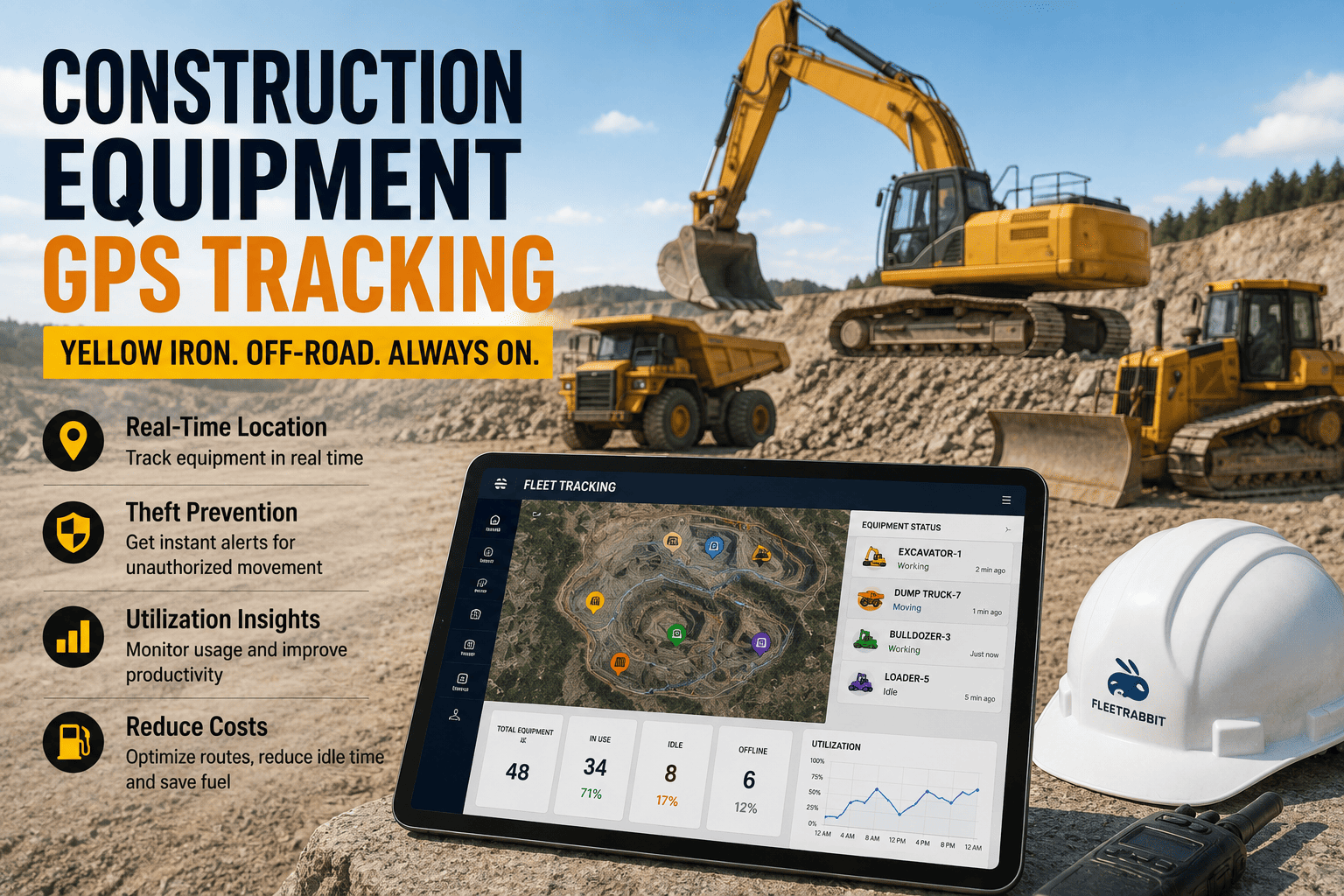
An excavator parked overnight on a remote job site is invisible to almost everyone except the crew that left it there, and that is exactly what makes yellow iron such an easy target. No cell towers nearby, no fence, no camera, just a 150,000 dollar machine sitting in the open until Monday morning. GPS tracking built for off-road conditions is what turns that same machine from an easy target into a monitored asset that reports back the moment something is wrong.
Construction equipment theft costs the US industry an estimated 300 million to 1 billion dollars a year, with an average loss near 30,000 dollars per incident, and fewer than 1 in 5 stolen machines are ever recovered without GPS tracking. Tracked equipment is recovered several times more often, and GPS tracking can reduce theft attempts by up to 85 percent through visible deterrence alone. Off-road environments add a second challenge beyond theft: cellular coverage often disappears entirely on remote sites, which is why dual-mode systems combining cellular and satellite connectivity matter as much as the tracker itself.
Why Yellow Iron Is the Easiest Target on Any Job Site
Unlike a passenger vehicle, heavy equipment rarely carries a standardized identification number, sits unattended on open sites for days at a time, and can be repainted or stripped for parts almost as soon as it disappears. Those conditions are exactly why the recovery math looks so grim without tracking in place. Fewer than one in five stolen machines is ever recovered when no GPS device is installed, and the average claim exceeds 30,000 dollars per incident once a machine goes missing.
The timing makes the problem worse for off-road and remote sites specifically. Roughly 70 percent of heavy equipment theft happens over the weekend, when crews are gone and job sites sit completely unattended from Friday evening through Monday morning, the exact window where a machine parked miles from the nearest paved road has no witnesses at all.
The Recovery Math Changes Completely With Tracking
Equipment fitted with active GPS tracking is recovered several times more often than untracked machines, and one industry study found that 69 percent of stolen construction equipment that was ultimately recovered had some form of tracking technology installed. The pattern is consistent across nearly every dataset available: tracking does not stop every theft attempt, but it turns what would otherwise be a total loss into a solved case, often within the first day rather than never.
| Statistic | Figure | What It Means for Off-Road Fleets |
|---|---|---|
| Annual Industry Loss | 300 million to 1 billion dollars | A persistent, industry-wide cost that lands hardest on contractors running remote or unattended sites |
| Recovery Rate Without GPS | Under 21 percent | Fewer than 1 in 5 stolen machines make it back without active tracking in place |
| Theft Timing | Roughly 70 percent on weekends | Remote sites sit unattended longest exactly when theft risk peaks |
| Theft Reduction With GPS | Up to 85 percent | Visible tracking devices deter attempts before they happen, not just after |
FleetRabbit combines GPS location, geofencing, and instant alerts so you know immediately if a machine leaves the yard or crosses a site boundary after hours. Sign up free to start tracking your fleet today, or book a demo to see how geofencing works across remote and off-road sites.
The Connectivity Problem Standard Trackers Don't Solve
Off-road tracking has a second challenge that never comes up on a paved city job site: cellular coverage simply does not exist across large stretches of rural, mountainous, or remote construction terrain. A GPS chip can calculate a machine's exact position anywhere on the planet using satellite signals, but getting that position back to a fleet dashboard requires a data connection, and that is precisely where standard cellular-only trackers fail on remote sites.
Why Dual-Mode Tracking Matters for Yellow Iron
Systems that combine cellular connectivity with satellite fallback keep reporting location even when a machine works far outside normal coverage, automatically switching to whichever network is available at that moment. This matters most for exactly the fleets facing the highest theft risk, since remote equipment and weak cellular coverage tend to overlap on the same job sites.
How Passive Tracking Fills the Gaps
When a connection genuinely cannot be reached, passive tracking stores location data locally and uploads the complete history the moment coverage returns, so a full trip log survives even a multi-day stretch in a dead zone rather than leaving a blank spot in the record.
Utilization Data Is the Bonus Most Fleets Underuse
The same tracking hardware that protects against theft also answers the operational question every fleet manager gets asked constantly: is a specific machine available, and how much has it actually run this month. Engine hours and idle time captured alongside location turn a security tool into a utilization tool at no extra cost.
Turning Idle Time Into a Redeployment Decision
A machine sitting unused on one site while another crew waits on equipment is a scheduling problem hiding in plain sight. Utilization data surfaces that gap immediately, instead of a supervisor discovering it weeks later during a slow month.
FleetRabbit keeps location data flowing even where cellular coverage disappears, so your excavators, dozers, and loaders stay visible on the most remote sites you work. Start your free trial now, or book a demo to see how tracking performs on off-road terrain.
What to Look For in a Rugged Tracking Setup
Not every tracker built for a passenger vehicle survives a season on a construction site. Dust, mud, vibration, and long stretches without a power source all shorten the life of consumer-grade hardware fast. A tracking system built for yellow iron needs a rugged, weatherproof housing, a power source that lasts through extended equipment idle periods, and reporting intervals that adjust automatically, sending frequent updates while a machine moves and slower pings while it sits still to conserve battery life.
Frequently Asked Questions
Remote sites should not mean invisible equipment. FleetRabbit tracks your excavators, loaders, and dozers with real-time location, geofencing, and dual-mode connectivity built for the terrain you actually work in.