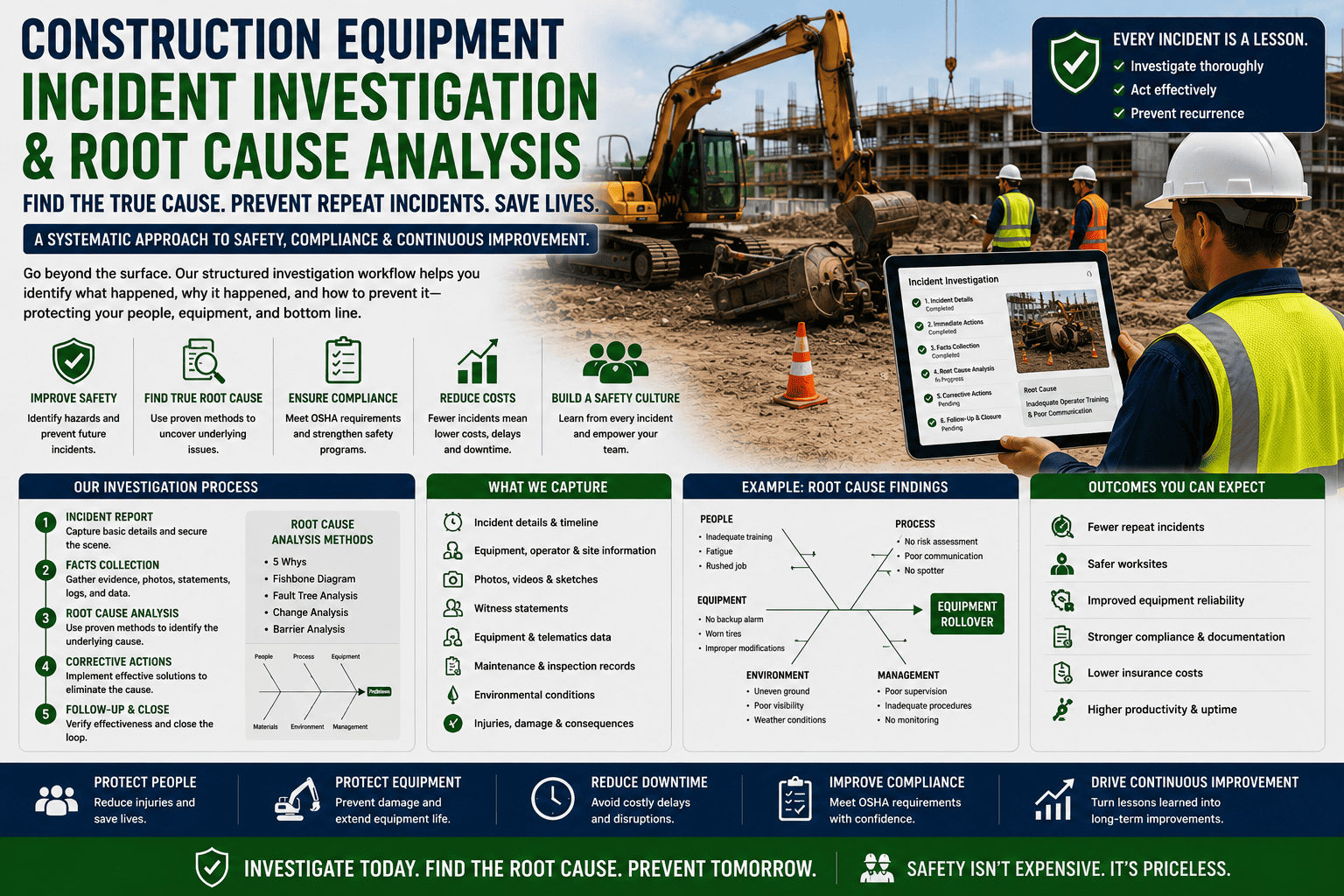
Construction Equipment Incident Investigation and Root Cause Workflow

construction-equipment-incident-investigation-root-cause

An excavator swings into a trench wall and a worker is hurt. The easy answer shows up in minutes: the operator moved too fast. The real answer usually takes longer, and it's rarely that simple. Maybe the operator was never trained on that specific attachment. Maybe the spotter was pulled to another task an hour earlier. "Operator error" closes the incident report, but it doesn't stop the next one. Root cause analysis does.

Quick Answer

A defensible equipment incident investigation follows a systems approach: preserve the scene, collect evidence, determine root causes using a structured method like 5 Whys, then implement corrective action. The goal is finding the underlying process failure, not just the immediate human action. Sign up for FleetRabbit to pull inspection and equipment data the moment an investigation starts, or book a demo to see how the evidence comes together.

35%
Share of construction worker deaths caused by falls
18%
Share of all workplace fatalities occurring in construction
8 Hours
Deadline to report a work-related fatality to OSHA
2-5 Whys
Typical number of questions needed to reach a fixable root cause

The Systems Approach vs. the Blame Instinct

The natural response to an equipment incident is to look for the person closest to it. Someone was operating the machine, so the operator becomes the answer. OSHA's guidance pushes hard against this instinct, and for good reason: stopping at human error almost always means missing the conditions that made the error possible in the first place. A systems approach assumes the root cause traces back to a failure in how safety is actually managed, not a single moment of carelessness.

Why "Operator Error" Rarely Holds Up

Investigations that stop at the first plausible explanation tend to close fast and repeat later. If an operator swung an excavator too close to a trench wall, the deeper question is why that was possible: was the operator certified on that specific machine, was the spotter position staffed at the time, was visibility around the trench ever assessed. Human behavior is almost always part of the story, but it's rarely the root cause on its own.

The Four-Step Investigation Workflow

A consistent, repeatable process protects both the investigation's quality and your company's position if the incident is later reviewed by OSHA or an attorney.

1
Preserve and Document the Scene
Provide medical care first, then secure the area, photograph the equipment and surroundings, and capture conditions before anything is moved or altered.
2
Collect Information
Gather witness statements, maintenance logs, inspection records, training history, and any telematics or equipment data tied to the moment of the incident.
3
Determine Root Causes
Apply a structured method, such as 5 Whys or a fishbone diagram, to trace the incident past its immediate cause to the underlying system failure.
4
Implement Corrective Action
Assign a specific owner and deadline to each fix, then verify the action was actually completed and the same failure pattern doesn't recur.
Start an Investigation With Data Already Waiting
Pull Equipment History the Moment You Need It

FleetRabbit keeps inspection records, maintenance history, and operator certifications organized by vehicle, so step two of an investigation takes minutes instead of days. Sign up to see your fleet's history today, or book a demo to see how records are pulled during a live investigation.

Following the Why Chain to a Real Root Cause

The 5 Whys technique is simple by design: state the problem, ask why it happened, then keep asking why to each new answer until you land on something systemic enough to actually fix. Most investigations reach a usable root cause somewhere between the second and fifth question.

Incident
A worker was struck by material that fell from an unsecured load on a flatbed trailer.
Why 1
The load shifted during transport because it wasn't strapped correctly.
Why 2
The operator wasn't aware of the correct strapping procedure for that load type.
Why 3
Load securement training hadn't been refreshed since the operator was first hired.
Root Cause
No recurring load securement training existed in the safety program for this vehicle type.

Fishbone Diagrams for More Complex Incidents

When an incident has several contributing factors instead of one clear thread, a fishbone diagram is often more useful than a single chain of whys. It sorts potential causes into categories, typically people, equipment, environment, process, and management, which helps a team spot how multiple small failures combined rather than forcing everything into a single linear explanation.

The Evidence That Makes or Breaks an Investigation

Step two of the workflow, collecting information, is where most investigations either come together quickly or stall for days. The evidence that matters most is rarely hard to find; it's just often scattered across different systems and people.

Pre-Trip Inspection Records
Shows whether the equipment was checked before operation and whether any defects were already flagged.
Maintenance History
Reveals whether known issues with the specific vehicle were addressed or left outstanding.
Operator Certification
Confirms whether the person operating the equipment was actually qualified for that specific machine.
Telematics and Timestamps
Provides an objective timeline of vehicle activity, speed, and location around the moment of the incident.

Investigations move fastest when this evidence is already organized before anything happens, rather than reconstructed under pressure once it does. FleetRabbit keeps inspection records, maintenance history, and operator certifications tied to each vehicle automatically, so an investigation team can move straight to root cause analysis instead of spending the first two days just tracking down paperwork. Sign up for a free trial to organize your fleet's records today, or book a demo to see how evidence is retrieved during a real investigation.

Incident Investigation Root Cause Analysis Construction Safety 5 Whys Method Equipment Safety Records Jobsite Investigation

Frequently Asked Questions

QWhat's the difference between an immediate cause and a root cause
An immediate cause is the direct action or condition that triggered the incident, like a load shifting. A root cause is the underlying system failure that allowed that condition to exist, like missing or outdated training. Fixing only the immediate cause tends to leave the root cause free to cause the next incident.
QDoes OSHA require a specific root cause analysis method
No. OSHA requires employers to investigate incidents and identify root causes but doesn't mandate a specific technique. Methods like 5 Whys and fishbone diagrams are widely recommended because they're structured, repeatable, and easy to document.
QWho should be involved in an equipment incident investigation
The most effective investigations involve both managers and the workers closest to the equipment and process, since each brings different knowledge. A supervisor alone often misses operational details that only the crew would know.
QHow quickly does equipment data need to be pulled after an incident
As soon as possible. Inspection and maintenance records are strongest evidence when they were created before anyone knew an incident would happen. Sign up for FleetRabbit to make sure that history is already organized and ready to pull.
QWhat happens if a root cause investigation isn't documented well
Incomplete investigations or a failure to take corrective action can expose an employer to more serious penalties, since it can look like a known hazard was left unaddressed. A documented investigation timeline, evidence, and completed corrective actions protects your position significantly.
QShould near misses get the same investigation as an actual incident
Yes, and near misses are often more valuable to investigate because they reveal the same system gap without anyone getting hurt. Book a demo to see how tracking near misses alongside equipment data helps catch patterns early.
Investigate Faster With Evidence Already in Place

FleetRabbit keeps inspection records, maintenance history, and operator certifications organized by vehicle, so your team can move straight to root cause analysis instead of chasing down paperwork after something goes wrong.

July 11, 2026 By John
All Posts

Share This Story, Choose Your Platform!

Latest Posts

Scroll