Every piece of construction equipment follows a predictable economic lifecycle — from the capital investment of acquisition through the productive years of peak utilisation, into the maintenance-intensive period where costs accelerate, and finally to the disposal decision that either recovers residual value or absorbs an avoidable loss. Fleet managers who track this lifecycle systematically make better decisions at every phase: they negotiate better acquisition terms because they have historical cost data from similar assets, they time preventive maintenance investments to extend the productive window, they identify the optimal disposal point before maintenance costs exceed the asset's operating value, and they build replacement forecasts based on actual fleet performance rather than manufacturer estimates. This article explains how FleetRabbit manages each phase of the construction equipment lifecycle — and how the data generated in each phase feeds the decisions required in the next. Book a lifecycle management assessment with our fleet analytics team.
FleetRabbit Lifecycle Intelligence
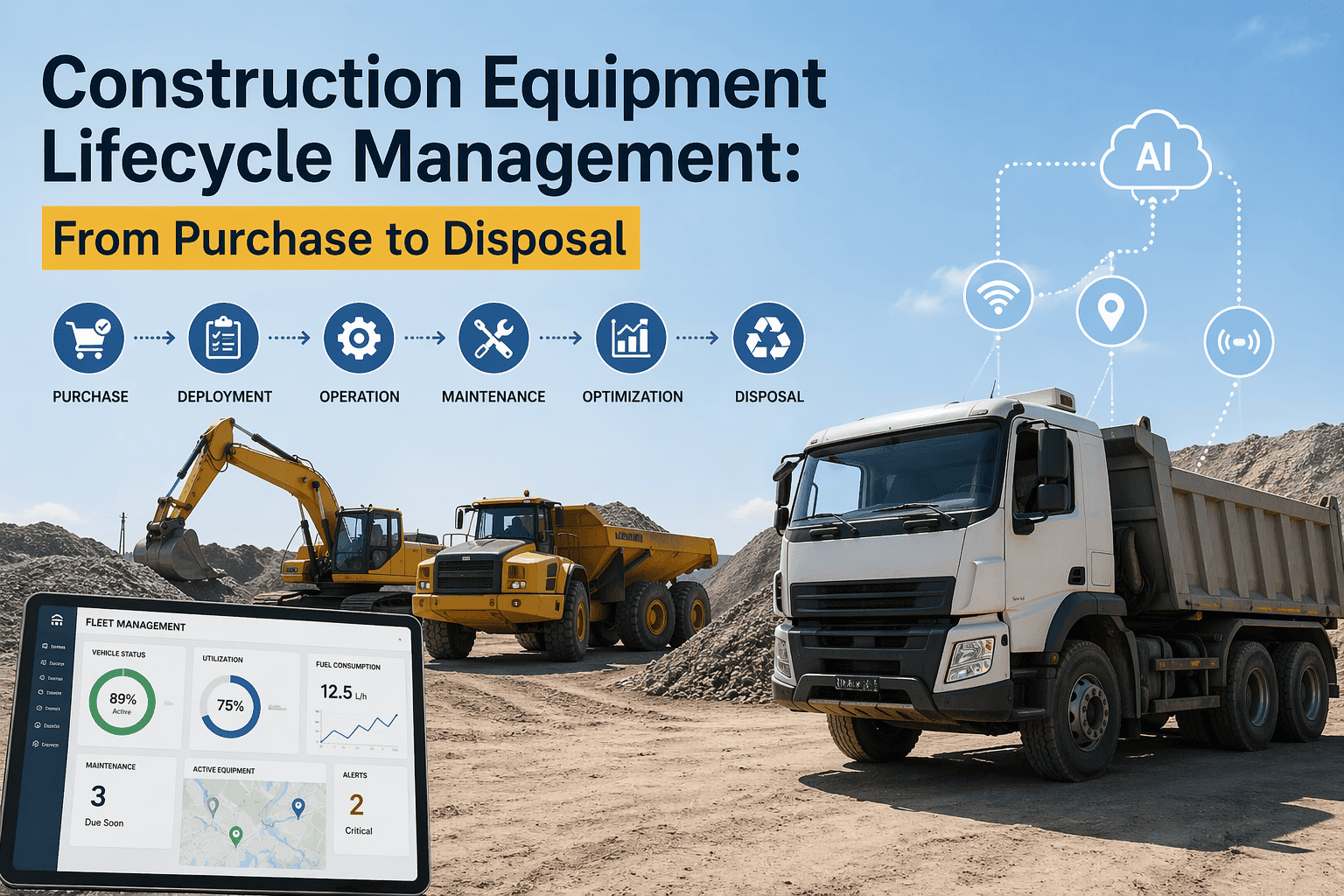
Construction Equipment Lifecycle Management: From Purchase to Disposal
A complete framework for managing every phase of the equipment lifecycle — covering acquisition cost benchmarking, commissioning and onboarding, productive life optimisation, maintenance cost trajectory monitoring, disposal timing analysis, and replacement planning — all tracked continuously in FleetRabbit.
01Acquire
02Commission
03Operate
04Monitor
05Dispose
06Replace
Phase 01 — Acquisition: Building the Cost Baseline
The lifecycle management process begins before the equipment arrives on site. The acquisition phase establishes the cost baseline against which every subsequent decision is measured — purchase price, financing terms, warranty coverage, and projected operating costs form the economic foundation that determines whether the asset will generate positive returns over its productive life.
01
Purchase Price & Financing Structure
FleetRabbit records the total acquisition cost including purchase price, delivery charges, sales tax, and any dealer-installed options — creating the capital baseline. For financed assets, the monthly payment schedule, interest cost, and residual value obligation are tracked alongside the physical asset record. For leased equipment, the lease term, monthly rate, and end-of-lease options (purchase, return, extend) are monitored with automatic alerts before decision deadlines.
02
Warranty Coverage & Expiry Tracking
Every warranty — powertrain, hydraulic, structural, and extended — is recorded with its expiry trigger (hours or calendar date, whichever comes first). FleetRabbit monitors engine hours against warranty thresholds and alerts the fleet manager 90 days, 60 days, and 30 days before each warranty expires — enabling strategic decisions about extended warranty purchases or accelerated inspection schedules before coverage ends.
03
Benchmark Cost-Per-Hour Target
At acquisition, FleetRabbit calculates a target cost-per-operating-hour based on the purchase price, projected annual utilisation, expected maintenance costs by age, and planned disposal timing. This benchmark becomes the standard against which actual operating costs are compared throughout the asset's life — the first signal that an asset is becoming uneconomic is when actual cost-per-hour consistently exceeds the acquisition benchmark.
Phase 02 — Commissioning: Building the Digital Record
Commissioning is the process of bringing a new or newly-acquired asset into the fleet's operational and compliance framework. A machine that arrives on site without being properly commissioned in FleetRabbit starts accumulating untracked hours, unrecorded fuel consumption, and compliance gaps from the first day of operation.
04
Telematics Connection & Data Verification
The first commissioning step is connecting the asset's telematics to FleetRabbit — either factory-fitted OEM telematics or an aftermarket unit installed during commissioning. Once connected, FleetRabbit verifies data flow: engine hours, GPS position, idle time, and fault codes all confirmed flowing correctly before the machine enters productive service. Data verification prevents the common problem of an asset operating for weeks before anyone notices the telematics connection failed.
05
Service Schedule Configuration
Every service interval from the manufacturer's maintenance schedule is entered in FleetRabbit — oil changes, filter replacements, hydraulic fluid changes, undercarriage inspections, and major component overhauls. Each interval is configured as engine-hour-based, calendar-based, or whichever-comes-first — and FleetRabbit begins tracking from the machine's current hour meter reading, not from zero, ensuring accurate service scheduling from the commissioning date.
06
Operator Assignment & Compliance Setup
The asset is assigned to its initial site and operator pool in FleetRabbit. Operator credential requirements for the equipment category are verified — certifications, medical cards, training records — and any gaps are flagged before the machine enters service. The pre-use inspection checklist for the equipment type is linked to the asset, and FleetRabbit begins requiring completed inspections before each operating shift.
FleetRabbit Lifecycle Platform
Every Asset Enters FleetRabbit With a Complete Digital Record — From Day One
FleetRabbit's commissioning workflow ensures every new asset enters the fleet with telematics connected, service schedules configured, warranty expiry alerts set, and operator compliance verified — creating a complete digital record from the first operating hour that feeds every subsequent lifecycle decision.
48hrTelematics connected
Day 1Complete digital record
AutoService schedule tracking
Phase 03 — Productive Life: Maximising Utilisation & Controlling Costs
The productive life phase is where the asset generates revenue — and where the daily operational decisions that determine lifetime profitability are made. FleetRabbit provides continuous visibility into the three metrics that define productive life performance: utilisation rate, fuel efficiency, and maintenance cost trajectory.
07
Utilisation Rate Monitoring
FleetRabbit tracks productive hours vs. total available hours for every asset continuously. The utilisation rate — expressed as a percentage — identifies assets that are earning their cost of ownership and assets that are underperforming. Fleet managers set target utilisation rates by equipment class and receive alerts when any asset falls below threshold for more than 5 consecutive operating days, enabling redeployment decisions before underutilisation compounds into wasted capital.
08
Fuel Consumption Tracking
Fuel is the largest variable operating cost in construction fleet management. FleetRabbit tracks litres-per-hour consumption for every asset, compares actual consumption against manufacturer benchmarks and the fleet's own historical baselines, and flags overconsumption above configured thresholds. Fuel overconsumption is both a cost issue and an early maintenance indicator — engines burning more fuel than baseline often have developing mechanical issues that will escalate if not investigated.
09
Preventive Maintenance Execution
Every service event completed on the asset is recorded in FleetRabbit with date, engine hours, work performed, parts used, labour hours, and total cost. The PM compliance rate — percentage of services completed on schedule — is tracked per asset and fleet-wide. Assets with PM compliance below 90% are flagged for review because missed preventive maintenance is the single strongest predictor of unplanned breakdown events and accelerated component wear.
Phase 04 — Cost Trajectory Monitoring: Identifying the Inflection Point
Every asset reaches an inflection point where maintenance costs begin accelerating faster than the asset's productive value. Identifying this inflection point accurately — and acting on it before costs compound — is the most valuable lifecycle management capability FleetRabbit provides. Fleet managers who rely on age or hours alone miss the inflection point because it varies significantly based on operating conditions, maintenance history, and duty cycle.
Early Life
0–3,000 hrs
Low & Predictable Costs
Warranty covers major components. Maintenance limited to scheduled services — oil, filters, greasing. Cost-per-hour at or below acquisition benchmark. FleetRabbit tracks costs but primary focus is utilisation optimisation during the highest-value operating window.
Mid Life
3,000–8,000 hrs
Increasing but Manageable Costs
Warranty expiring or expired. Undercarriage, hydraulic hoses, and wear components require replacement. Cost-per-hour rising but still within economic threshold. FleetRabbit flags the transition from warranty to full-cost maintenance and increases monitoring frequency on cost-per-hour trend.
Late Life
8,000–12,000+ hrs
Accelerating Costs — Disposal Window
Major component overhauls — engine, transmission, final drives — become due. Each event costs 30–60% of a similar new-asset purchase. FleetRabbit calculates whether the overhaul cost is recoverable over remaining productive life or whether disposal before the overhaul generates better fleet economics. This is the inflection point where data-driven fleet managers gain their largest cost advantage.
Phase 05 — Disposal: Recovering Maximum Residual Value
The disposal decision is binary: sell the asset while it still commands market value, or hold it until maintenance costs and declining reliability destroy its resale position. FleetRabbit provides the data that makes this decision objective rather than emotional.
10
Disposal Timing Analysis
FleetRabbit calculates the projected cost-per-hour for the next 12 months based on the asset's current maintenance trajectory, upcoming major service events, and historical cost acceleration rate. When the projected cost-per-hour exceeds the cost of a replacement asset (owned or rented), FleetRabbit flags the asset for disposal review. Fleet managers receive this alert while the asset still has market value — not after a catastrophic failure eliminates resale potential.
11
Complete Maintenance History Package
FleetRabbit exports a complete maintenance history for the disposal asset — every service event, every part replaced, every inspection record, and every defect correction documented with dates and engine hours. A machine sold with a complete, verifiable maintenance history commands 8–15% higher resale value than an identical machine sold without documentation. The FleetRabbit maintenance export is the highest-value document in the disposal process.
12
Replacement Planning & Capital Forecasting
When an asset is flagged for disposal, FleetRabbit simultaneously generates a replacement requirement — equipment category, required specifications, projected utilisation at the receiving site, and budget estimate based on current market pricing. Fleet managers build 12-month and 24-month capital replacement forecasts based on the fleet's actual cost trajectory data rather than arbitrary age-based replacement schedules that either replace too early (wasting remaining productive life) or too late (absorbing preventable maintenance costs).
From the Field
"We'd been replacing excavators on a 10,000-hour schedule regardless of condition — it was our company policy for 15 years. When we started tracking cost-per-hour in FleetRabbit, we discovered that three of our machines had hit the cost inflection point at 7,200 hours because they'd been working in abrasive conditions that accelerated undercarriage wear. We were running them for another 2,800 hours past the point where replacement would have been cheaper. On the other side, two machines running in less demanding conditions were still economically productive at 12,500 hours — we'd have replaced them 2,500 hours too early under the old policy. FleetRabbit's lifecycle data saved us $340,000 in the first year by timing five disposal decisions on actual cost data instead of a fixed hour target."
Fleet Director
·
Heavy Civil Contractor — 84 Assets — 6 Active Projects
Frequently Asked Questions
QHow quickly can FleetRabbit begin tracking lifecycle costs for an existing fleet?
For existing fleets, FleetRabbit can import historical maintenance records during onboarding — giving you retrospective cost-per-hour data from the asset's acquisition date. Real-time cost tracking begins immediately once telematics and maintenance workflows are connected, typically within the first 2 weeks. Most fleet managers report actionable lifecycle insights within 60 days of full fleet connection.
Discuss your fleet onboarding with our team.
QDoes FleetRabbit track lifecycle costs for rented equipment as well as owned assets?
Yes. Rented equipment is tracked as a distinct asset category with daily or weekly hire cost as the baseline rather than purchase price. FleetRabbit monitors utilisation against hire cost to identify rental assets that are costing more per productive hour than ownership would. This own-vs-rent analysis is one of the most valuable lifecycle decisions for fleet managers operating mixed owned and rented fleets.
QCan FleetRabbit predict when a specific asset will hit its cost inflection point?
FleetRabbit projects the cost-per-hour trajectory based on the asset's actual maintenance cost history, upcoming scheduled services, and the fleet's historical cost patterns for similar equipment. While not a predictive model in the machine-learning sense, this data-driven projection identifies the probable disposal window 6–12 months in advance — giving fleet managers adequate time to plan capital replacement and negotiate disposal terms.
QHow does the maintenance history export improve resale value at disposal?
Buyers pay a premium for documented machines because complete maintenance records reduce the buyer's risk. A machine with verified oil change history, filter replacement records, and documented component overhauls demonstrates that the asset was maintained to schedule — the single strongest indicator of remaining productive life. FleetRabbit's export includes every service event, defect correction, and inspection record formatted for buyer review.
FleetRabbit Lifecycle Intelligence Platform
Track Every Asset From Purchase to Disposal — Make Every Lifecycle Decision on Actual Cost Data
FleetRabbit manages the complete equipment lifecycle — acquisition cost benchmarking, commissioning workflows, productive life optimisation, cost trajectory monitoring, disposal timing analysis, and replacement planning — all from a single platform that builds a continuous cost record for every asset from the first operating hour.
Acquisition Cost Baseline
Warranty Expiry Alerts
Cost-Per-Hour Tracking
Disposal Timing Analysis
Replacement Forecasting
April 23, 2026
By Michael
All Posts