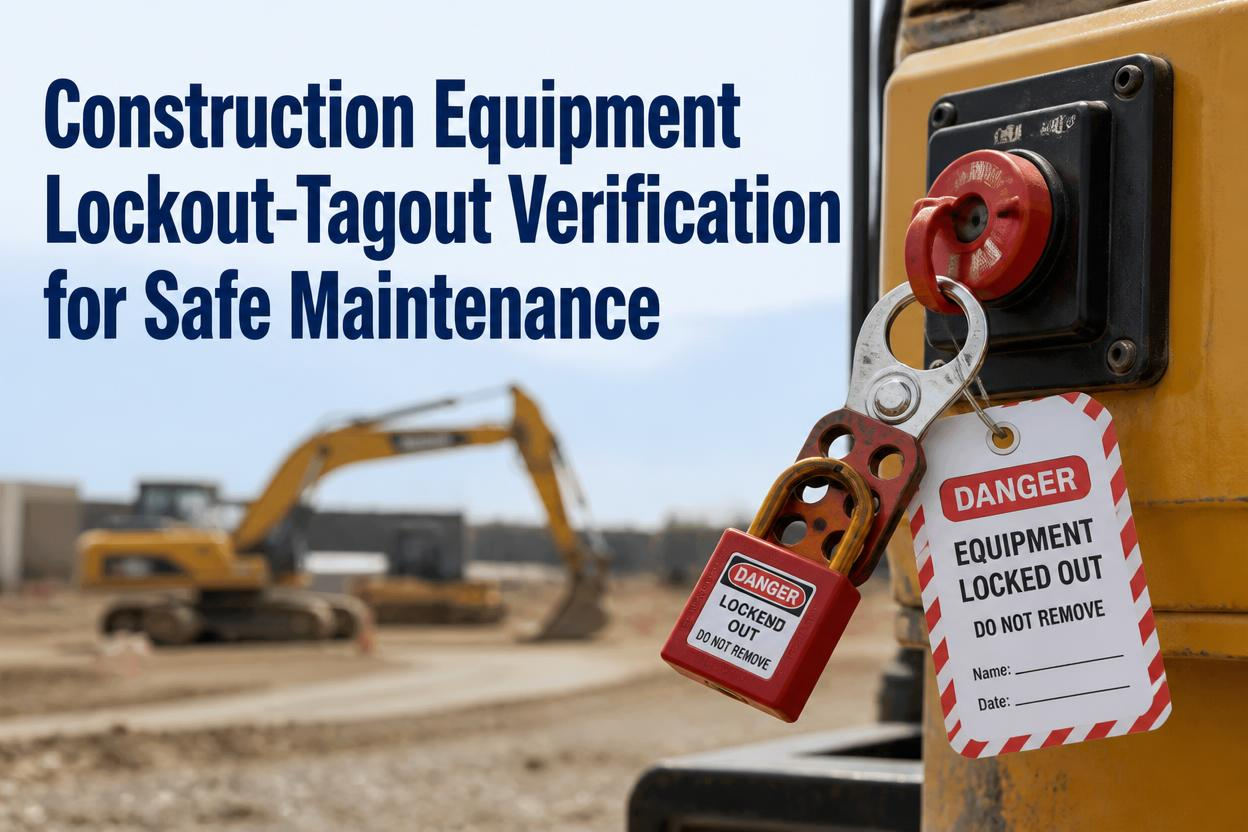
A maintenance technician crawls under a hydraulic excavator boom to replace a worn hose fitting. The engine is off. The key is out. But somewhere in the arm, residual hydraulic pressure is still holding thousands of pounds in place, and nobody confirmed it was released before work began. This is how lockout-tagout failures happen on construction sites, not through carelessness, but through a verification step that got skipped in the rush to finish a repair. Energy isolation without verification is just a guess, and guesses on live equipment cost lives.
Hazardous energy releases cause roughly 120 fatalities and 50000 injuries across US worksites every year, and lockout-tagout remains one of OSHA's most cited standards with over 2100 citations in recent years. Construction crews face elevated risk because equipment carries multiple energy types at once: hydraulic, mechanical, electrical, and gravitational. Tying lockout-tagout verification directly to digital work orders closes the gap that paper tags and memory alone cannot.
Why Lockout-Tagout Breaks Down On Construction Equipment
Construction equipment is uniquely dangerous for energy control because it rarely has just one energy source. An excavator carries hydraulic pressure in its cylinders, mechanical tension in its tracks, electrical current in its control panel, and gravitational energy in a raised boom or bucket. A skid steer has hydraulics feeding attachments plus a spring-loaded seat bar. A crane holds enormous stored energy in its load line even with the engine off. Each of these energy types needs its own isolation method, and missing even one turns a routine repair into a potential amputation, crush injury, or fatality.
Field conditions make this worse. Technicians often work alone on remote job sites, under time pressure to get equipment back into rotation. Paper tag logs get left in a truck cab or a job trailer, disconnected from the actual repair happening at the machine. A different crew member may walk up and attempt to start equipment that a technician is actively servicing, not knowing a tag is even in place, because nothing linked that tag to a live, visible work order. The isolation itself may be done correctly, but without a verification checkpoint that confirms zero energy state before hands go near moving parts, the entire procedure depends on trust rather than proof.
The Three Points Where Verification Usually Fails
Most lockout-tagout incidents on construction equipment trace back to one of three verification gaps: the isolation device was applied but never tested for effectiveness, a second energy source was missed entirely, or the tag was removed before work was actually complete. Each of these is a process failure, not a training failure, which means the fix is a better process, not another poster on the wall.
FleetRabbit attaches a lockout-tagout verification checklist to every maintenance work order for your construction fleet. Technicians confirm each energy source is isolated, log the zero-energy check, and the record stays attached to that machine permanently. Start your free trial and see how verification becomes part of the workflow instead of an afterthought.
The Lockout-Tagout Verification Checklist For Heavy Equipment
A verification checklist turns lockout-tagout from a one-time action into a confirmed state. Every energy source on the machine needs to be identified, isolated, and then physically tested to prove the isolation worked, before anyone is authorized to begin the repair. The table below breaks down the verification step for each energy type common to construction equipment.
| Energy Type | Where It Hides | Isolation Method | Verification Step |
|---|---|---|---|
| Hydraulic | Cylinders, hoses, attachment lines under residual pressure | Close isolation valves, lock out pump controls | Cycle control levers to confirm zero movement and bleed pressure gauges to zero |
| Mechanical | Raised booms, buckets, blades, tensioned tracks or springs | Lower to ground or install physical support blocks and pins | Attempt to release the load path and confirm the block or pin bears full weight |
| Electrical | Battery systems, control panels, starter circuits | Disconnect battery, apply lockout to breaker panel | Test with a meter to confirm zero voltage at the isolation point |
| Pneumatic | Air brake systems, pneumatic attachment controls | Close air supply valve, lock out compressor | Release air through a bleed valve and confirm pressure gauge reads zero |
| Gravitational | Elevated attachments, suspended loads, sloped parking | Lower load fully or install rated blocking | Visually confirm full contact with blocking before removing hydraulic support |
Why Physical Testing Matters More Than The Tag Itself
Applying a lock and hanging a tag is only half the job. The verification step is the physical proof: pressing the control lever with the lock in place, checking the voltage meter, or pushing against a lowered bucket to confirm it will not shift. Skipping this step is the single most common reason lockout-tagout procedures fail even when every device was installed correctly.
Paper Tags Versus Digital Verification Records
Most construction fleets still rely on physical tags and a paper logbook kept in the shop office. That approach works until a machine moves between job sites, a shift changes mid-repair, or an inspector asks for proof that verification actually happened three months ago. Digital verification solves each of those gaps by attaching the checklist to the machine's permanent record rather than a slip of paper that can be lost, ignored, or removed early.
What Changes When Verification Goes Digital
A digital system requires a technician to actively confirm each energy source before the work order can move to the next stage, which removes the option of skipping a step under time pressure. It also timestamps every confirmation, attaches the technician's name, and keeps that record searchable for as long as the equipment is in the fleet. If OSHA or an internal safety audit asks for evidence of a specific isolation event, the answer is a lookup, not a search through a filing cabinet.
FleetRabbit's mobile work order system requires technicians to confirm each lockout-tagout step before a repair is marked in progress, then keeps a permanent, searchable log tied to that specific machine. Book a demo to see the verification workflow on your own equipment types.
Building A Verification Program That Actually Gets Followed
A lockout-tagout program only works if it fits into how technicians already operate. Programs that add extra paperwork on top of an existing process get skipped the first time a crew is behind schedule. Programs that build verification directly into the same work order the technician is already opening get followed, because there is no separate step to forget.
Start With Machine-Specific Procedures
A generic lockout-tagout checklist does not account for the difference between a wheel loader's hydraulic accumulator and a crane's load line. Build a short, machine-specific procedure for each equipment type in your fleet, listing every energy source and the exact verification action for that model. This removes guesswork for technicians who may service ten different machine types in a single week.
Require Confirmation Before Work Begins
Structure the work order so the repair task cannot be marked started until every isolation point is confirmed. This single rule change closes the most common gap, where a technician intends to verify isolation but gets pulled into the repair before completing the check.
Audit A Sample Of Records Monthly
Pick a handful of completed work orders each month and confirm the verification steps were filled out completely and make sense for that machine. This catches technicians who are rushing through digital checklists without actually performing the physical test, before it becomes a habit across the whole crew.
Verification Metrics Worth Tracking
Fleet and safety managers can measure lockout-tagout program health the same way they measure uptime or repair cost. Verification completion rate tracks the percentage of work orders where every required energy source was confirmed isolated before work began, with a target of 100 percent for any fleet running hydraulic or high-mass equipment. Near-miss reporting rate measures how often crews report an isolation that did not hold on first test, which is a sign the program is catching problems rather than hiding them. Time to verification measures how long it takes a technician to complete the full isolation and confirmation sequence, useful for spotting machines whose isolation points are hard to access and need design changes or additional training.
What A Healthy Program Looks Like
Fleets with a mature verification program typically see near-miss reports increase in the first few months, not because more problems exist but because technicians are actually catching and logging them instead of working around them silently. Over time, actual LOTO-related incidents trend down as the underlying isolation habits improve.
Lockout-tagout only protects your crew when verification is built into the work, not left to memory. FleetRabbit ties an energy isolation checklist to every construction equipment work order, so nothing moves to the repair stage until zero energy is confirmed and logged.