Construction equipment management has crossed a threshold in 2026 that separates the contractors still running spreadsheet maintenance logs and paper inspection forms from the ones deploying edge AI systems that predict hydraulic failures three weeks before they happen, optimise fuel consumption across 40-machine fleets in real time, and generate ISO 9001 audit packages automatically while the equipment is still on site. The gap between these two operating models is not a technology gap — the hardware and software to run AI-powered fleet intelligence has been commercially available and cost-effective for mid-size construction fleets since 2023. The gap is an implementation gap. Contractors who understand what AI-powered construction equipment management software actually does, what it costs, what it returns, and how to deploy it without a six-month IT project are capturing the productivity and cost advantages that the spreadsheet operators are still losing to unplanned breakdowns, fuel theft, idle-time overruns, and equipment utilisation blind spots every week. This guide covers the complete 2026 picture: what the technology does, which use cases generate the highest ROI, how to evaluate platforms, and why FleetRabbit's edge-AI architecture delivers results in 6 to 12 weeks across mixed-brand fleets of any size. Book a FleetRabbit AI equipment management demo.
FleetRabbit Fleet Intelligence — 2026 Complete Guide
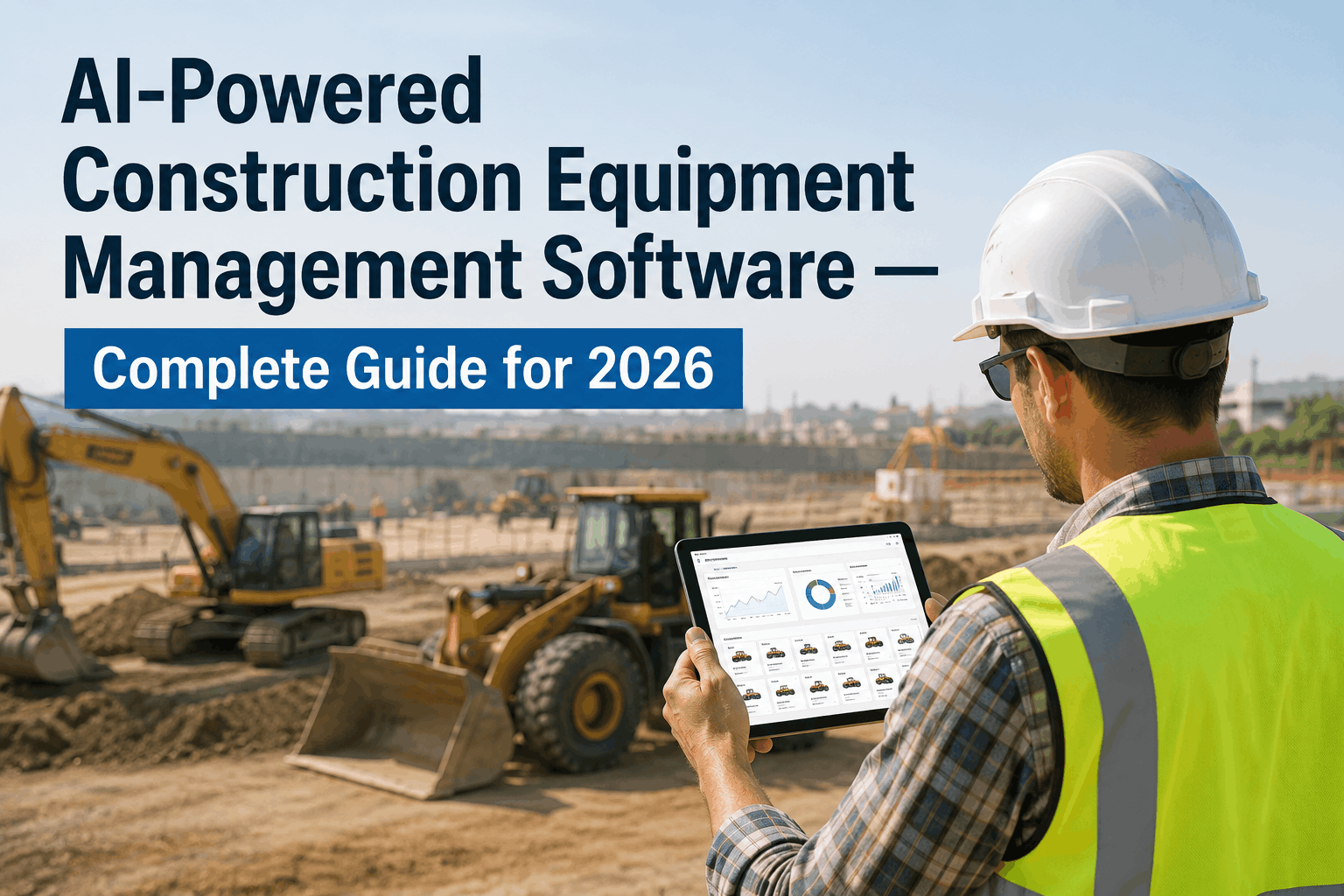
AI-Powered Construction Equipment Management Software — Complete Guide for 2026
Definitive guide covering real-time GPS, predictive maintenance, fuel monitoring, operator scorecards, and downtime reduction. FleetRabbit as turnkey edge-AI platform — ROI calculator, 6–12 week deployment, and free trial. How construction fleet managers cut downtime 67%, reduce fuel waste, and achieve full fleet visibility with AI-powered equipment management software built for the real complexity of mixed-brand, multi-site construction operations.
67%Average Unplanned Downtime Reduction with AI Predictive Maintenance
18–23%Fuel Cost Reduction Through AI Idle Monitoring and Route Optimisation
6–12 wkFleetRabbit Deployment Timeline from Contract to Live AI Intelligence
4.2×Average ROI in First Year Across FleetRabbit Construction Deployments
What AI-Powered Construction Equipment Management Software Actually Does in 2026
The term "AI-powered" is applied so broadly across fleet management marketing that it has become nearly meaningless without a precise definition of which AI capabilities are delivering operational value versus which are cosmetic product positioning. In 2026, genuine AI-powered construction equipment management operates across five distinct intelligence layers — each of which generates measurable financial return independently and compounds when deployed together on the same fleet data infrastructure.
Predictive Fault Intelligence
AI Layer 1 — From Reactive to Predictive Maintenance
Machine learning models trained on millions of equipment fault sequences detect the early-stage signatures of impending failures — abnormal hydraulic pressure variance, rising coolant temperature deviation patterns, injector performance degradation trends — before any fault code is triggered by the OEM threshold. FleetRabbit's edge-AI devices process sensor data on-device, identifying fault precursor patterns and transmitting alerts with predicted failure windows rather than raw fault codes. The result: maintenance teams receive a "hydraulic pump failure predicted within 14–21 days" alert rather than a "hydraulic pump failure" event after the machine has already shut down on site.
Fuel Consumption AI
AI Layer 2 — Waste Detection and Consumption Optimisation
AI fuel monitoring correlates fuel consumption against engine load, task type, site conditions, and operator behaviour to distinguish productive consumption from waste. Idle time that exceeds task-appropriate thresholds, fuel consumption rates that deviate from baseline for the equipment type and application, and refuelling events that do not match tank capacity and prior fuel level — all surface as AI-generated anomalies rather than requiring manual data review. Construction fleets implementing AI fuel monitoring consistently achieve 18–23% fuel cost reduction within the first 90 days, driven by idle reduction and fuel theft detection rather than operational changes.
Operator Behaviour Scoring
AI Layer 3 — From Anecdote to Objective Performance Data
AI operator scoring analyses acceleration patterns, braking events, speed exceedances, idle behaviour, and impact shock signatures to generate objective operator performance scores that correlate directly with maintenance cost per hour and incident frequency. Operators in the bottom performance quartile consistently generate 2.3 to 3.1 times the maintenance cost per operating hour of top-quartile operators on equivalent equipment — a cost differential that AI scoring makes visible and actionable through targeted coaching rather than anecdotal management. Scorecards update in real time, enabling supervisor intervention during shift rather than in retrospective weekly reviews.
Utilisation Intelligence
AI Layer 4 — Fleet Right-Sizing and Allocation Optimisation
AI utilisation analysis identifies underperforming assets whose lease or ownership cost exceeds their productive contribution — not through simple hour-counting but through task-adjusted utilisation scoring that accounts for shift patterns, project phase, and equipment category. Recommendations for asset reallocation between sites, lease return timing, and rental supplementation during peak demand periods are generated automatically rather than requiring manual data interpretation. Construction fleets acting on AI utilisation recommendations typically identify 2 to 4 reallocation or return opportunities per quarter, with annual lease cost savings that exceed platform subscription costs within the first six months.
Compliance Automation
AI Layer 5 — From Audit Scramble to Continuous Documentation
AI compliance engines monitor inspection completion rates, maintenance schedule adherence, corrective action closure velocity, and calibration expiry approach — generating real-time compliance health scores that surface gaps before they become audit findings rather than after. ISO 9001 Clause 7.1.3 documented information, corrective action registers under Clause 10.2, and operator certification tracking are maintained automatically as outputs of normal operational data capture. Audit preparation shifts from a three-week document compilation exercise to a single report generation action, with complete asset histories retrievable in under eight minutes for any asset in the fleet.
Real-Time GPS Intelligence
AI Layer — Location, Geofence, and Movement Analytics
AI-enhanced GPS moves beyond location tracking to pattern analysis — identifying equipment movement anomalies that indicate theft risk, detecting assets approaching geofence boundaries before the crossing event rather than after, and correlating location data with productivity metrics to identify site layout inefficiencies that increase machine cycle times. After-hours movement alerts reach the right respondent within two minutes of the geofence event, with AI-assessed risk classification that distinguishes authorised late transfers from theft-pattern movements and routes the alert to security or fleet manager accordingly.
The ROI Case for AI Construction Equipment Management — By Fleet Size
Return on investment calculations for AI fleet management platforms are frequently presented at the fleet category level — "construction fleets save X%" — without accounting for the significant variation in return profile across different fleet sizes, equipment mixes, and operational contexts. The ROI framework below breaks down the financial return by fleet size band, reflecting the actual return patterns observed across FleetRabbit construction deployments in 2025 and 2026. Use these figures as directional benchmarks rather than guaranteed outcomes — your specific fleet composition, current maintenance cost baseline, and operational intensity will determine the final return calculation.
S
Small Fleet — 5 to 15 Assets — ROI Profile
Small construction fleets of 5 to 15 assets generate ROI primarily through downtime prevention and fuel waste elimination rather than utilisation optimisation — the fleet is too small for significant reallocation gains but highly sensitive to single-asset breakdown events that shut down entire site operations. A 5-machine civil contractor where one excavator breakdown halts the full crew for two days loses more in that single event than the annual platform subscription. AI predictive maintenance that prevents two such events per year generates a 3 to 4× return on platform cost before fuel savings, theft prevention, or compliance benefits are counted. Deployment timeline for fleets in this band: 4 to 6 weeks from contract to live AI intelligence. Typical first-year ROI range: 2.8× to 3.9×.
M
Mid-Size Fleet — 15 to 40 Assets — ROI Profile
Mid-size construction fleets of 15 to 40 assets are the highest-return deployment segment for AI fleet management in 2026 — large enough to generate significant utilisation optimisation savings through asset reallocation and lease return decisions, complex enough that multi-brand telematics fragmentation is creating substantial daily management overhead, and operationally intensive enough that fuel monitoring returns are material. Fleets in this band typically span 4 to 7 equipment brands, operate across 3 to 8 active sites, and have at least 30% of assets outside OEM telematics coverage due to age. AI fleet management generates value across all five intelligence layers simultaneously at this scale. Deployment timeline: 6 to 10 weeks. Typical first-year ROI range: 3.8× to 5.2×.
L
Large Fleet — 40 to 100+ Assets — ROI Profile
Large construction fleets of 40 or more assets generate the highest absolute return from AI fleet management but require the most sophisticated deployment approach — multi-site data architecture, enterprise API integrations with ERP and project management systems, and custom alert routing logic for complex organisational hierarchies. At this scale, the utilisation optimisation layer alone — identifying assets suitable for return, reallocation, or rental supplementation across 40+ machines — typically generates annual savings that cover the full platform cost within the first quarter. Compliance automation value is also highest at this scale, with ISO 9001 surveillance audits covering larger asset populations requiring consolidated reporting that manual compilation cannot deliver efficiently. Deployment timeline: 8 to 12 weeks. Typical first-year ROI range: 4.5× to 6.8×.
✓
ROI Calculator — Estimate Your Fleet's Return
To estimate your fleet's first-year AI management ROI: multiply your fleet size by your average monthly maintenance cost per machine, then apply a 28–35% reduction factor for predictive maintenance savings. Add your estimated monthly fuel spend and apply a 20% reduction factor for AI idle monitoring. Add the average unplanned breakdown cost for your operation multiplied by the number of breakdown events you experienced in the past 12 months, then apply a 60–70% reduction factor for AI fault prediction. Sum these three figures and compare against the annual FleetRabbit platform subscription cost. For most mid-size construction fleets, this calculation produces a first-year ROI between 3.5× and 5.5× before compliance, theft prevention, and operator behaviour benefits are included. Book a demo to have FleetRabbit's team run a customised ROI calculation against your actual fleet data.
FleetRabbit AI Platform
Edge AI. Real-Time GPS. Predictive Maintenance. Fuel Intelligence. One Turnkey Platform.
FleetRabbit's edge-AI construction equipment management platform deploys in 6 to 12 weeks across mixed-brand fleets of any size — delivering predictive fault detection, fuel waste elimination, operator behaviour intelligence, and ISO-ready compliance documentation from the first operational week.
Core Platform Capabilities — What FleetRabbit Delivers Across Every Fleet
FleetRabbit's AI construction equipment management platform is built on an edge-AI architecture that processes sensor data on-device before transmission — reducing latency, enabling offline operation in low-connectivity site environments, and allowing AI fault pattern detection to run continuously regardless of cellular signal quality. The platform capabilities below apply across every asset in the fleet — powered equipment, older machines without OEM telematics, non-powered assets, and rented equipment — from a single unified interface with one login, one PM schedule, one alert system, and one compliance record infrastructure.
GPS & Tracking
Real-time position updates at 30-second to 2-minute intervals depending on asset type and operational context. Polygon geofencing for irregular site shapes with AI-enhanced boundary alerts that distinguish theft-pattern movements from authorised transfers. After-hours movement detection with automatic security escalation. Asset location history playback for any time period. Live fleet map with asset status, engine state, and utilisation indicators across all sites simultaneously.
Predictive Maintenance
Edge-AI fault signature detection identifying failure precursors 14 to 28 days before OEM fault code threshold is reached. Hour-based and calendar-based PM scheduling with automatic work order generation. Fault code library covering 2,800+ construction equipment fault codes across all major OEM brands with AI-enhanced diagnostic guidance. Maintenance cost per hour tracking by asset, operator, and project. Service history accessible in under five minutes for any asset in the fleet.
Fuel Monitoring
AI fuel consumption baseline modelling by equipment type and application. Real-time idle time monitoring with configurable alert thresholds by machine category and task context. Fuel theft detection through refuelling event anomaly analysis. Consumption deviation alerts when burn rate exceeds task-appropriate baseline by configurable margin. Project-level fuel cost allocation for accurate job costing. Monthly fuel waste reports with AI-identified reduction opportunities ranked by potential saving value.
Operator Scorecards
Real-time operator behaviour scoring across speed compliance, impact events, idle time, aggressive acceleration and braking, and pre-shift inspection completion rate. Individual and team scorecards updated continuously during shift. Operator performance trend analysis identifying coaching priority individuals. Correlation reporting linking operator scores to maintenance cost per hour and incident frequency. Supervisor alert when operator score drops below configurable threshold during active shift, enabling real-time intervention rather than retrospective review.
Compliance & Audits
ISO 9001 Clause 7.1.3 and 10.2 documented information generated automatically from operational data capture. Digital pre-shift inspection checklists with mandatory field enforcement, photo evidence capture, and automatic work order generation for safety-critical defects. Corrective action register with structured closure workflow and effectiveness verification. Calibration due date tracking with advance warning alerts. Audit-ready asset history exports in under eight minutes for any asset, any date range.
Utilisation Analytics
AI-powered utilisation scoring by asset, site, shift, and project phase. Underutilisation alerts when assets fall below configurable productive hour thresholds. Over-utilisation warnings when assets approach accelerated maintenance interval triggers. Cross-site reallocation recommendations identifying assets suitable for transfer between projects. Fleet right-sizing analysis identifying lease return or rental supplementation opportunities with estimated annual cost impact. Benchmarking against fleet-wide and industry utilisation norms by equipment category.
Multi-Brand Integration
OEM telematics integration via AEMP 2.0 for all participating manufacturers — Caterpillar, Komatsu, John Deere, Volvo, Doosan, Hitachi, and 20+ others. Proprietary API connections for Caterpillar VisionLink, Komatsu SmartConstruction, and John Deere Operations Center for extended data depth. Aftermarket CAN bus devices for older assets outside OEM telematics coverage. Battery-powered trackers for non-powered assets. All asset types in one unified fleet dashboard — no multi-portal management, no data format reconciliation.
Reporting & Alerts
Role-based alert routing delivering the right notification to the right person — predictive fault alerts to fleet managers, safety defect alerts to site supervisors, compliance gap alerts to quality managers, and operator behaviour alerts to crew supervisors. Configurable alert channels: mobile push, SMS, email, and in-platform notification centre. Automated weekly fleet health summary delivered to senior management. Custom report builder for project-level cost, utilisation, and compliance reporting. API access for integration with ERP, project management, and BI systems.
How FleetRabbit Compares to Competing AI Fleet Management Platforms in 2026
The AI construction fleet management market in 2026 includes legacy CMMS platforms that have added AI labels to existing rule-based alert systems, OEM telematics portals with single-brand scope, generic GPS tracking platforms that have extended into maintenance scheduling, and purpose-built AI fleet intelligence platforms like FleetRabbit. Evaluating these categories honestly against real construction fleet requirements produces a clear differentiation picture that vendor comparison pages consistently obscure.
01
FleetRabbit vs Legacy CMMS with AI Add-Ons
Legacy CMMS platforms built for fixed-plant maintenance have added AI-labelled features — typically rule-based threshold alerts rebranded as predictive maintenance — to compete in the construction fleet market. The fundamental architecture limitation is that these platforms were designed for desktop data entry in workshop environments, not for mobile-first field data capture across multi-site construction operations. Pre-shift inspection workflows, real-time operator behaviour monitoring, and edge-AI fault detection before code threshold are capabilities that require ground-up mobile architecture, not a desktop CMMS with a mobile skin. FleetRabbit's construction-native architecture delivers genuinely predictive fault intelligence — pattern recognition trained on construction equipment fault sequences — rather than threshold-based alerting relabelled as AI. Deployment timelines reflect this: FleetRabbit deploys in 6 to 12 weeks versus the 6 to 18 month CMMS implementation timelines that construction IT teams consistently experience.
02
FleetRabbit vs OEM Telematics Portals
OEM telematics portals — Caterpillar VisionLink, Komatsu SmartConstruction, John Deere Operations Center — provide deep native intelligence for their respective equipment brands but are fundamentally single-brand solutions. A construction fleet running Caterpillar, Komatsu, and Volvo equipment manages three separate portals, three separate alert systems, and three incompatible data formats — with no consolidated fleet view, no cross-brand utilisation comparison, and no coverage for older assets or non-powered equipment. FleetRabbit integrates all three OEM feeds via AEMP 2.0 and proprietary API alongside aftermarket device data for unconnected assets, delivering unified cross-brand AI intelligence in one platform. The OEM data depth is preserved — Caterpillar fault diagnostics, Komatsu SmartConstruction integration — while the fragmentation overhead of multi-portal management is eliminated entirely.
03
FleetRabbit vs Generic GPS Tracking Platforms
Generic GPS fleet tracking platforms — originally designed for commercial vehicle fleets — have extended into construction equipment management by adding maintenance scheduling modules to their location tracking core. The limitation is architectural: these platforms capture where equipment is and when it moves but lack the CAN bus integration, edge-AI fault detection, and construction-specific maintenance intelligence that convert location data into operational value. Knowing that an excavator left Site 4 at 3am is useful. Knowing that the same excavator has been showing hydraulic pressure variance patterns consistent with pump failure in the next 18 days — and automatically scheduling a pre-emptive service during the next planned downtime window — is what separates AI-powered construction equipment management from GPS tracking with a maintenance log attached.
04
FleetRabbit's Edge-AI Architecture Advantage
FleetRabbit's edge-AI architecture processes sensor data on the device installed in the equipment rather than transmitting raw data to a cloud server for analysis. This architectural choice delivers three operational advantages that cloud-only AI platforms cannot match in construction environments. First: AI fault detection runs continuously regardless of cellular connectivity — a critical capability on remote civil sites where signal quality is inconsistent and cloud-dependent AI would miss fault signature data during connectivity gaps. Second: alert latency drops from minutes to seconds, enabling real-time intervention on active fault events rather than delayed notification after cloud processing. Third: data volume from dense sensor sampling can be processed locally with only actionable outputs transmitted, reducing cellular data costs by 60 to 80% compared to raw data stream transmission architectures.
Deployment Roadmap — 6 to 12 Weeks from Contract to Live AI Intelligence
The most common barrier to AI fleet management adoption among construction contractors is not cost and not technology readiness — it is the expectation, based on prior enterprise software experience, that deployment will take six months, consume significant internal IT resources, and deliver a platform that needs another three months of configuration before it reflects the real fleet. FleetRabbit's construction deployment model is designed to contradict every element of that expectation. The roadmap below reflects the actual deployment sequence for a mid-size construction fleet of 15 to 40 assets — adjusted timelines for smaller and larger fleets are noted at each phase.
W1
Weeks 1–2 — Fleet Audit and Device Specification
FleetRabbit's onboarding team conducts a complete fleet audit against the asset register provided during contracting — identifying each asset's OEM telematics status, CAN bus accessibility, age, and connectivity environment to specify the correct device type for each machine. Assets with active OEM telematics are configured for AEMP 2.0 or proprietary API integration. Assets without OEM telematics receive CAN bus aftermarket devices. Non-powered assets receive battery-powered GPS trackers. The fleet audit output is a device specification list and installation schedule that sequences installation to minimise operational disruption — prioritising high-value and high-risk assets for early installation so that the most important data starts flowing within the first week of the physical deployment phase.
W3
Weeks 3–5 — Device Installation and OEM Integration
Telematics device installation is completed by FleetRabbit's certified installation team across all assets in the fleet — CAN bus connections on powered equipment, battery tracker deployment on non-powered assets, and OEM API credential configuration for manufacturer-connected machines. Installation is scheduled around operational requirements, with most assets completing installation during routine shift transitions or planned maintenance windows rather than requiring dedicated downtime. OEM telematics connections via AEMP 2.0 are activated during this phase, with historical data backfill from the OEM's retention period providing immediate maintenance history context rather than starting with a blank record. Live GPS data, fuel monitoring, and basic fault code feeds are typically active for the first assets within 72 hours of physical installation commencement.
W6
Weeks 5–7 — PM Schedule and Inspection Configuration
Preventive maintenance schedules are configured in FleetRabbit against the fleet manager's existing PM intervals — or against OEM-recommended schedules where the fleet manager does not have a documented programme — with automatic work order generation triggers set by engine hours, calendar intervals, or kilometres as appropriate for each equipment type. Pre-shift inspection checklists are built for each asset category using FleetRabbit's template library as a starting point, customised with site-specific items, mandatory photo evidence fields for identified defect types, and automatic escalation routing for safety-critical items. Historical maintenance records from existing systems — spreadsheets, paper job cards, prior CMMS exports — are migrated into the platform's asset history store during this phase, providing auditors with a continuous record that pre-dates the FleetRabbit go-live date.
W9
Weeks 7–12 — AI Baseline Training and Live Operations
FleetRabbit's AI models require 3 to 6 weeks of live operational data to establish asset-specific performance baselines before predictive fault detection reaches full accuracy — the period during which the AI distinguishes normal operating variation for each machine from deviation patterns that indicate developing faults. During this baseline training period, standard threshold-based alerts remain active so that no fault event is missed. By weeks 10 to 12, the AI predictive layer is generating fleet-specific fault predictions with the 14 to 28 day advance warning that characterises FleetRabbit's predictive maintenance performance. Operator scorecard baselines, fuel consumption models, and utilisation benchmarks are all established during this phase, with the first AI-generated fleet intelligence reports available to fleet management by the end of week 12 at the latest — typically by week 8 for smaller fleets.
From the Field — AI Fleet Management in Real Construction Operations
"We went into the FleetRabbit deployment sceptical — we had tried two other fleet management platforms in the previous four years, and both of them promised AI and delivered a dashboard with alerts that were either obvious or irrelevant. What changed with FleetRabbit was the predictive maintenance layer. Six weeks after go-live, the system flagged a deviation pattern on our Komatsu PC390 — not a fault code, just a pattern the AI had identified in the hydraulic pressure data. Our workshop supervisor looked at it, wasn't immediately concerned because the machine was running fine, but booked it for inspection at the next available window. When the technician got into it, there was a developing crack in the hydraulic manifold that would have been a catastrophic failure within two to three weeks. We were in the middle of a bridge abutment pour schedule — that breakdown would have cost us the pour window, the concrete already batched, and a month's programme delay. The repair cost $4,200. The avoided breakdown would have cost us north of $80,000 in direct losses and programme penalties. That one event paid for three years of FleetRabbit subscription. We now have 34 machines on the platform across four sites and the fuel monitoring alone is saving us approximately $6,800 per month against where we were running twelve months ago."
Fleet & Plant Director
·
Civil & Structures Contractor — 34-Machine Fleet — 4 Active Sites — Multi-Brand
Selecting AI Construction Equipment Management Software — Evaluation Framework
The evaluation framework below is designed for construction fleet managers assessing AI equipment management platforms in 2026 — structured to surface the capability and architecture differences that vendor demonstrations consistently obscure. Work through each criterion with every platform under evaluation and require evidence rather than commitment: ask for live demonstrations of AI fault predictions on real fleet data, request reference contacts from deployments on mixed-brand fleets comparable in size to yours, and test the mobile inspection interface under field conditions before signing any contract.
AI Authenticity
Distinguish genuine machine learning fault prediction from threshold-based alerting relabelled as AI. Ask vendors: what training data was the predictive model built on, how many fault sequences does it cover, and what is the average advance warning period before failure? Require a live demonstration of a predictive fault alert on actual fleet data — not a pre-prepared scenario. Platforms that cannot demonstrate genuine predictive capability with real data are delivering rule-based alerts with AI marketing language.
Multi-Brand Coverage
Test coverage against your specific fleet composition — every brand, every age, every asset type including non-powered equipment. Request confirmation of AEMP 2.0 integration for each OEM brand in your fleet and evidence of CAN bus device capability for your oldest assets. Platforms that require full OEM telematics coverage to function at full capability will leave your oldest and most failure-prone assets outside the AI monitoring envelope — exactly where predictive maintenance value is highest.
Deployment Timeline
Require a specific written deployment timeline with milestone dates, not a generic "typical deployment" range. Ask what internal resources the deployment requires from your team and what causes timelines to extend beyond the committed range. Request reference contacts from deployments of comparable fleet size and complexity and ask specifically about the gap between committed and actual go-live dates. Platforms with consistently extended deployment histories will reveal this pattern through reference conversations that sales processes do not.
Mobile-First Field Use
Evaluate the operator and technician mobile experience under real field conditions — not on a demo device on a fast WiFi connection. Pre-shift inspection completion, fault reporting, work order sign-off, and alert response all happen in the field on mobile devices in varying connectivity conditions. Platforms with desktop-first architectures that have added mobile interfaces typically show workflow gaps, slow load times in low-connectivity environments, and inspection forms that are difficult to complete on a phone screen in a gloved hand at 5am in winter conditions.
Frequently Asked Questions — AI Construction Equipment Management 2026
QHow does FleetRabbit's AI predictive maintenance differ from standard fault code monitoring, and what is the typical advance warning period before a predicted failure?
Standard fault code monitoring triggers an alert when a sensor reading crosses the OEM-defined threshold — at which point the fault has already occurred and the equipment is either already down or operating in a degraded state that risks imminent failure. FleetRabbit's edge-AI predictive layer analyses the pattern of sensor readings over time — pressure variance trends, temperature deviation sequences, vibration signature changes, injection timing drift — to identify the pre-fault signature that precedes threshold crossing by days to weeks. The AI model has been trained on millions of construction equipment fault sequences across all major OEM brands and equipment categories, enabling it to recognise fault precursor patterns that are invisible to threshold-based monitoring. The average advance warning period across FleetRabbit deployments is 14 to 28 days before the OEM fault threshold would have been reached — sufficient time to schedule a pre-emptive repair during a planned maintenance window rather than responding to a breakdown on site. For high-criticality components including hydraulic systems, engine cooling, and drivetrain components, the advance warning period has extended to 35 days in documented cases where the fault progression was gradual.
QWhat happens to AI fault detection when equipment is operating in remote sites with poor cellular connectivity?
FleetRabbit's edge-AI architecture specifically addresses the connectivity limitation that prevents cloud-dependent AI from functioning reliably in remote construction environments. All AI fault pattern analysis runs on the edge device installed in the equipment — the machine learning inference happens locally, not in the cloud. This means fault signature detection continues uninterrupted regardless of cellular signal quality or complete connectivity loss. When connectivity is restored — at shift end when machines return to areas with coverage, or when cellular signal becomes available on site — the locally processed alerts, fault predictions, and operational data are transmitted to the platform automatically. In practice, the vast majority of FleetRabbit's alert and prediction outputs are delivered with minimal delay even in challenging connectivity environments because the AI processing latency is eliminated from the transmission critical path. Only the final alert delivery to the fleet manager's phone is connectivity-dependent — the detection itself is always running.
QCan FleetRabbit integrate with our existing project management and ERP systems, and how is maintenance cost data allocated to specific projects?
FleetRabbit's API supports integration with major construction ERP systems — including Viewpoint, Procore, MYOB, SAP, and Oracle — as well as project management platforms used in construction for programme scheduling and cost tracking. Maintenance cost data is project-allocated within FleetRabbit based on asset assignment to active project codes, enabling maintenance cost per operating hour to flow into project job costing systems without manual re-entry. When an asset is reassigned between projects mid-period, cost allocation is split at the reassignment date automatically. Work order costs — parts, labour, breakdown call-out — are captured against the asset and project record at the point of work order closure, making project-level equipment cost reporting accurate to the day rather than requiring month-end reconciliation. For fleets with complex cost centre structures, FleetRabbit's multi-level project hierarchy supports cost allocation to project, sub-project, and work package level, matching the granularity that construction financial controllers require for accurate job costing and project profitability reporting.
QWhat is the FleetRabbit pricing model and what does a typical mid-size construction fleet pay annually?
FleetRabbit's pricing is structured on a per-asset monthly subscription model with the hardware cost for telematics devices handled through either an upfront purchase or a bundled monthly fee depending on fleet size and contract term preference. For a typical mid-size construction fleet of 20 to 35 assets spanning multiple brands and including both powered equipment and non-powered asset trackers, the all-in annual cost — platform subscription, device connectivity, and support — ranges from levels that generate a demonstrable positive ROI in the first year based on downtime prevention alone. FleetRabbit does not publish a fixed price list because fleet compositions, device type mixes, and integration requirements vary significantly between deployments, and a published list price for a standardised configuration would misrepresent the actual cost for most real fleets. The accurate approach is a customised quote based on your specific asset register — which FleetRabbit's team provides within 48 hours of receiving fleet composition details, alongside a customised ROI projection using your actual maintenance cost baseline and operational data where available. Book a demo to initiate the quote and ROI projection process.
QHow does FleetRabbit handle equipment that is rented or hired short-term, where installation of permanent devices may not be appropriate?
Short-term and long-term rental equipment presents a specific tracking challenge that FleetRabbit addresses through two complementary approaches depending on rental duration and device installation feasibility. For rental equipment on site for more than four weeks, FleetRabbit recommends installing aftermarket CAN bus devices that connect through the diagnostic port — a reversible, non-invasive connection that does not require dealer authorisation in most jurisdictions and is removed when the equipment is returned. These devices provide full AI fault monitoring, GPS tracking, utilisation data, and pre-shift inspection integration for the rental period. For short-term rentals where device installation is not practical, FleetRabbit's magnetic-mount GPS trackers provide location, geofence monitoring, and basic utilisation data through a non-invasive attachment that takes under five minutes to install and remove. Both approaches give contractors independent tracking and utilisation verification data for rental equipment — enabling rental invoice verification against actual on-site presence and utilisation, which consistently recovers costs on contested billing periods.
FleetRabbit AI Construction Equipment Management
67% Downtime Reduction. 23% Fuel Savings. ISO 9001 Compliance. 6–12 Week Deployment. One Platform.
FleetRabbit's edge-AI construction equipment management platform delivers predictive fault detection, real-time GPS, fuel waste elimination, operator behaviour intelligence, and automated ISO compliance documentation — across every brand, every age, and every asset type in your fleet — from a platform that deploys in weeks and generates measurable ROI before the first invoice arrives.
Edge-AI Predictive Maintenance
Real-Time GPS Tracking
AI Fuel Monitoring
Operator Scorecards
ISO 9001 Compliance
6–12 Week Deployment
May 22, 2026
By John Mark
All Posts