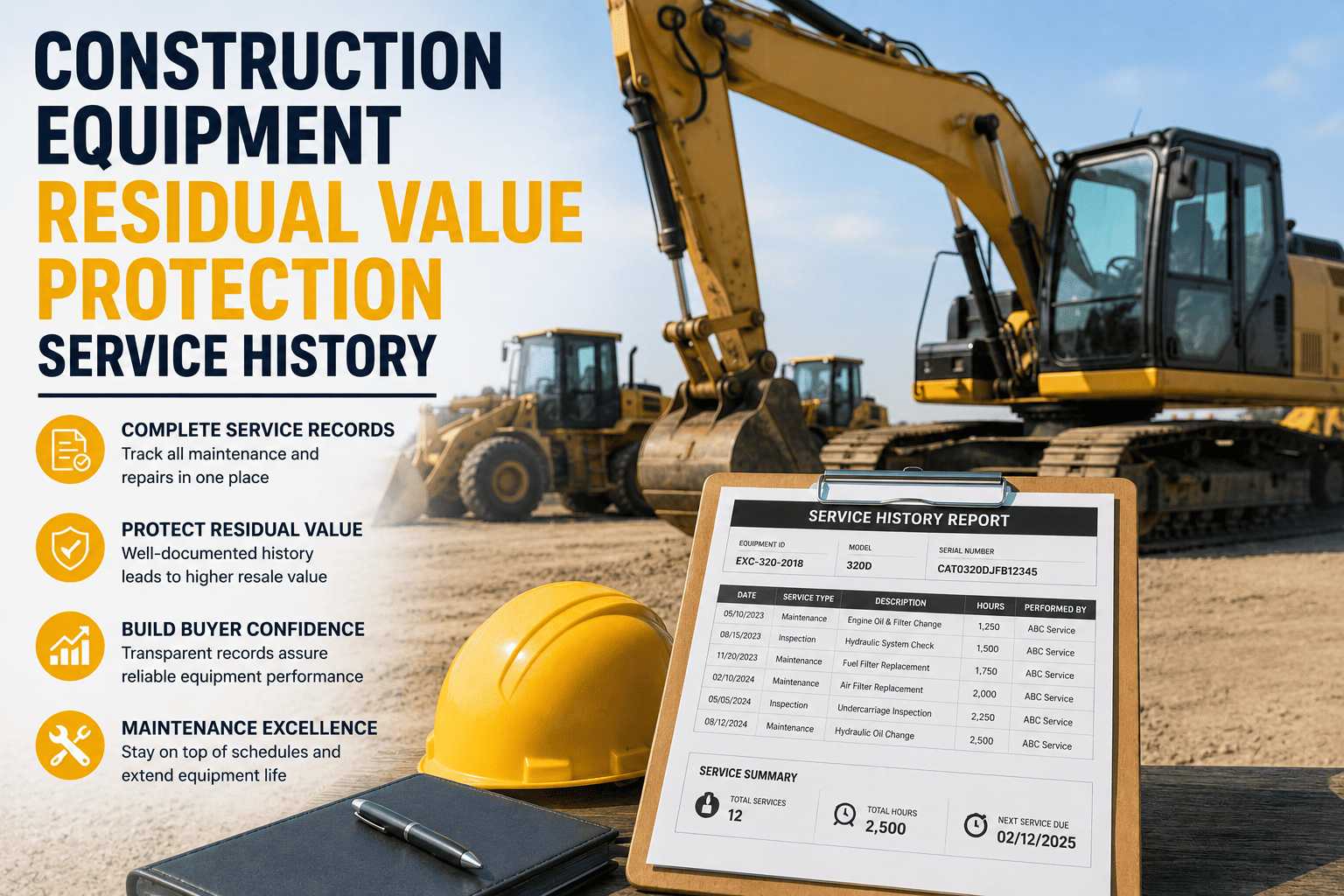
A crawler excavator with 6,000 hours on the clock and a complete digital service file can sell for tens of thousands of dollars more than an identical machine with the same hours and a shoebox of faded receipts. Buyers aren't just purchasing steel and hydraulics. They're purchasing certainty. When that certainty is missing, auction houses and dealers price in the risk, and the discount comes straight out of your bottom line. Construction fleets that treat service history as a byproduct of maintenance, rather than an asset in its own right, are quietly leaving money on the table every time a machine changes hands.
Documented service history can lift construction equipment resale value by 10 to 20 percent compared to identical machines with incomplete records, because buyers pay a premium for verified maintenance and reduced mechanical risk. Machines with gaps in their maintenance log are typically discounted 15 to 30 percent at auction, even when the equipment runs well, simply because unknown history reads as unknown risk.
Why Service History Has Become a Residual Value Driver
Construction equipment loses value the moment it leaves the dealer lot, but the speed and shape of that depreciation curve is not fixed. Two identical excavators purchased the same month, run in similar conditions, can sell three years later for very different prices. The gap almost always traces back to documentation. Appraisers, dealers, and private buyers increasingly rely on maintenance records as the single best proxy for a machine's true condition, because hour meters and paint jobs can be misleading, but a consistent service log cannot be faked easily.
Buyers in today's used equipment market are more cautious than they were a decade ago. Financing costs are higher, project margins are tighter, and nobody wants to inherit someone else's deferred maintenance. A machine that arrives with a digital record of every oil change, filter swap, undercarriage inspection, and repair gives a buyer a defensible reason to pay closer to fair market value. A machine without that record forces the buyer to assume the worst, and that assumption becomes a discount.
What Counts as "Complete" Service History
Complete does not mean a folder of paper invoices. It means a structured, time-stamped, searchable record that covers preventive maintenance intervals, unscheduled repairs, parts replaced, fluid analysis results, inspection findings, and operator-reported issues. Fleets that centralize this information digitally through a platform like FleetRabbit can produce a full history in seconds when a buyer or appraiser asks for it, rather than reconstructing it from memory during a sale negotiation.
Why Gaps Cost More Than They Seem To
A missing six-month stretch in a maintenance log does not just represent unknown information. It represents unknown risk, and buyers price risk conservatively. An undercarriage that was never inspected during that window might be perfectly fine, but the buyer has no way to confirm that, so they assume the expensive outcome and negotiate the price down accordingly. Closing these gaps before a sale is one of the highest-leverage things a fleet manager can do to protect asset value.
| Documentation Element | What It Proves to a Buyer | Typical Value Impact |
|---|---|---|
| Preventive maintenance log | Service intervals were followed consistently, not skipped under deadline pressure | Supports asking price near published fair market value |
| Fluid and oil analysis reports | Internal wear on engine and hydraulic components is within normal range | Reduces buyer inspection contingencies and haggling |
| Repair and parts history | Major components were addressed properly rather than patched temporarily | Prevents buyers from assuming hidden mechanical liabilities |
| Digital inspection records | Undercarriage, attachments, and structural points were checked on schedule | Speeds up appraisal and auction listing approval |
| Operator usage and hours data | Machine was used within its intended duty cycle, not overworked or misapplied | Supports low-hour, low-stress pricing category |
FleetRabbit captures every inspection, repair, and maintenance event in one searchable digital file, so when it's time to sell, trade, or refinance, your equipment's history speaks for itself. Sign up free and start building a resale-ready record today, or book a demo to see it on your own fleet data.
How Residual Value Erodes Without a Documented History
Depreciation on heavy equipment is never perfectly linear, and undocumented maintenance accelerates the steep parts of the curve. When a buyer cannot verify how a machine was cared for, three things tend to happen at once. The appraisal defaults to a conservative condition rating regardless of how the machine actually looks. The negotiation shifts in the buyer's favor because they can point to uncertainty as leverage. And the pool of interested buyers shrinks, because cautious buyers walk away entirely rather than take on unknown risk, leaving only the most aggressive bargain hunters at the table.
This compounds over a machine's life. A loader that goes through three ownership transitions without ever building a consolidated record starts each sale further behind, because each new owner has even less visibility into what happened before they took possession. By the time that machine reaches its fourth or fifth owner, its documented history may be effectively unrecoverable, and its price reflects that permanently.
Auction and Dealer Behavior Around Undocumented Machines
Auction houses routinely list "service history unknown" or "no records available" next to lots that lack documentation, and buyers read that language as a warning. Dealers appraising trade-ins apply similar caution, often defaulting to a lower condition tier when maintenance records cannot be produced on request. Neither party is being unfair. They are pricing in the same risk a fleet manager would price in if the roles were reversed.
The Compliance Angle Buyers Also Check
Beyond mechanical condition, buyers and financing institutions increasingly want proof that safety inspections, emissions requirements, and manufacturer recall items were addressed on schedule. A digital record that ties inspection completion to specific dates and technicians satisfies this check quickly. A verbal assurance does not.
Building a Resale-Ready Maintenance Program
Protecting residual value starts long before a machine goes up for sale. It starts with how maintenance is scheduled, tracked, and documented from the day equipment arrives on site. Fleets that build this discipline early consistently outperform fleets that scramble to reconstruct history only when a sale is already in motion.
Standardize Every Inspection Into a Digital Form
Paper checklists get lost, smudged, or filled out from memory after the fact. Digital inspection forms completed on a phone or tablet at the point of service create a timestamped, unambiguous record that becomes part of the machine's permanent file.
Track Fluid Analysis as a Value-Protecting Habit
Routine oil and hydraulic fluid sampling does more than catch problems early. It creates an ongoing scientific record of internal component condition that buyers and appraisers trust more than a visual inspection alone.
Log Every Repair, Not Just the Big Ones
Small repairs, filter changes, and component swaps all belong in the same file as major overhauls. A pattern of consistent minor maintenance is itself evidence of good ownership, and omitting it makes the record look thinner than it should.
Centralize Records Before They're Needed, Not After
Reconstructing three years of maintenance history the week before an auction listing is stressful and incomplete. Centralizing records continuously through a platform like FleetRabbit means the file is always ready, whether the sale opportunity comes next year or next month.
Calculating What Documentation Is Worth on Your Fleet
Estimating the residual value impact of better documentation starts with your own trade-in and resale history. Pull the last 10 to 15 machine sales or trade-ins from the past several years and note which ones had complete maintenance records available at the time of sale and which did not. Compare the final sale price against the published fair market value benchmark for that model, condition, and hour range at the time. Machines sold with complete records typically land much closer to benchmark value, while machines sold without them tend to land noticeably below it.
Multiply that average gap by your typical annual equipment turnover to estimate what incomplete documentation is costing your fleet every year. For a mid-sized construction fleet that rotates 8 to 12 machines annually, even a modest average gap per machine adds up to a meaningful six-figure difference in recovered capital over time, capital that could otherwise fund new equipment purchases or reduce financing needs.
FleetRabbit keeps inspection logs, repair history, and fluid analysis results organized and exportable, so you can hand a buyer or appraiser a complete file in minutes instead of days. Explore the platform with a free sign up, or talk through your fleet's specific resale goals when you book a demo.
Benchmarking Your Documentation Practices
A useful way to check whether your fleet is resale-ready is to measure documentation coverage the same way you would measure uptime or utilization. Record completeness rate tracks the percentage of scheduled services that have a matching digital record, aiming for close to full coverage on every active machine. Record retrieval time tracks how long it takes to produce a complete history on request, with a strong target being minutes rather than days. Sale price versus benchmark value tracks how your actual resale prices compare to published fair market value for each disposed asset, revealing whether documentation gaps are quietly costing you at the point of sale.
Fleets that review these three metrics quarterly tend to catch documentation gaps while equipment is still in service, when they're easy to fix, rather than discovering them at the worst possible moment, during a sale negotiation when the leverage has already shifted to the buyer.
Frequently Asked Questions
Protecting Value Is a Daily Habit, Not a Pre-Sale Scramble
Residual value is not decided in the final week before a sale. It is decided every time a technician completes an inspection and either logs it properly or lets it slide into memory. Fleets that build documentation into daily operations, rather than treating it as paperwork to catch up on later, consistently sell for closer to true fair market value and spend less time defending their equipment's condition during negotiations. The equipment itself may be identical to a competitor's, but the file behind it is what convinces a buyer to pay full value with confidence.
FleetRabbit turns everyday maintenance activity into an organized, exportable service record for every asset in your fleet, so residual value is protected from day one instead of negotiated after the fact. Create your free account to get started, or schedule time with our team to map out a documentation strategy for your equipment.