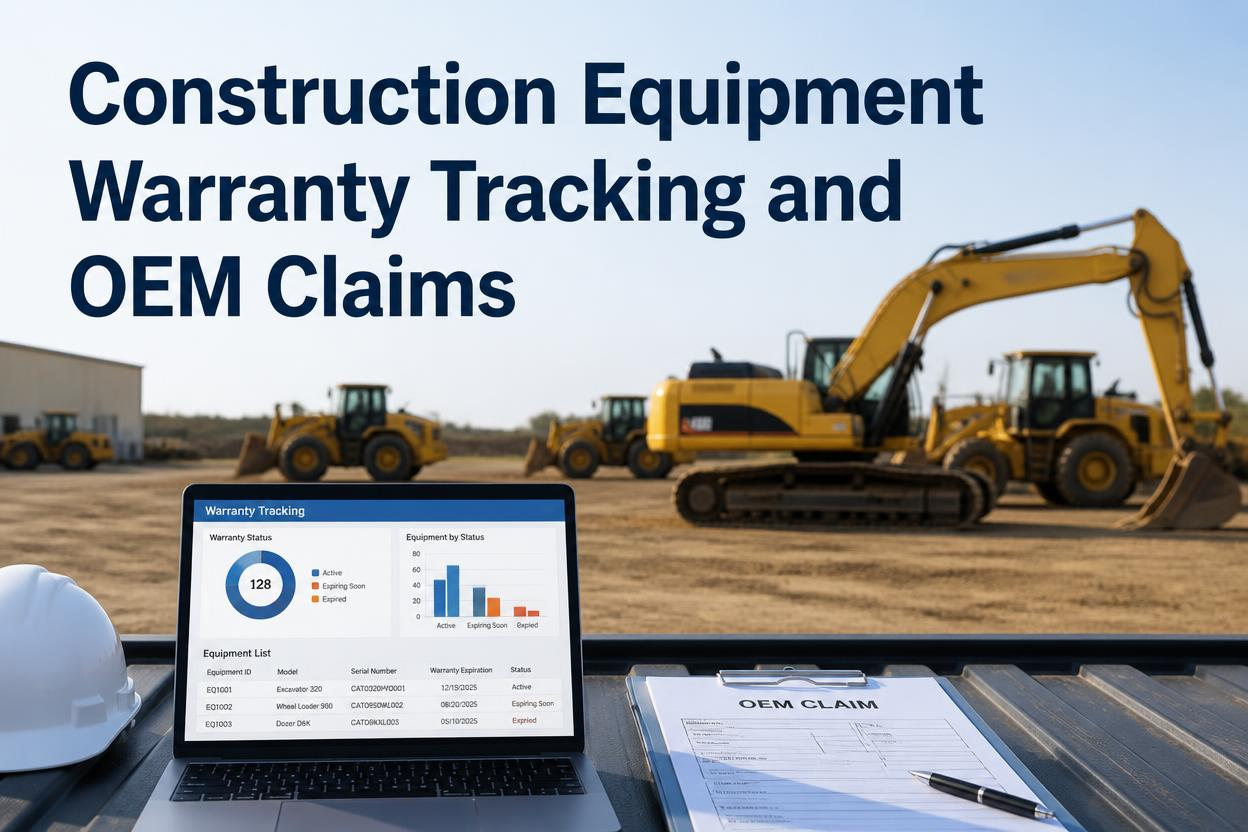
Somewhere in your fleet right now, there's probably a repair that the manufacturer should have paid for, and didn't, simply because nobody caught it in time. Warranty coverage on construction equipment isn't automatic. It has to be identified before a repair starts, documented while the work happens, and submitted before a filing window closes, and missing any one of those steps usually means the fleet absorbs a cost the OEM was contractually obligated to cover. For a business running excavators, loaders, and dozers worth six figures each, that gap adds up fast, and it's almost always a tracking problem rather than a coverage problem.
Construction equipment warranty tracking means mapping every machine's active coverage against its actual operating hours, flagging qualifying repairs before work begins, and keeping maintenance records organized enough to prove the equipment was serviced according to the OEM's schedule. Fleets running manual, spreadsheet-based tracking commonly recover only 15 to 22 percent of the warranty value they're actually owed. Structured tracking closes most of that gap by catching coverage and filing deadlines before they're missed.
Why Warranty Claims Get Denied on Construction Equipment
Missing or Incomplete Maintenance Records
OEMs increasingly want proof that a machine was serviced according to the manufacturer's schedule before they'll pay out on a failure. A missed oil change, an ungreased fitting, or a service interval that ran long can be enough for the manufacturer to argue the failure was caused by neglect rather than a defect, and without a documented record proving otherwise, the fleet has no way to push back.
Repairs Performed Before Coverage Was Confirmed
Many OEMs require pre-authorization for repairs above a set dollar threshold, and performing the work first, then requesting reimbursement afterward, usually results in denial regardless of whether the repair genuinely qualified. By the time coverage gets checked after the fact, the opportunity to claim it correctly is often already gone.
Discarded Parts and Missing Filing Deadlines
Many manufacturers require the physical failed component returned for inspection before approving a claim. A part that gets scrapped or lost means an automatic denial, no matter how strong the rest of the documentation is. Filing late is just as costly. Most claim windows run 30 to 60 days from repair completion, and a valid claim submitted a few days past that window is typically rejected outright.
The Warranty Claim Workflow, Stage by Stage
A warranty claim isn't a single form, it's a sequence, and most denials happen at one specific stage rather than being spread evenly across the process.
| Stage | What Happens | Most Common Failure Point |
|---|---|---|
| 1. Coverage Check | Confirm the machine's warranty status against its serial number and operating hours | Coverage checked after repair instead of before |
| 2. Pre-Authorization | Get OEM or dealer sign-off before labor begins on repairs above the claim threshold | Repair completed before authorization is obtained |
| 3. Documentation | Capture maintenance history, fault codes, photos, and the failed part itself | Failed part discarded or photos not taken |
| 4. Submission | File the claim through the OEM's process within the required window | Claim filed after the deadline has passed |
| 5. Recovery Tracking | Follow the claim through review to final reimbursement | Approved claims never followed up on to confirm payment |
FleetRabbit connects each asset's warranty terms with its maintenance history and flags qualifying repairs the moment a work order opens. Sign up to see your fleet's unclaimed warranty exposure today.
What Documentation OEMs Actually Require
Requirements vary by manufacturer, but most claims need the same core evidence pack tied to the specific machine's serial number.
Maintenance and Service History
Dates, machine hours, work performed, and the specific fluids or parts used, ideally linked directly to the asset rather than stored in a general shop log that's hard to trace back to one serial number.
Failure Evidence
Photographs of the failed component, diagnostic fault codes captured before the repair begins, and the physical part itself, retained and tagged in case the manufacturer requires it returned for inspection.
Authorization and Timing Records
A documented pre-authorization number for repairs above the OEM's threshold, and a clear timestamp showing the claim was filed within the required window from repair completion.
Building a Warranty Tracking System That Works
Step 1: Load Every Machine's Coverage Terms in One Place
Warranty start dates, expiration by hours or by calendar time, and what's actually covered vary by manufacturer and sometimes by component. Centralizing this per asset is the foundation everything else depends on.
What to Capture First
Purchase date, warranty type and duration, hour-based expiration limits, and any extended or component-specific coverage that runs on separate terms from the base warranty.
Step 2: Flag Coverage the Moment a Work Order Opens
Checking warranty status before a technician starts turning wrenches, not after, is the single change that prevents the largest share of missed claims. A flag at work order creation gives the team a chance to pre-authorize before cost gets locked in.
Step 3: Standardize the Evidence Capture
A consistent checklist for photos, fault codes, and part retention removes the guesswork that leads to incomplete claims. Technicians shouldn't have to remember what a specific OEM wants documented, the workflow should prompt them.
A Simple Retention Rule
Tag and store every failed part until the claim is confirmed closed, since a part discarded even after a claim looks likely to be approved can still trigger a denial if the OEM later requests it.
Step 4: Track Every Claim to Actual Reimbursement
An approved claim isn't the finish line, the deposited credit is. Reconciling recovered amounts against original repair costs is the only way to know whether the warranty program is actually working or just generating paperwork.
The Role of Technology in Warranty Recovery
Spreadsheet-based warranty tracking depends entirely on someone remembering to check coverage, someone remembering the filing deadline, and someone remembering to follow up after submission. Connected fleet software removes that dependency by tying warranty terms directly to each asset's live operating hours, triggering an alert the moment a qualifying repair is logged, and tracking every claim through to final payment. The difference isn't convenience, it's the gap between recovering a fraction of what a fleet is owed and recovering nearly all of it.
Key Takeaways on Warranty Tracking and OEM Claims
Warranty coverage on construction equipment is only worth what a fleet actually recovers, and most fleets recover far less than they're entitled to simply because tracking depends on someone remembering the right step at the right time. Checking coverage before a repair starts, documenting every failure the way the OEM expects, and following every claim through to actual payment turns warranty recovery from an afterthought into a real, measurable source of savings.
FleetRabbit ties every machine's coverage to its maintenance history and flags qualifying repairs before it's too late to claim them. Sign up for a free trial or book a demo to see your fleet's unclaimed warranty exposure.