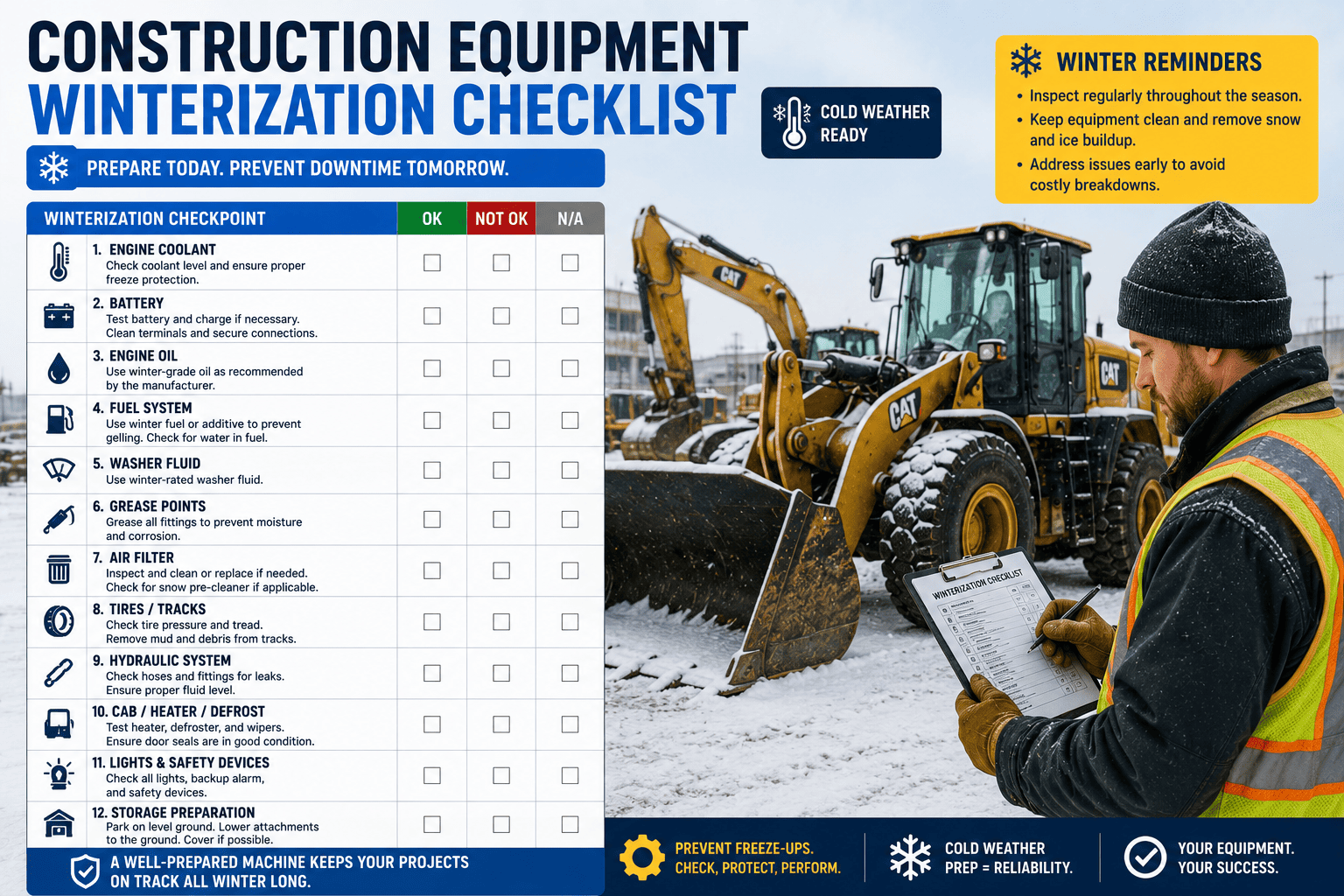
The forecast drops below freezing overnight, and by morning a loader that started instantly all autumn just clicks. Somewhere in that machine, diesel fuel has started to wax, battery output has quietly dropped by a third, and hydraulic fluid has thickened enough to make the first cycle of the day sluggish and strained. None of that happened suddenly. It built up over weeks of skipped winter prep, and it shows up on the one morning a crew can least afford a dead machine. A proper construction equipment winterization checklist is what keeps that morning from happening at all.
Winterizing construction equipment means switching to cold-weather grades of diesel, oil, coolant, and hydraulic fluid, testing and warming batteries, and inspecting hoses, seals, and undercarriage components before the first hard freeze. Battery cranking capacity can drop by roughly 20 to 30 percent at freezing temperatures and by half at around minus 18°C, diesel fuel can begin waxing near 32°F and gel entirely near 0°F, and hydraulic fluid can freeze outright around minus 10°F, all of which make an unwinterized machine far more likely to fail on the coldest morning of the season.
Why Cold Weather Attacks Every Fluid System at Once
Cold weather is arguably the most damaging environment for heavy equipment, not because of any single failure but because condensation, stiff seals, reduced battery output, and thickened fluids all compound at the same time. A machine that runs fine in October can struggle to start, respond sluggishly, or strand a crew entirely by January if none of its fluid systems were prepared for the drop in temperature.
Why Small Temperature Drops Cause Big Problems
Diesel fuel can begin waxing around 32°F and gel entirely around 0°F, blocking fuel flow before an engine ever turns over. Hydraulic fluid thickens well before it actually freezes, causing sluggish boom and auxiliary circuit response long before the fluid reaches its roughly minus 10°F freezing point. These aren't failures that wait for the coldest day of the year. They start showing symptoms the first time temperatures dip meaningfully below normal operating range.
The Battery Problem Nobody Notices Until It's Too Late
A battery's effective cranking capacity can drop by roughly 20 to 30 percent at freezing temperatures, and by around half once temperatures fall near minus 18°C. A battery that seemed perfectly healthy in warm weather can simply not deliver enough cranking power on the coldest morning, which is exactly why battery checks belong at the top of every winterization list, not an afterthought.
The Four Systems That Need Attention Before the First Freeze
Winterizing a fleet comes down to four interconnected systems, each vulnerable to cold in its own way.
Fuel
Switch to winter-blend diesel with a lower cloud point, add anti-gel additives, and replace fuel filters to clear any wax particles before they restrict flow during a cold start.
Battery & Electrical
Test voltage under load, clean and tighten terminal connections to remove corrosion, and use battery blankets or trickle chargers to hold charge in machines that sit overnight.
Hydraulics
Switch to a low-viscosity, cold-weather-rated hydraulic fluid, inspect hoses for cracking or softness, and warm the system gradually before heavy-load work.
Coolant & DEF
Test antifreeze concentration against expected lows, confirm a proper mix ratio, and keep diesel exhaust fluid insulated since it can freeze around 12°F.
Fuel and Fluids: What Actually Changes for Winter
Every fluid in a machine has a summer specification and a winter specification, and running the wrong one is one of the most common, and most avoidable, causes of cold-weather downtime.
Diesel Fuel and the Gelling Problem
Diesel #2 gels at colder temperatures, while Diesel #1 has a lower viscosity and resists gelling better in extreme cold. Most fuel stations in colder regions offer a seasonal blend suited to local temperatures, and pairing that with an anti-gel additive gives an extra margin of protection during an unexpected cold snap.
Hydraulic Fluid and Warm-Up Discipline
A low-viscosity, cold-weather-rated hydraulic fluid keeps pumps and motors from straining against thickened fluid on a cold start. Even with the right fluid, giving the system time to circulate and reach a normal operating temperature before heavy-load work meaningfully reduces strain on hoses and pumps during the first hour of a cold shift.
Schedule and Verify Every Winterization Step Automatically
FleetRabbit schedules fluid switches, battery checks, and cold-weather inspections across your whole fleet, then confirms each task was actually completed with a digital record. Sign up to set up your winterization schedule in minutes, or book a demo to see it running first.
Summer Spec vs. Winter Spec at a Glance
Knowing what to actually switch to is half the battle. Here's how common fluid and component specs typically shift for cold-weather operation.
| Component | Warm-Weather Spec | Cold-Weather Spec | Why It Matters |
|---|---|---|---|
| Diesel fuel | Standard Diesel #2 blend | Winter-blend or #1/#2 mix with anti-gel additive | Prevents waxing and gelling that blocks fuel lines and filters |
| Hydraulic fluid | Standard viscosity grade | Low-viscosity, cold-weather-rated fluid such as ISO 32 or 22 | Reduces pump strain and sluggish boom or auxiliary response |
| Coolant | Standard antifreeze mix | 50/50 antifreeze-to-water ratio tested against expected lows | Prevents cracked engine blocks from frozen coolant |
| Track tension | Standard summer tension | Slightly looser tension to account for frozen buildup | Reduces premature undercarriage wear in freeze-thaw cycles |
Batteries, Undercarriage, and the Checks Easy to Overlook
Fluids get most of the attention, but two other areas cause just as much winter downtime when skipped.
Battery Testing Beats Battery Guessing
A battery that looks fine and holds a charge in mild weather can fail to deliver enough cranking amps once temperatures drop. Testing voltage under load, rather than just checking that it powers on, is what actually reveals a battery that needs replacing before the cold arrives, not after a crew is stranded.
Grease, Seals, and Tire Pressure
Cold weather makes rubber brittle and thickens grease at every pivot point. Applying a cold-weather-rated grease to pins and bushings, inspecting hoses and seals for cracking, and rechecking tire pressure regularly, since pressure drops as temperatures fall, all prevent small issues from turning into breakdowns mid-shift.
Building Winterization Into Your Fleet's Routine
The fleets that avoid winter breakdowns treat winterization as a scheduled task with a checklist and a deadline, not a reminder someone eventually gets around to. Pinpointing which machines need attention, tracking which winterization tasks are actually completed, and getting ahead of the first hard freeze rather than reacting to it is what separates a smooth winter from a season of unexpected downtime. If you'd like to see how a scheduled, trackable winterization program looks in practice, booking a demo is the fastest way to judge the fit for your fleet.
Frequently Asked Questions
Don't Let the First Cold Snap Catch Your Fleet Off Guard
A machine that isn't winterized doesn't fail gradually, it fails on the coldest morning of the season when you can least afford it. FleetRabbit schedules and verifies every winterization task across your fleet automatically. Sign up for a free trial or book your demo today.