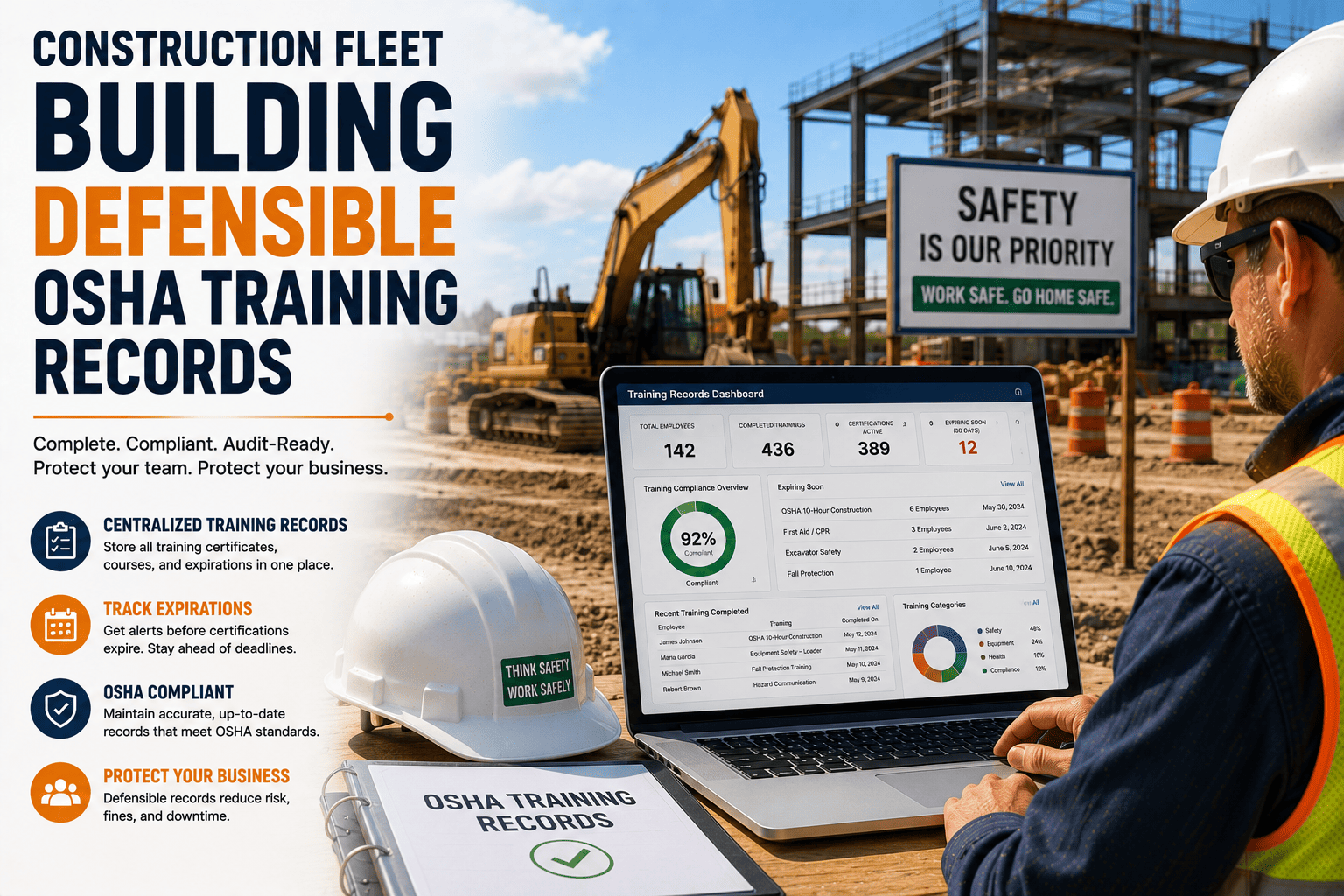
An OSHA inspector doesn't ask whether the training happened. They ask you to prove it. A compliance officer who requests training documentation and gets a blank stare treats that the same as no training ever occurring, which means a crew that completed every required session can still get cited if the paperwork can't back it up. On a construction site where workers rotate between projects and subcontractors bring their own crews through the gate, that paperwork gets harder to keep straight every single week.
A defensible OSHA training record needs the employee's name, training date, topics covered, trainer identity, and proof of comprehension, kept for whatever period the specific standard requires. Per-violation penalties currently reach 16,550 dollars for a standard violation and 165,514 dollars for a willful or repeated one. Sign up for FleetRabbit to track every operator's training and certification in one place, or book a demo to see audit-ready records in action.
What Actually Makes a Training Record Defensible
Most OSHA documentation failures aren't training failures. Documentation failures are more common than training failures, because employers can't prove training happened even when it did. A defensible record needs to hold up on its own, without anyone in the room to vouch for it.
Employee Name and Signature
Confirms the specific individual who attended and completed the session.
Training Date and Duration
Every training session must include the date and duration alongside the topics covered.
Trainer Identity and Qualifications
Confined space certification, for example, requires the signatures or initials of the trainers along with the dates of training.
Proof of Comprehension
A quiz score, evaluation, or sign-off confirming the worker actually understood the material, not just attended it.
Never Scramble for a Training Record Again
FleetRabbit stores every operator's certification, training date, and renewal deadline in one searchable record, ready the moment an inspector asks. Start your free trial to digitize your training files, or book a 30-minute demo to see it set up for your crew.
How Long You're Required to Keep Each Record
Retention rules aren't uniform across OSHA standards, and construction crews are often covered by several at once. Retention periods vary by standard, ranging from a minimum of one year for general safety training up to the duration of employment plus 30 years for certain exposure and medical surveillance records.
| Record Type | Minimum Retention |
|---|---|
| General Safety Training (1910.120) | 1 year |
| Powered Industrial Truck / Forklift Training | 3 years |
| Injury and Illness Records (OSHA 300 Logs) | 5 years |
| Fall Protection Certification (1926.503) | Duration of employment |
| Exposure Monitoring / Medical Surveillance | Employment plus 30 years |
Records should be kept current, accurate, legible, and dated, both for OSHA and for the employer's own protection. Best practice for many standards without a specified period leans toward keeping records for the full duration of employment, since a documentation gap discovered years later is much harder to explain than one caught immediately.
Why Construction Sites Make This Especially Hard
Workers Move, But Their Records Need to Follow Them
Construction sites face added complexity because the workforce, the hazards, and the physical location of the work all change continuously throughout a project, so training records need to be accessible no matter which site an operator ends up on next.
Subcontractor Crews Add a Layer of Responsibility
General contractors bear responsibility for ensuring subcontractor employees working on their sites have received required safety training, which means your compliance exposure extends beyond your own payroll.
Every Standard Has Its Own Rules
Dozens of substance-specific and construction standards carry their own training documentation rules, and the pattern is consistent: the more hazardous the activity, the more detailed the recordkeeping requirement. Tracking that manually across a rotating crew is where most gaps start.
Building an Audit-Ready System
Centralize Every Certification in One Place
One record per worker, covering every standard that applies to their role, instead of scattered binders and spreadsheets.
Set Renewal Reminders Ahead of Expiration
Certifications lapse quietly if nobody is tracking the calendar, and an expired certification is treated the same as no certification at all.
Include Subcontractor Records in the Same System
Keep proof of subcontractor training accessible on-site, since responsibility extends to every crew working under your project.
Run Internal Audits Before OSHA Does
The single most important habit for inspection readiness is conducting regular internal audits of your training records.
Keep Every Certification Audit-Ready, Automatically
FleetRabbit tracks training dates, renewal deadlines, and subcontractor certifications so your compliance record is complete before an inspector ever asks. Create your free account today, or schedule a demo to see your workforce compliance dashboard.
Frequently Asked Questions
OSHA doesn't expect perfection, but it does expect proof. The construction companies that come through an inspection clean aren't necessarily the ones with the fewest incidents. They're the ones who can pull up every operator's training history in a few clicks instead of digging through file boxes while the clock is running. Sign up for FleetRabbit to get your training records in order before you need them, or book a demo to see how it works for your team.
Make Every Training Record Inspection-Ready
FleetRabbit centralizes operator certifications, training history, and renewal deadlines so you can prove compliance the moment it's requested.