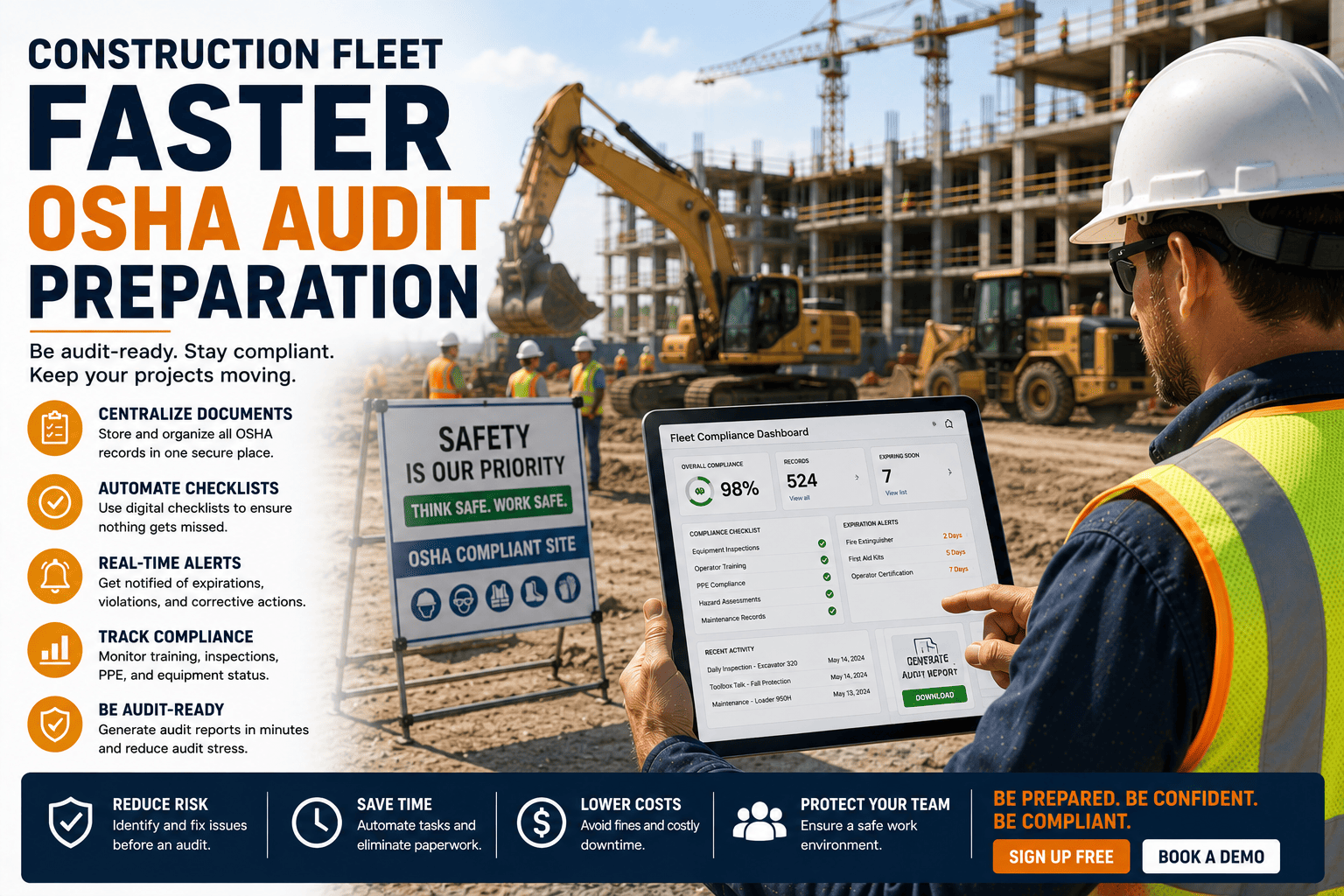
The auditor calls on a Tuesday and asks to see records by Thursday. For most construction fleet managers, that phone call triggers a scramble through filing cabinets, truck cabs, and old email threads, hoping the right inspection sheet from March is still somewhere. It does not have to work this way. Fleets that build audit readiness into their daily routine turn a two day scramble into a two minute export, and that difference is often what separates a clean audit from a five figure fine.
A serious OSHA violation can run 16,131 to 161,323 dollars per instance, and 71 percent of fleet managers report gaps in their inspection records once an audit actually begins. Paper-based systems typically achieve only a 73 percent audit pass rate, while centralized digital records reach closer to 96 percent, with full document retrieval in under 60 seconds instead of hours or days.
What An Auditor Actually Asks For First
OSHA compliance officers do not wander a site looking for problems at random. They work through a defined sequence of document requests, and how quickly you produce each one shapes the tone of the entire visit. The four categories below come up in nearly every construction equipment audit.
Pre-Shift Inspection Records
Dated, signed inspection logs for every piece of equipment in operation, showing defects found and corrective action taken.
Maintenance And Repair History
Proof that flagged defects were actually repaired and verified before equipment returned to service, not just noted and forgotten.
Operator Qualification Files
Training certificates, license renewals, and equipment-specific qualifications for every operator currently assigned to that machine class.
Site Safety Program Documentation
Written safety programs, hazard assessments, and records showing frequent, regular inspections by a competent person as required under 1926.20.
Why Preparation Usually Takes Days, Not Minutes
The gap between a fast audit and a painful one rarely comes down to whether inspections happened. It comes down to whether anyone can find proof of them fast enough to matter. The comparison below shows where paper-based fleets lose time that digital fleets simply do not.
Fleets running paper logs also see inspection consistency vary by as much as 40 percent between sites, since one crew's thorough process is another crew's rushed one. That inconsistency is exactly what an auditor notices first, and exactly what teams that sign up for FleetRabbit eliminate within their first few weeks on the platform.
FleetRabbit keeps inspection logs, maintenance history, operator certifications, and safety documentation in one searchable cloud dashboard. Pull a complete audit package for any asset or site in seconds, not days. Start free with three vehicles today.
The Four OSHA Standards Behind Every Equipment Audit
Construction equipment audits are structured around a small set of governing standards. Knowing which standard applies to which equipment category makes it far easier to know exactly what documentation to keep ready at all times.
| Standard | Covers | Documentation Auditors Request |
|---|---|---|
| 1926.20 | General safety and accident prevention programs | Written safety program, competent person inspection logs, training records |
| 1926.600 | General equipment condition and operation | Pre-shift inspection sheets, defect logs, repair verification records |
| 1926.602 | Material handling equipment such as loaders and haulers | Equipment-specific checklists, seatbelt and backup alarm function checks |
| Subpart CC | Cranes and derricks | Shift, monthly, and annual documented inspections, operator certification |
Building A Fleet That Is Always Audit-Ready
The goal is not to prepare for an audit, it is to never need to prepare because the records are already organized. Getting there follows the same three phases whether your fleet runs five machines or five hundred.
Phase One: Centralize Every Record Type
Move inspection logs, maintenance history, and operator files off paper and email threads and into a single system. When everything lives in one place, there is nothing left to hunt for when a request comes in.
Tag records by equipment and standard
Link each document to the specific machine and the OSHA standard it satisfies, so a single search pulls every relevant file instantly instead of requiring a manual cross-check.
Phase Two: Run Mock Audits Quarterly
Time how long it actually takes to produce a complete file for a single asset. If retrieval takes more than a few minutes, the organization system needs work before a real auditor exposes the gap.
Assign a single audit coordinator
One named person should own communication and document handoff during any real inspection, so nothing falls through the cracks between the safety coordinator, project manager, and fleet manager.
Phase Three: Automate The Record Trail
Digital checklists that require photo evidence and timestamps create the audit trail automatically, closing the loop between a defect being found and a defect being fixed without anyone needing to remember to file the paperwork.
Fleets ready to move away from scattered paper files can book a demo and see exactly how FleetRabbit organizes records by equipment, standard, and site before the next audit notice arrives.
Audit Readiness Scorecard
Use these benchmarks to check whether your fleet would hold up if an auditor called tomorrow.
FleetRabbit organizes every inspection, repair, and certification into one audit-ready dashboard, so your team never scrambles again. See how fast a complete record pull can really be.