Ask any construction fleet manager what keeps them up at night and inspection completion rates will come up fast. Operators skip steps when they're rushing to start a shift. Paper forms get left in the cab, stuffed in a glovebox, or never filled out at all. Then an OSHA inspector shows up, or worse, a machine fails mid-lift, and the gap between "we have a checklist" and "the checklist actually gets done" becomes very expensive very quickly.
Most construction fleets complete only 60 to 75 percent of required pre-start inspections on paper, and even fewer are filled out accurately in the field. Digital inspection systems with automated reminders and photo verification push completion rates above 95 percent, cut OSHA citation exposure, and catch equipment defects before they turn into breakdowns or jobsite injuries.
Why Inspection Completion Rates Fall Apart on Real Jobsites
Every construction fleet has an inspection checklist somewhere. The problem is rarely the checklist itself. It is what happens between the checklist being written and it actually getting completed on a cold Monday morning with three machines needing to move dirt in the next ten minutes. Paper forms achieve roughly 73 percent audit pass rates, while digital inspection systems with timestamped entries reach closer to 96 percent, and that gap tells the real story of where completion breaks down.
The Operator Time Pressure Problem
Operators are judged on production, not paperwork. When a foreman needs an excavator moving material by 7:00 a.m., a five-minute walkaround inspection feels like the first thing to sacrifice. Without a system that makes the inspection faster than skipping it, "pencil-whipping" becomes the default, where boxes get checked without anyone actually looking at the machine.
The Lost Paper Trail
A clipboard left in a truck cab, a form that never made it back to the office, a signature nobody can read months later. Paper inspection records fail the moment an inspector asks for documentation on the spot, because "readily accessible" is not the same as "somewhere on a jobsite." If it isn't documented, in the eyes of OSHA it did not happen.
No Visibility Until It's Too Late
Fleet managers overseeing multiple sites often only discover an inspection was skipped after equipment fails or a citation lands. Without real-time tracking, there is no way to flag a missed inspection before that machine starts its shift, which is exactly the window where prevention actually matters.
Push, Don't Wait
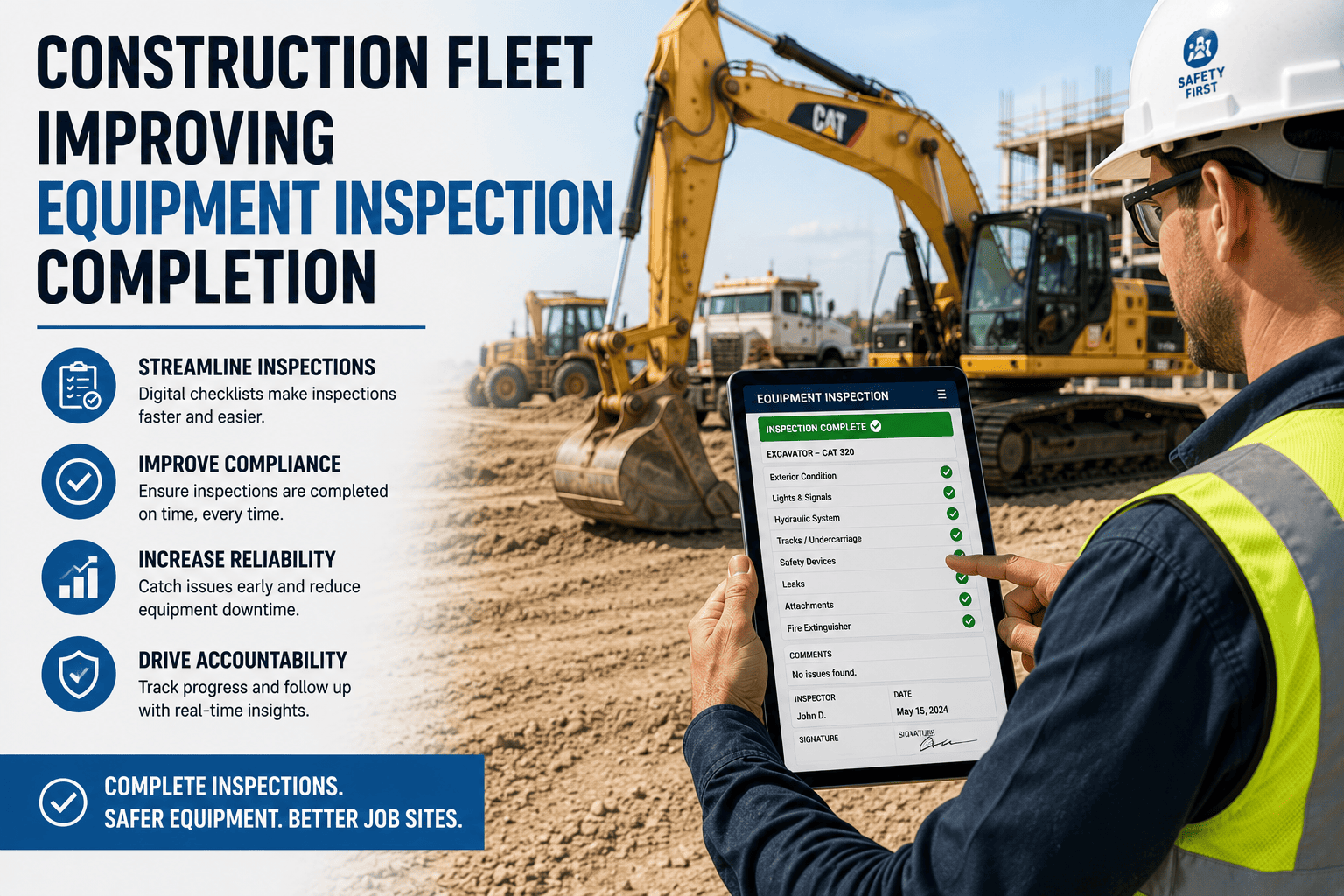
Checklists are sent directly to the operator's device before the shift starts, instead of relying on someone remembering to grab a form.
Verify With Evidence
Photo capture and GPS timestamps confirm the inspection happened at the machine, at the right time, not from memory afterward.
Flag Before It's Overdue
Managers get alerted the moment an inspection is missed or a defect is logged, instead of finding out during an audit.
Close The Loop
Every flagged defect routes into a work order automatically, so "documented but never repaired" stops being a liability.
FleetRabbit pushes digital pre-start checklists straight to operator devices, captures photo proof automatically, and flags overdue inspections before equipment ever leaves the yard. Sign up free and see your completion rate climb within the first week.
Paper Checklists vs Digital Inspection Systems
The difference between a paper clipboard and a digital inspection platform is not just convenience. It shows up directly in audit outcomes, defect follow-through, and how fast a fleet manager can answer an OSHA officer's questions.
| Factor | Paper Checklist | Digital Inspection System |
|---|---|---|
| Audit Pass Rate | Around 73 percent | Around 96 percent |
| Proof Of Completion | Signature only, easy to backdate or skip | Timestamp, GPS location, and photo evidence |
| Manager Visibility | None until form is manually collected | Real-time dashboard, instant overdue alerts |
| Defect Follow-Up | Often lost between form and work order | Auto-routed to a work order the moment it's logged |
| Record Retrieval For Audits | Minutes to hours searching filing cabinets | Under 3 minutes for any equipment or date range |
What It Actually Costs When Inspections Get Skipped
Incomplete inspection programs do not just risk a citation. Enforcement priorities now put digital documentation front and center, and enhanced penalty structures have pushed violation costs up by roughly 45 percent. A serious violation can run close to 16,550 dollars per instance, and a willful or repeated violation can climb past 165,000 dollars. Beyond the fine, a work stoppage triggered by a failed inspection or safety incident can cost a jobsite 25,000 to 75,000 dollars per day in idle crews and delayed schedules.
Unqualified Operator Risk
Missed inspection sign-off is often tied to a bigger problem: operators submitting checklists for equipment they are not certified to run. Citation costs for unqualified operator violations typically range from 5,625 to 15,625 dollars per equipment type, and that number multiplies fast across a multi-site fleet.
The Documented-But-Ignored Trap
One of the most damaging outcomes is a defect that gets logged on an inspection form and then never repaired. That single record becomes proof the hazard was known, which turns a routine maintenance gap into a much harder violation to defend.
Benchmarks Worth Tracking
A completion rate on its own does not tell the whole story. Fleet managers who actually move the needle track a small set of numbers consistently.
Reading The Numbers
If your fleet sits below 90 percent completion, or if defects are logged without a clear repair record attached, those are the two clearest early signals that your inspection program is closer to a paper trail than a safety system. Both are fixable, and both are exactly what a digital platform is built to close.
A Quick Gut Check
Ask yourself how long it would take to pull every inspection record for a single excavator over the last 90 days, right now. If the honest answer is more than a few minutes, that gap is where risk lives.
Getting From Paper To Full Completion
Fixing completion rates does not require ripping out your entire maintenance program. It starts with removing the friction that makes operators skip steps in the first place.
Make The Checklist Meet The Operator
Push the inspection to the device the operator already has in the cab, timed to appear right as the shift starts, instead of expecting someone to remember a form.
Require Evidence, Not Just A Signature
A photo of the tire, the hydraulic line, or the fluid pool on the ground is much harder to fake than a checkbox, and it gives fleet managers something concrete to review.
Close The Gap Between Defect And Repair
Every flagged issue should generate a work order automatically. A defect sitting in a form with no linked repair is the single most common gap OSHA auditors look for.
FleetRabbit gives every piece of equipment a permanent, timestamped inspection history, complete with photo evidence and automatic defect routing. Book a demo to see how fast your team can go fully digital.
Every incomplete inspection is a hidden liability sitting on your jobsite. FleetRabbit makes the right way the easy way, with checklists that land on the operator's device, evidence that proves the work was done, and alerts that catch problems before they become citations. Sign up free or book a demo to see it running on your fleet.