Ask five operators on five different crews to inspect the same excavator, and you will likely get five different results. One checks the hydraulic hoses carefully. Another rushes through in ninety seconds because the shift is starting late. A third checks off every box without ever leaving the cab. This is not a training problem alone, it is a quality problem, and it is the single biggest reason equipment failures still surprise contractors who technically "do inspections" every day.
Paper-based inspection programs achieve roughly 73 percent audit pass rates, while guided digital checklists with required fields and photo evidence reach around 96 percent. Rushed or skipped pre-shift checks are the leading cause of equipment failures discovered mid-operation rather than before it. Standardizing inspection quality across crews, shifts, and job sites closes this gap and turns a compliance chore into a genuine safety and cost advantage.
Why Inspection Quality Quietly Falls Apart
Most contractors are not skipping inspections outright. The bigger issue is quality drift, the same checklist producing wildly different levels of scrutiny depending on who fills it out and how rushed they feel. Left unmanaged, this drift becomes invisible until a machine fails on the job site or an auditor asks for proof of what was actually checked.
Checked, Not Inspected
Under shift pressure, operators mark items complete without ever touching the machine. The form gets filled, but the hazard stays hidden until it fails during operation.
Inconsistent Standards
Without a guided process, quality depends entirely on who is holding the clipboard. One crew's thorough inspection is another crew's quick glance at the same asset class.
Lost Paper Trails
Completed forms disappear into a truck cab or a site trailer drawer, so nobody can prove an inspection happened when it matters most, during an audit or after an incident.
No Trend Visibility
A single inspection tells you little. Without a history of readings over time, gradual wear and repeated defects go unnoticed until the equipment finally breaks down.
What Poor Inspection Quality Actually Costs
Inspection quality is not an abstract safety metric, it shows up directly in downtime, citations, and insurance costs. When inspections happen but do not actually catch defects, contractors lose the one advantage a checklist is supposed to provide: an early warning.
The gap between those pass rates is not about whether crews are careful people. It is about whether the process itself forces real scrutiny. A rushed inspection on paper looks identical to a thorough one, a blank checkbox says nothing about whether the hose was actually examined. That is exactly the gap a guided digital process is built to close, and it is why teams that sign up for FleetRabbit usually see their pass rates move within the first few weeks.
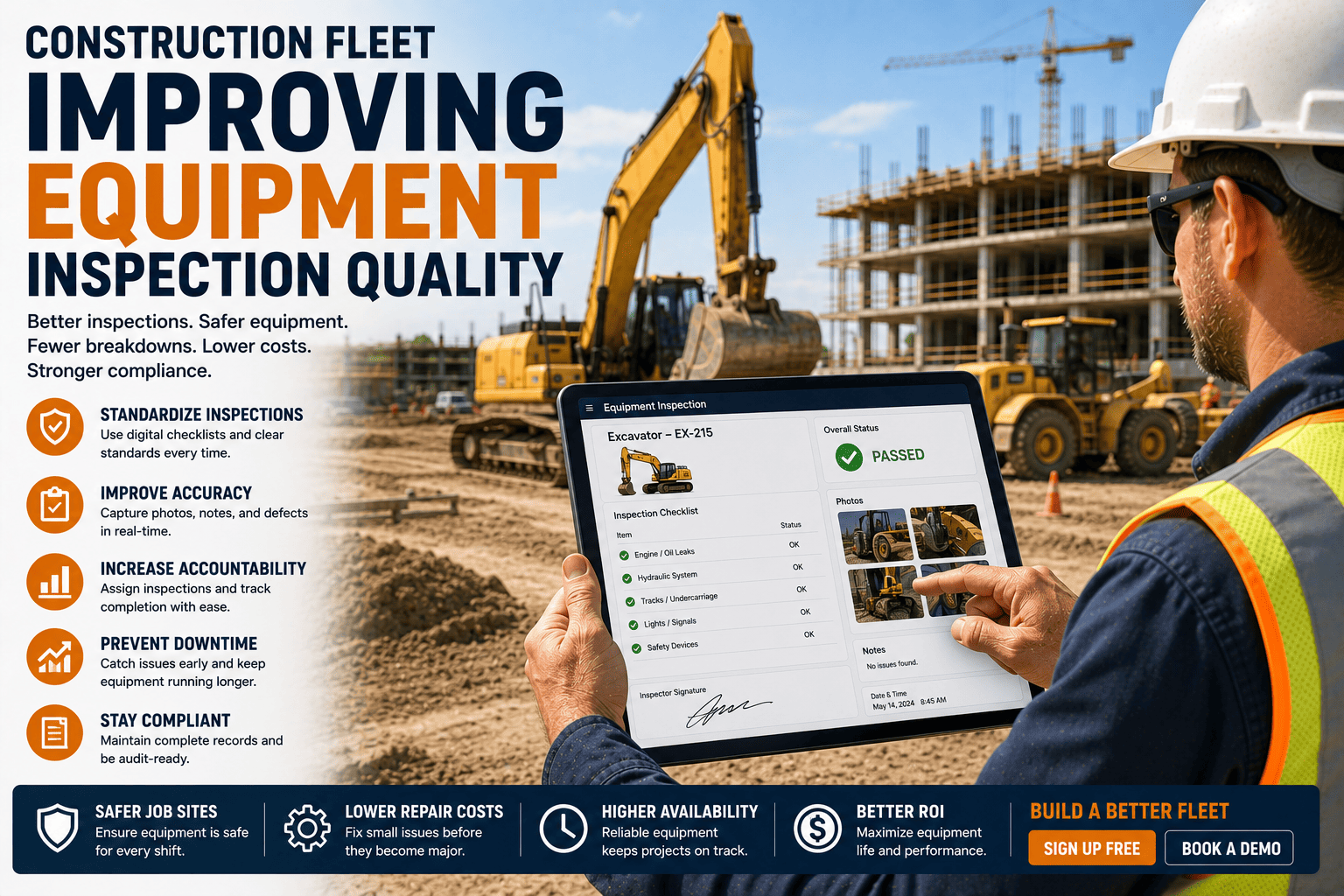
FleetRabbit pushes equipment-specific checklists to every operator's phone before each shift, requires photo evidence at key checkpoints, and won't let a form submit with skipped fields. Try it free with three vehicles and see the difference in your first week of reports.
Paper Checklists Versus Guided Digital Inspections
The format of an inspection shapes the quality of the inspection. A guided digital process does not just move the same form onto a screen, it changes what is possible to submit in the first place.
| Quality Factor | Paper Checklist | Guided Digital Checklist |
|---|---|---|
| Skipped Fields | Common, no way to enforce completion before submission | Blocked, required fields must be completed before the form submits |
| Proof of Real Inspection | A checkmark only, no evidence the item was actually examined | Timestamped, photo-verified entries at key checkpoints |
| Consistency Across Crews | Varies by operator habit and how rushed the shift feels | Same guided sequence for every operator on every asset type |
| Retrieval During Audit | Minutes to hours searching trucks, drawers, and job trailers | Seconds, pulled from a searchable cloud dashboard |
| Trend Detection | Manual comparison across stacks of paper, rarely done | Automatic tracking of condition and repeat defects over time |
Building A Real Inspection Quality Program
Improving inspection quality is less about adding rules and more about removing the ways a rushed inspection can slip through. The strongest programs follow the same three phases, whether they are running one job site or fifty.
Standardize The Checklist Itself
Every asset class needs its own guided checklist covering the items that actually matter for that machine, not a generic form reused across excavators, cranes, and loaders.
Structural and functional items
Separate pre-use condition checks from functional tests, so operators verify structure first and safety systems second, in that order, every single time.
Remove The Room For Shortcuts
Required fields, mandatory photos at key checkpoints, and time-stamping of each item completion make it obvious when an inspection was rushed or skipped altogether.
Escalation ownership
A failed item needs a named owner and a corrective action status, not just a note, so defects get controlled instead of quietly carried forward shift after shift.
Review Trends, Not Just Single Reports
One inspection is a snapshot. A history of inspections is a trend line that shows gradual wear before it becomes a breakdown or a citation.
Supervisor visibility
Real-time dashboards let supervisors spot inspections completed suspiciously fast, unresolved defects, and assets that are drifting toward failure across every crew and site at once.
Contractors who put this structure in place typically see the improvement fast because the process itself, not extra training hours, is what was allowing quality to slip. Teams ready to move can book a demo and walk through how the checklist logic maps to their exact equipment mix.
Benchmarks Worth Tracking
A few metrics reveal whether your inspection program is truly working or just generating paperwork. Track these across your fleet on a monthly basis.
FleetRabbit's guided checklists, required photo checkpoints, and real-time dashboards make it obvious when an inspection was rushed and effortless when it was thorough. Get every site working from the same standard, starting this week.