A machine's real value is not just what it can still do, it is what a buyer, an insurer, or a warranty department can prove about what has already been done to it. Ask most construction fleets to produce a complete service history for a ten-year-old excavator and you get a mix of shop invoices in a filing cabinet, a few notes in someone's phone, and a gap of eighteen months nobody can explain. That gap is not a paperwork inconvenience. It is a denied warranty claim, a lowball resale offer, and a rebuild decision made on gut feel instead of real data.
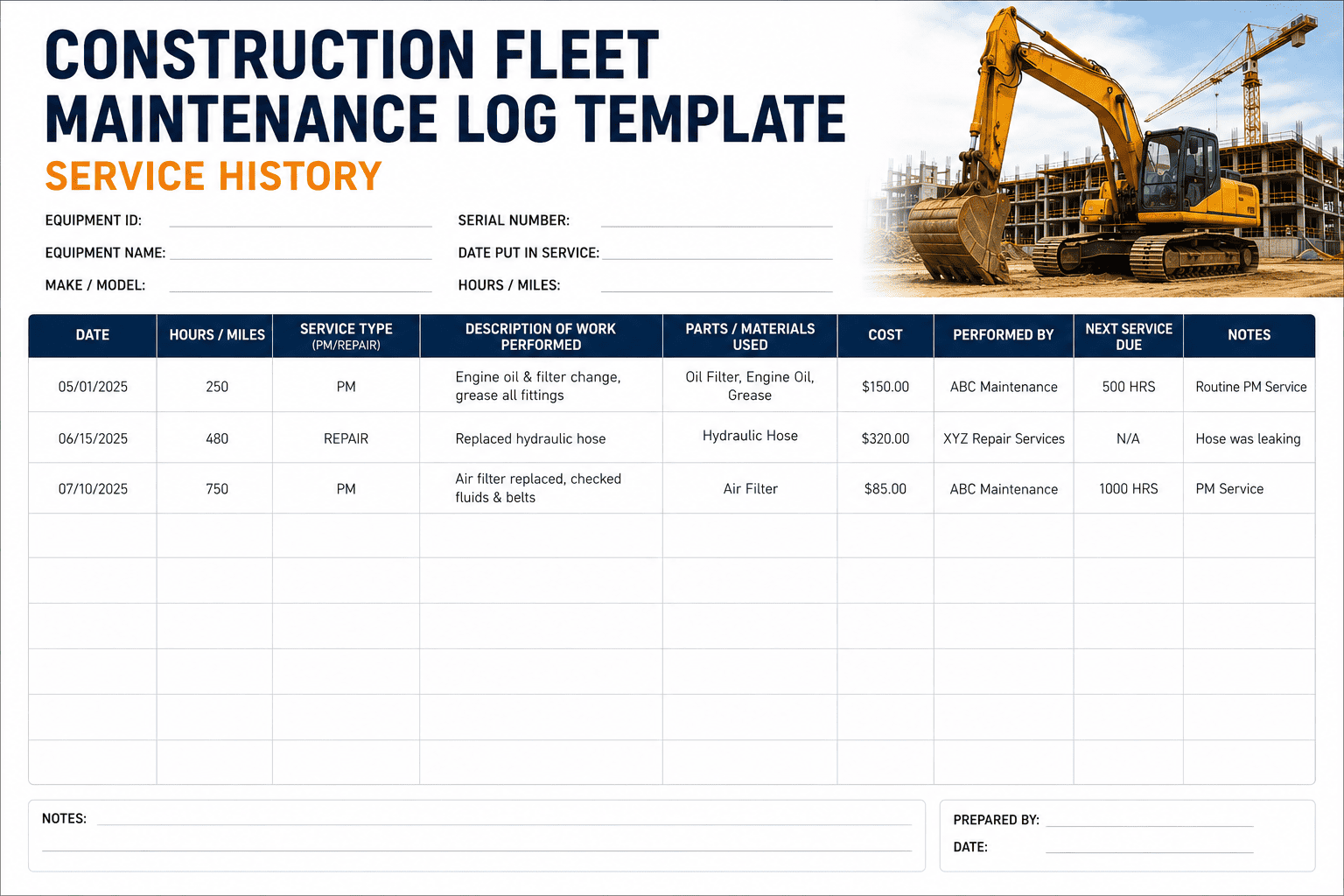
A construction fleet maintenance log should capture equipment identification, a date-stamped record of every service event, the technician who performed the work, parts replaced, labor and total cost, warranty status, and the next service due date. Complete, uninterrupted service history is what supports warranty claims, protects resale value, and gives fleet managers real cost data for repair-versus-replace decisions. FleetRabbit records every inspection, repair, and preventive maintenance event automatically, so the log stays complete without anyone chasing down paper invoices later.
What a Complete Log Entry Captures
A maintenance log entry that gets written days after the work happened is already unreliable, full of gaps and guesses that undermine it the moment it needs to support a warranty claim. Every entry should be completed at the time of service and include four groups of information.
Equipment Identification
Asset ID, make, model, and serial number, so the log ties to one specific machine from the day it enters service until the day it is sold.
Service Event Details
Date, technician name, work performed, and parts replaced with part numbers, written down at the time of the service, not reconstructed afterward.
Usage at Time of Service
Engine hours or mileage logged at the moment of service, which is the number a future buyer or warranty adjuster will check first.
Cost and Warranty Status
Labor hours, parts cost, total event cost, and whether the repair fell under warranty coverage, so nothing gets paid for twice.
Three Reasons This Log Pays for Itself
A maintenance log feels like paperwork right up until the moment it is the only thing standing between your company and a denied claim or a lowball resale offer. Here is exactly where a complete log earns its keep.
Warranty Claims Actually Get Paid
Manufacturers require proof that service intervals were followed. A single missing entry at the wrong moment can void a warranty worth far more than the repair itself.
Resale Value Holds Up
Buyers pay more for equipment with a documented service history because it proves the machine was cared for, not just running until something broke.
Rebuild-vs-Replace Gets a Real Answer
Cumulative repair cost data turns a gut-feel decision into a numbers-based one, showing exactly when a machine has crossed the point where rebuilding costs more than it is worth.
FleetRabbit records every inspection, repair, and preventive maintenance event as it happens, building a complete service history for every machine in your fleet without a single manual entry lost to a filing cabinet. Sign up free to start logging your fleet today, or book a demo to see a full service history pulled for one machine in seconds.
Sample Maintenance Log Template
Use this layout as the starting structure for a single asset's log. One row per service event, kept in one continuous record for the life of the machine.
| Date | Hours / Mileage | Work Performed | Parts Replaced | Cost | Warranty |
|---|---|---|---|---|---|
| 03/14/26 | 1,240 hrs | Oil and filter change | Oil filter, engine oil | $185 | No |
| 05/02/26 | 1,510 hrs | Hydraulic hose replacement | Return line hose | $420 | Yes |
| 06/19/26 | 1,680 hrs | Undercarriage inspection | Track pad, sprocket | $1,150 | No |
Where Most Maintenance Logs Fall Apart
A log looks complete right up until someone tries to use it. The most common failure is mixed records, where entries for two or three different machines end up in one shared log, making it impossible to trace the full history of any single asset. The fix is simple: one log per asset ID, labeled clearly from day one.
Cost data that never gets reviewed is data that never helps
A log that is filled in faithfully but never analyzed offers no predictive value. The same hydraulic hose fails three times in eighteen months and nobody notices the pattern until the fourth failure shuts down a job site. A quarterly review of every asset's log surfaces recurring failure modes before they become expensive habits.
FleetRabbit keeps one continuous, searchable service history per asset and surfaces repeat repairs automatically, so patterns show up long before they become a pattern of downtime. Sign up free to start building a complete history for every machine, or book a demo to see recurring-failure detection in action.
Frequently Asked Questions
A maintenance log only protects your fleet if it is complete, consistent, and easy to pull on demand. FleetRabbit builds that record automatically for every machine you own, from the first service to the day you sell it.