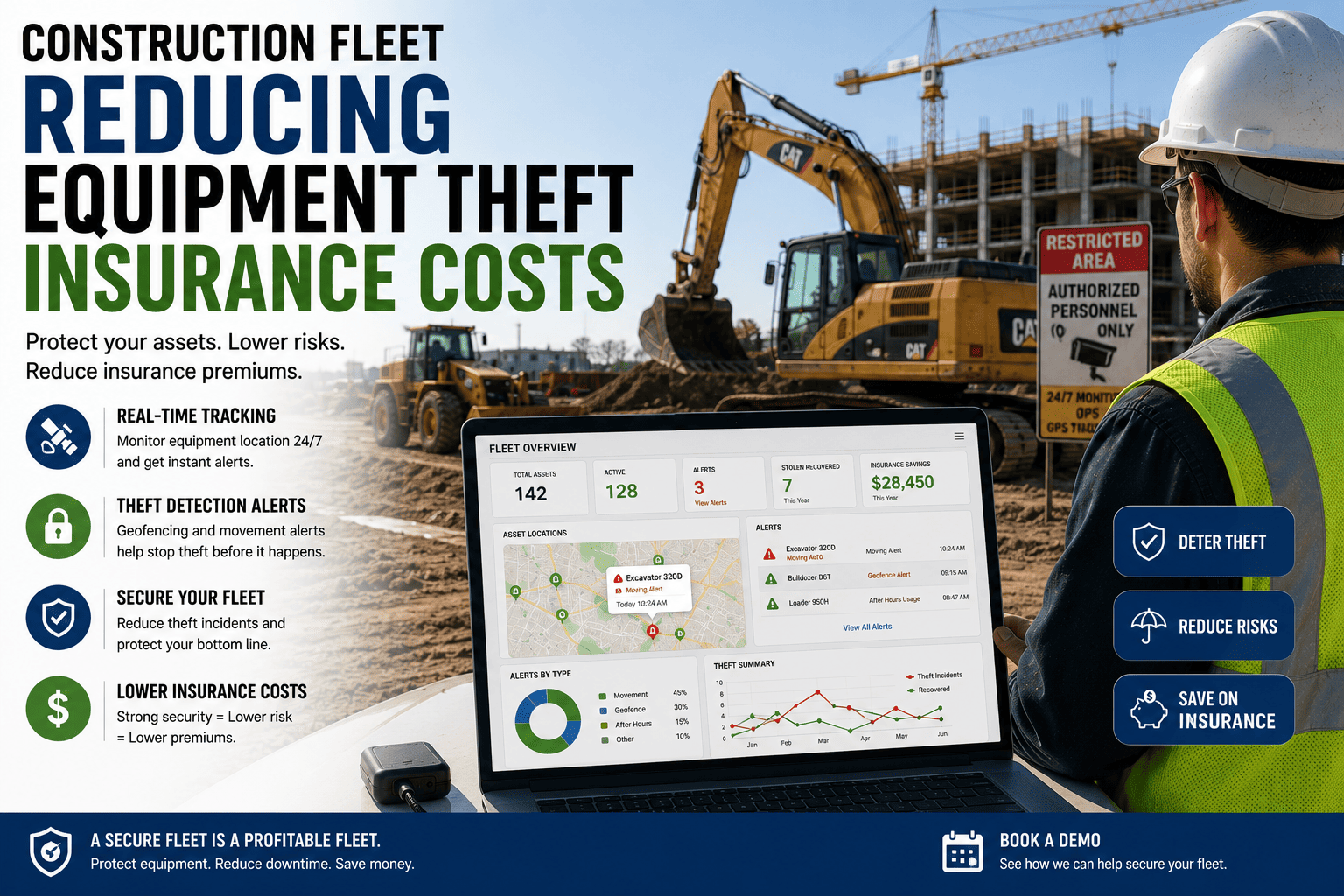
A stolen excavator does not just disappear from the yard, it disappears from your bottom line in three separate ways. There is the replacement cost, typically thirty thousand dollars or more for heavy equipment. There is the rental fee for a temporary stand-in while the schedule waits. And then there is the part contractors underestimate most: the premium increase that follows the claim, often twenty to forty percent, sitting on your policy for years after the machine is gone.
Fewer than one in four stolen pieces of heavy equipment are ever recovered, which means insurers treat every unprotected machine on your site as a near-total loss waiting to happen. That risk gets priced directly into your premium. The good news is that this is one of the more controllable risk factors on your policy, and the fix is largely about visibility rather than replacing your entire security setup. Here is what actually moves the needle on theft-related insurance costs, and how FleetRabbit helps contractors put that protection in place.
Why Theft Risk Drives Your Premium So Directly
Insurers do not just price theft based on how often it happens. They price it based on how often it gets resolved. Heavy equipment without active tracking is recovered roughly 21 percent of the time, meaning a carrier is effectively underwriting a total loss for the large majority of theft claims on unprotected machines. Tracked equipment tells a completely different story, with recovery rates running several times higher and claims resolving far faster.
Equipment owners who maintain GPS tracking data typically resolve theft claims 40 to 60 percent faster than those without it, because the carrier is working with verified location history instead of a police report built on a description and a serial number. Faster, more successful claims history is exactly what underwriters reward with better terms at renewal.
The Timing Pattern Underwriters Already Know
Roughly 80 percent of construction equipment thefts happen on weekends or holidays, and about 70 percent occur overnight when a site sits unattended for hours at a stretch. Underwriters price risk around these patterns, which means a contractor who can show active monitoring during exactly those windows is demonstrating the kind of protection that actually changes their pricing conversation.
FleetRabbit provides continuous GPS location history for every asset, the exact documentation carriers ask for when pricing theft risk. Sign up free and see your fleet's current coverage of high-value assets.
When Theft Actually Happens
Occur on Weekends or Holidays
Sites sitting empty across a long stretch give thieves the uninterrupted window they need to load equipment onto a trailer without drawing attention.
Happen Overnight
Darkness and empty job sites combine to create the highest-risk hours of the week, exactly when active monitoring matters most.
Recovery Rate for Untracked Machines
Without location data, police are working from a description and a serial number, which explains why so few unprotected machines are ever found.
What Actually Lowers Your Premium
Active GPS Tracking on High-Value Assets
Continuous location monitoring is the single most effective step, and it is increasingly treated by carriers as a condition of coverage on high-risk equipment rather than an optional add-on.
Documented Recovery History
A track record of recovered assets, backed by tracking data, gives your broker concrete evidence to negotiate with at renewal instead of a verbal assurance that security has improved.
Geofencing and After-Hours Alerts
Automatic alerts when equipment moves outside approved hours or boundaries catch a theft in progress instead of during the next morning's walk-around.
Complete Asset Inventory With Serial Numbers
A documented inventory tied to tracking data speeds up both the insurance claim and the police report, which is exactly what shortens resolution time after a loss.
Tracked Versus Untracked: The Real Difference in Outcomes
| Outcome | Untracked Equipment | GPS-Tracked Equipment |
|---|---|---|
| Recovery Odds | Roughly 1 in 5 machines ever recovered | Recovery rates several times higher |
| Claim Resolution Time | Slower, relies on police report alone | 40 to 60 percent faster with verified location data |
| Insurance Terms | Priced as high-risk, no discount applied | Premium discounts commonly 5 to 25 percent |
| Post-Theft Premium Impact | Increases of 20 to 40 percent are common after a claim | Faster recovery limits the claim's impact on renewal pricing |
| Underwriting Requirements | May restrict coverage on high-value equipment | Increasingly accepted or required for full coverage terms |
FleetRabbit tracks location, movement, and after-hours activity across your fleet, giving your broker the documentation carriers need to apply theft-related discounts. Book a demo to see how this fits your current policy.
Getting the Discount Conversation Started
Audit Your Highest-Value Assets First
Not every piece of equipment needs the same level of protection. Start with the machines an underwriter would flag as highest risk, typically excavators, skid steers, and generators that are easy to move and hold strong resale value.
Bring Tracking Data to Your Broker Directly
A broker cannot negotiate a discount they do not know you qualify for. Exporting your tracking coverage and recovery history ahead of renewal turns a generic policy review into a specific negotiation.
Confirm What Your Carrier Actually Requires
Some carriers now treat active tracking as a condition of full payout on high-value equipment, not just a discount opportunity, so confirming your policy's specific terms protects you from a reduced claim down the line.
Every unprotected piece of equipment is a near-total loss waiting to happen in your insurer's eyes. FleetRabbit gives every asset the visibility that turns theft risk into a documented discount instead of a rising premium.