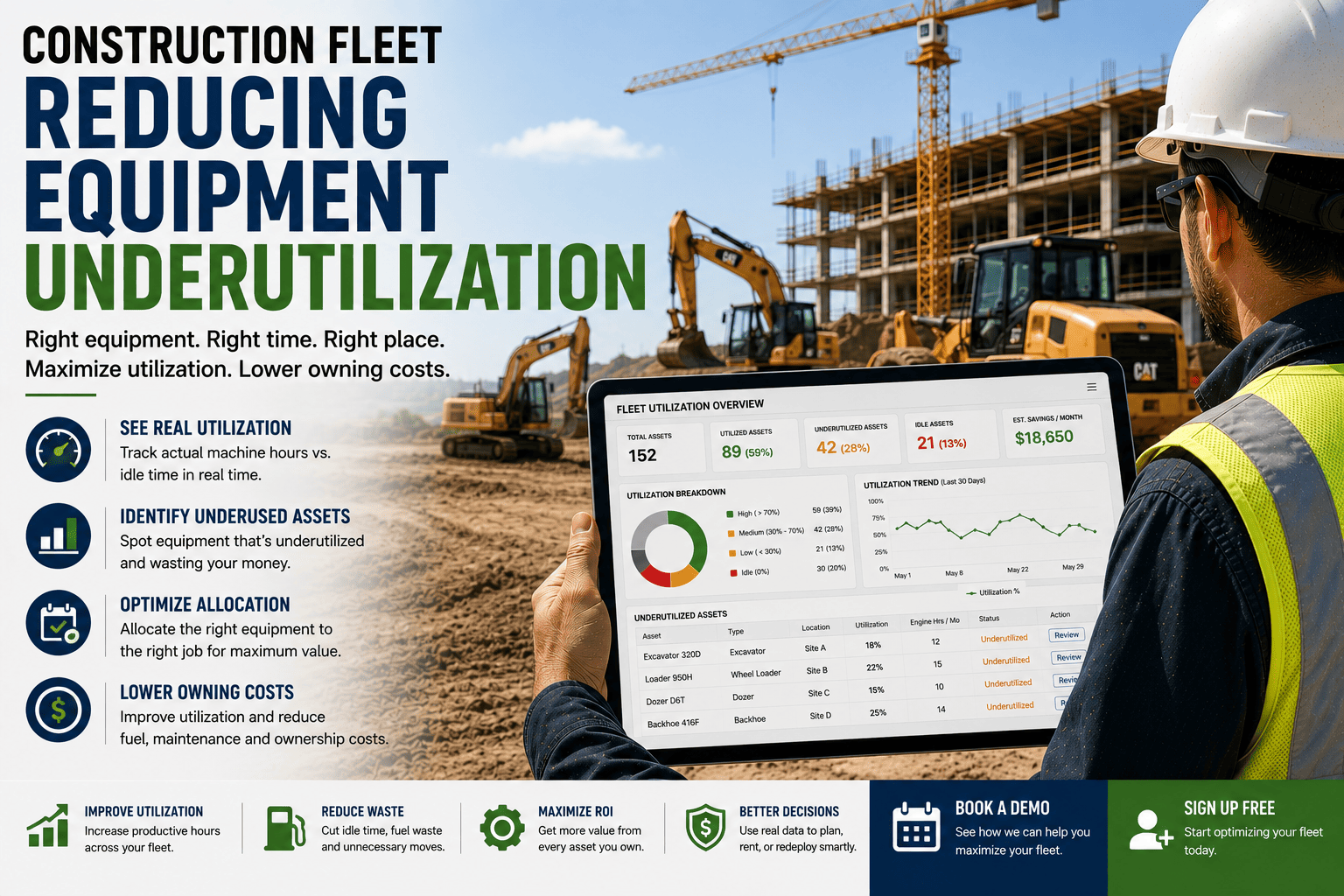
Walk any active job site and you'll usually spot at least one machine parked at the edge of the yard, engine cold, doing absolutely nothing for the project's bottom line. That excavator or skid steer is still costing you money in insurance, depreciation, and storage every single day it sits there. Multiply that across a fleet of forty or fifty units and underutilization quietly becomes one of the largest hidden expenses in construction. The good news is that it's also one of the most fixable, once you can actually see where the idle capital is hiding.
Construction fleets typically sit at only 55 to 70 percent utilization, with idle time reaching as high as 30 to 50 percent of available hours. A single underused machine can drain 15,000 to 40,000 dollars a year in depreciation, insurance, and storage. Fleets that track utilization in real time and redeploy idle assets routinely push productivity back into the 70 to 85 percent optimal range.
Why Underutilization Is Costing You More Than You Think
Underutilization doesn't announce itself the way a breakdown does. There's no smoke, no service call, no red warning light. A machine simply sits at a low-activity site, or in the yard, generating zero output while every fixed cost attached to it keeps accumulating in the background. That silence is exactly why it's so dangerous financially. Most contractors can quickly tell you which machine broke down last month, but very few can tell you which machine has been running at 35 percent capacity for the past quarter.
What Underutilization Actually Looks Like on a Job Site
Underutilization rarely happens because equipment is unnecessary. It happens because of scheduling gaps, poor communication between sites, and a lack of real-time data on where every machine actually is and what it's doing. A dozer purchased for a project that wrapped up early might sit forgotten at a satellite yard for weeks while a different crew rents an identical unit because nobody realized the first one was available.
Common Causes Behind Idle Equipment
Four patterns show up again and again across fleets that struggle with utilization. Recognizing them is the first step toward correcting them.
Scheduling and Communication Silos
When procurement, scheduling, and field teams don't share a single source of data, machines get double-booked at one site while sitting empty at another. Equipment becomes stranded simply because nobody had visibility across the whole portfolio.
Manual, Outdated Tracking
Paper logs and spreadsheets can't keep pace with a fleet spread across multiple active sites. By the time a utilization report reaches a manager, the data is already weeks old and the opportunity to redeploy an idle machine has usually passed.
Over-Purchasing to Avoid Delays
Without fleet-wide visibility, it's common to buy or rent new equipment simply because nobody can confirm whether an existing machine is actually free. This quietly duplicates capacity the company already owns.
No Clear Ownership of the Metric
Utilization often falls between departments. Operations blames scheduling, scheduling blames the field, and the machine keeps sitting idle because no single team is accountable for tracking and acting on the number.
FleetRabbit turns engine hours, GPS data, and jobsite activity into a live utilization score for every machine you own. Sign up to see exactly which assets in your fleet are underused right now, or book a demo to walk through your idle-asset report with our team.
How to Calculate Your Equipment Utilization Rate
Before you can reduce underutilization, you need a number to measure against. The formula itself is simple: divide the hours a machine actually operated by the total hours it was available, then multiply by 100.
The Basic Formula
Utilization Rate (%) equals Actual Operating Hours divided by Total Available Hours, multiplied by 100. An excavator available for 10 hours a day that actually runs for 6 hours has a 60 percent utilization rate, meaning the other 4 hours are still costing you insurance, depreciation, and storage with nothing to show for it.
Reading the Result
A rate between 70 and 85 percent is generally considered the healthy zone for most equipment categories. Anything consistently below 60 percent signals a machine that should be redeployed, rented out, or reviewed for disposal. Rates that stay above 90 percent for long stretches deserve attention too, since they often point to accelerated wear and a higher risk of unplanned breakdowns.
| Utilization Range | What It Means | Typical Cause | Recommended Action |
|---|---|---|---|
| Below 60 percent | Machine is underutilized and quietly draining cash | Poor scheduling visibility, wrong site assignment, project wind-down | Redeploy to a higher-demand site or consider selling or short-term renting it out |
| 60 to 70 percent | Below industry average, room for improvement | Inconsistent tracking, minor scheduling gaps | Review weekly activity logs and tighten site-to-site coordination |
| 70 to 85 percent | Optimal productive range for most asset classes | Consistent scheduling and real-time tracking in place | Maintain current process and monitor for seasonal shifts |
| Above 90 percent | Possible overuse leading to faster wear | Fleet undersized for current project demand | Evaluate adding capacity or rotating machines to spread wear evenly |
Turning Idle Assets Into Recovered Revenue
Once you know which machines are underused, the fix is rarely complicated. It's about building a repeatable process so idle equipment gets caught in days rather than months.
Practical Steps That Move the Needle
Track Engine Hours and Location in Real Time
Telematics data removes the guesswork that manual logs introduce. When you can see live engine hours and GPS position across every site, an idle machine becomes obvious within days instead of being discovered at year-end.
Redeploy Before You Rent
Before approving a new rental request, check whether an owned unit sitting idle at another site could fill the need instead. Avoiding just a few months of rental on a single mid-size machine can save well over 20,000 dollars.
Set Utilization Thresholds and Alerts
Assign clear ownership of the metric and set automatic alerts when a machine drops below your target range for more than a few days. Same-week intervention is far cheaper than discovering the issue in a quarterly report.
Review Fleet Composition Regularly
Utilization data collected over several months reveals whether your fleet is actually sized correctly for the work you're taking on, helping you decide what to sell, rotate, or hold onto for the next project cycle.
Benchmarks to Track Every Month
A handful of consistent metrics tells you almost everything you need to know about how well your fleet is performing.
Utilization Rate — actual operating hours divided by available hours, targeting 70 to 85 percent for most categories. Idle Time Percentage — the share of available hours where the engine ran without productive output, ideally kept under 20 percent. Cost Per Hour of Operation — total maintenance and fuel divided by productive hours, which rises sharply as utilization falls. Redeployment Frequency — how often idle machines get moved to active sites instead of sitting still, a direct indicator of how well your scheduling process is working.
FleetRabbit's utilization dashboard flags underused machines automatically and recommends where they're needed most. Book a demo to see your fleet's idle-asset report, or sign up and start tracking utilization across every site today.
Key Takeaways
Underutilization is one of the few fleet problems that's almost entirely preventable once it's visible. Construction fleets average only 55 to 70 percent utilization, with idle time climbing as high as 50 percent on some sites, and every idle machine quietly costs thousands of dollars a year regardless of whether it ever turns a wheel. Real-time tracking, clear redeployment rules, and consistent monthly review of utilization benchmarks are what separate fleets that recover that lost capital from fleets that keep bleeding it out year after year.
Every day a machine sits underused, it's costing you in depreciation, insurance, and storage without producing a dollar of value. FleetRabbit gives you a live utilization score for every asset across every site, so idle equipment gets caught in days, not months. Start your free trial today with no credit card required.