Ask five crew leads on five different job sites how often the excavators get greased, and you'll likely get five different answers. One superintendent runs maintenance off a whiteboard. Another relies on whichever operator remembers last time. A third only services equipment when something starts making noise. Same fleet, same company, five different standards, and the machine that gets the least attention is usually the one that breaks down mid-pour.
Crew-by-Crew Guesswork
Service intervals live in someone's head. Checklists change depending on who's running the site. Records sit in a notebook that never makes it back to the shop.
One Playbook, Every Site
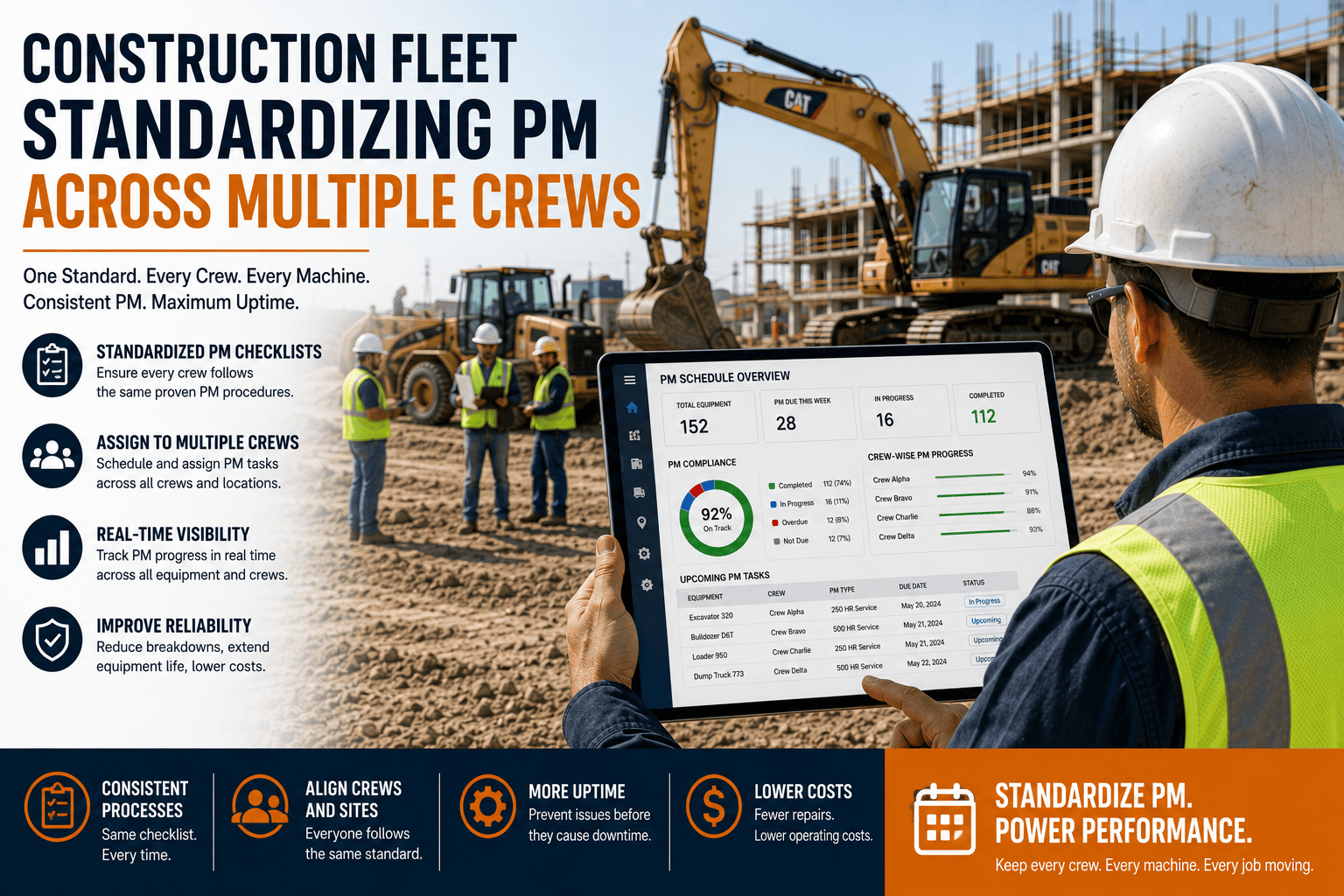
Every machine follows the same interval and checklist regardless of which crew or job site it's assigned to, and every completed service is logged automatically against that asset.
Why Maintenance Standards Drift Between Crews
Inconsistent preventive maintenance is rarely a discipline problem. It's a systems problem. When equipment moves between projects and crews faster than paperwork can keep up, the standard quietly bends to whoever is holding the machine that week.
Give Every Crew the Same Playbook
FleetRabbit keeps one maintenance standard attached to each asset, no matter which crew or job site it's working on. Sign up free and set your first standardized schedule in minutes.
What Inconsistent PM Actually Costs a Contractor
A healthy preventive maintenance program runs mostly on plan, not on emergency. When standards drift between crews, that ratio flips, and the budget feels it first.
That gap between planned and unplanned work is where the real money leaks out. Emergency repairs cost several times more than the same service done on schedule, and a machine that misses its interval on one site because the paperwork didn't transfer is a machine at risk of failing on the next one.
One Standard, Built in Tiers
Standardizing maintenance doesn't mean forcing every machine onto the same interval. It means giving every crew the same tiered structure to follow, so an excavator is always serviced like an excavator no matter who's operating it.
Hour-based fluid checks, filter changes, and daily walkaround inspections applied the same way at every site.
More frequent hydraulic, undercarriage, and structural checks, standardized so no crew skips a step under deadline pressure.
Standard mileage and time-based service so pickups and service trucks don't fall through the cracks between projects.
Benchmarks Worth Tracking
A standardized program is working when planned maintenance climbs above 80 percent of total service events and uptime across the fleet holds between 95 and 98 percent. Both numbers are easy to lose sight of when every site is tracking maintenance its own way, and easy to see clearly once every crew reports into the same system.
How FleetRabbit Keeps Every Crew on the Same Standard
FleetRabbit attaches maintenance schedules, checklists, and service history directly to each asset instead of to a crew, a site, or a notebook. When equipment moves to a new job or a new team takes over, the standard moves with it automatically, so nothing gets reset to guesswork. Superintendents get the same digital checklist regardless of location, and managers get one dashboard showing which assets across every site are current, due, or overdue. Contractors ready to see this working across their own fleet can book a demo and walk through a real multi-site setup with the team.
One Standard. Every Crew. Every Site.
Stop letting maintenance quality depend on which crew has the machine this month. FleetRabbit keeps every piece of equipment on the same schedule no matter where it's working.