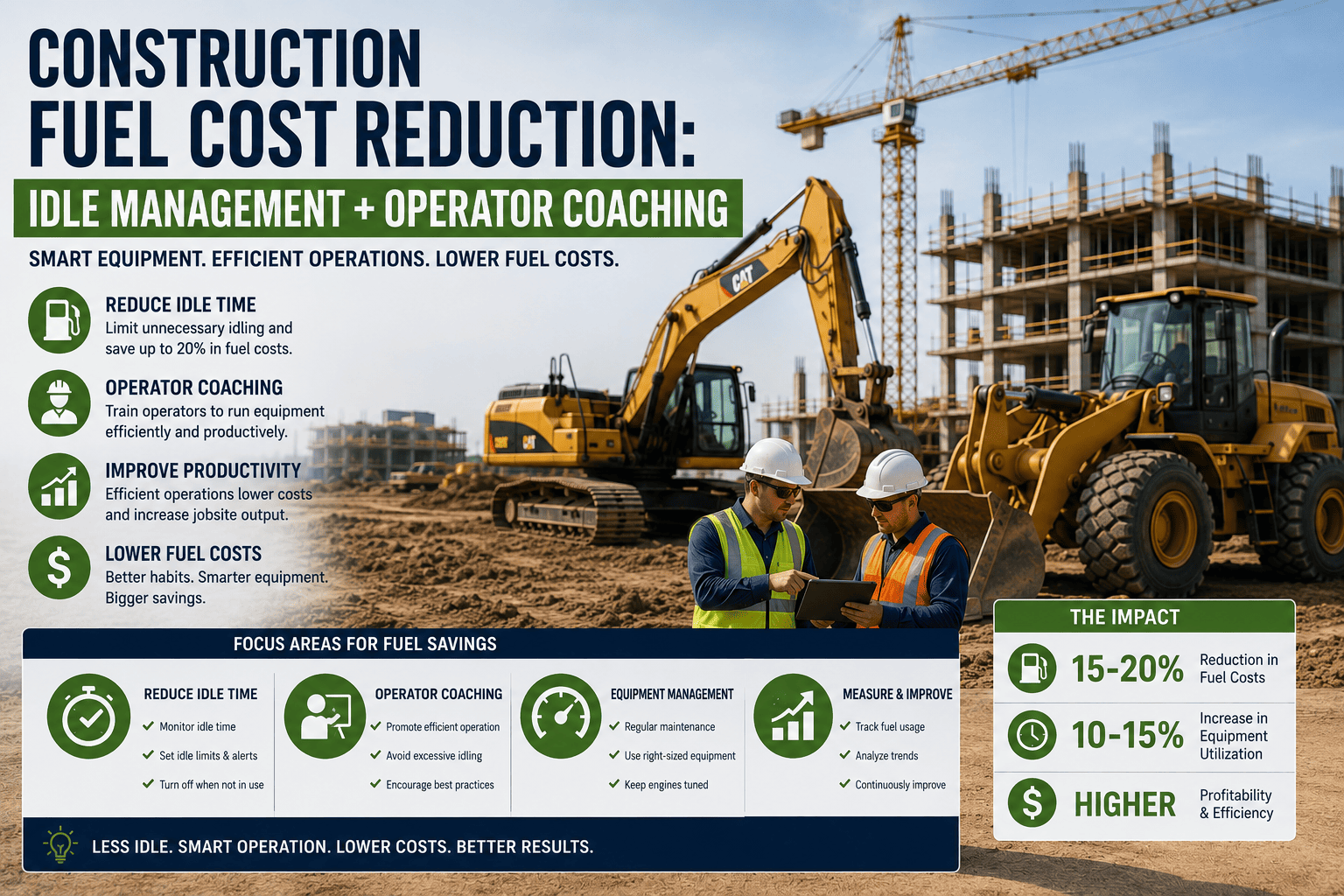
Diesel has climbed past 5.60 dollars a gallon in many markets, and fuel now eats up more than a third of total equipment operating cost on the average job site. Most contractors treat that number as fixed — the price of doing business. It isn't. A large share of fuel spend is sitting in idle engine time and rough operator habits that nobody is watching, which means it's one of the few operating costs you can actually shrink without slowing a single project down.
Heavy equipment fleets typically waste 20 to 25 percent of total fuel spend through preventable causes: excessive idle time, deferred maintenance, and rough operator technique. Idle time alone accounts for 10 to 30 percent of total fuel consumption on a construction site. Fleets that track idle and operator behavior with telematics commonly cut idle time in half and reduce total fuel spend by 15 to 25 percent within 90 days.
Where Preventable Fuel Waste Actually Comes From
Fuel waste on a construction site isn't spread evenly — it clusters in a few specific behaviors, and once you can see them, they're straightforward to fix.
Approximate share of preventable fuel waste by cause across a typical heavy equipment fleet.
Idle Time: The Single Biggest Lever
A large excavator can burn 1.5 to 2.5 gallons of fuel an hour just sitting at idle, and a dozer can burn even more. Multiply that across a fleet running 2,000 hours a year and idle time alone can represent tens of thousands of dollars in fuel that produced zero work. Because it's also the fastest problem to fix — no capital investment, no new equipment, just visibility and a shutdown habit — idle reduction is where most fuel programs should start.
Rough Operator Technique
Aggressive acceleration, high RPM, and harsh braking waste 10 to 15 percent of fuel compared to smooth, progressive operation on the identical machine. Two operators running the same excavator on the same task can differ by 15 percent or more in fuel burn purely from throttle habits, not from moving more material.
Why This Gets Missed
Fuel cards show what was purchased, not how it was used. Without engine-level data tied to a specific operator and machine, a fuel bill spike looks like a price increase instead of a technique problem, and it never gets coached.
Turn Idle Time and Rough Operation Into Fuel You Keep
FleetRabbit tracks idle percentage, harsh operating events, and fuel burn by machine and operator, then flags the exact patterns draining your budget so you can coach the same day, not at month-end reconciliation. You can start a free trial to see your fuel waste breakdown, or book a demo for a fuel reduction assessment on your fleet.
The Four Kinds of Idle Time — And Why the Fix Is Different for Each
Not all idle time has the same cause, and treating it as one problem means the fix misses most of it. Separating idle time by category tells you whether the answer is coaching, coordination, maintenance, or workflow.
What a Coaching Program Actually Looks Like
The pattern shows up the same way almost everywhere: an operator parks a machine and walks to a break area but leaves the engine running, adding 45 to 60 minutes of unnecessary idle during lunch alone, plus another 15 to 20 minutes across morning and afternoon breaks. That single behavior can add well over an hour of pure waste to a shift.
Real coaching programs succeed because they're built on specific, verifiable data rather than a general reminder to "use less fuel." A weekly scorecard showing idle percentage and harsh-event counts by operator, with the bottom performers coached directly using their own numbers, consistently outperforms a blanket policy memo. Fleets that track the result after each intervention — not just issue the coaching and move on — catch the cases where the fix didn't stick and need a second look.
Building a Fuel-Efficient Operator Culture
Smooth, progressive throttle control instead of jerky, high-RPM movements is the core habit worth reinforcing. Skilled operators using this technique commonly use 10 to 15 percent less fuel than less experienced operators running the identical machine on the identical task, with no drop in production. Publishing scorecards and recognizing top performers turns fuel efficiency into a visible, ongoing standard instead of a one-time training session that fades within a month.
The Math on a Real Idle Reduction Program
A machine burning roughly a gallon of fuel per hour at idle, cutting idle time in half through nothing more than a shutdown habit during breaks, can save well over 9,000 dollars in fuel alone over five years on a single unit — and that's before counting the reduced engine hours, fewer routine services, and better resale value that come from a lower-hour machine. Scale that across a fleet of even a dozen similar machines and the annual fuel savings alone can reach well into six figures.
The fastest-moving programs attack idle time first because it requires no capital and shows results within weeks, then layer in maintenance compliance and operator coaching once the tracking data reveals where the next-biggest opportunity sits. If you'd like a clearer picture of where your own fleet's fuel is going before building a program, you can book a demo and bring a recent fuel bill to compare against the data.
Frequently Asked Questions
Stop Paying For Fuel That Never Did Any Work
Idle time and rough operation are quietly inflating your fuel bill every single day. FleetRabbit gives you real-time visibility into exactly where that waste is happening, by machine and by operator, so you can fix it before the next fuel bill lands. Sign up to see your fleet's fuel waste breakdown, or book a demo for a fuel reduction assessment.