Construction equipment theft and idle-time losses cost U.S. contractors an estimated $400 million annually — and fleets without real-time GPS visibility are the primary target. Whether you're managing a 15-machine excavation fleet in Texas or a mixed-equipment rental yard in California, choosing the wrong GPS tracker type means dead batteries mid-job or trackers going dark when equipment matters most. Fleet Rabbit's fleet management platform integrates hardwired, solar, and battery-powered GPS trackers into unified equipment visibility across every power type. Book a demo to see Fleet Rabbit's GPS tracking applied to your equipment fleet.
Quick Answer
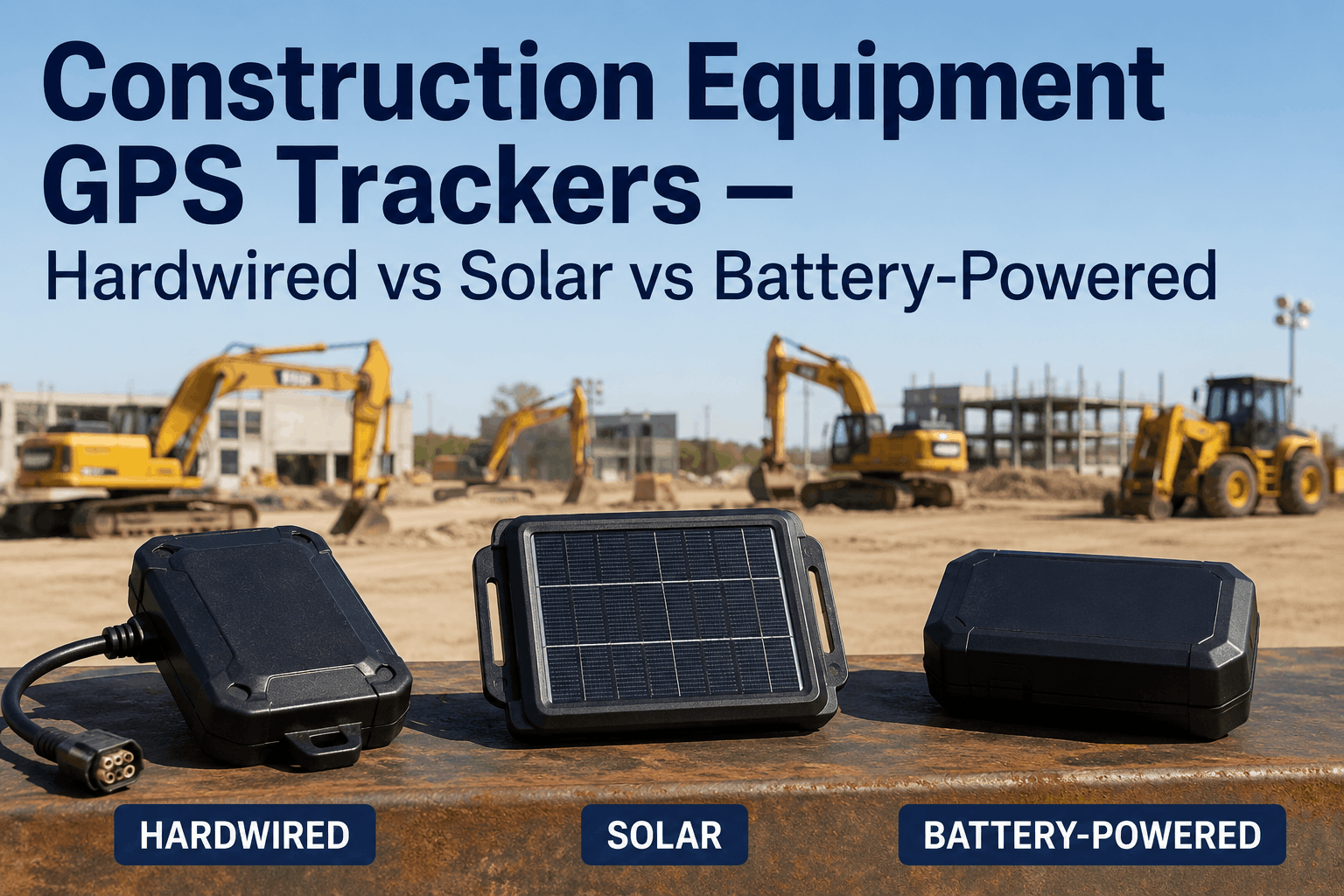
Construction equipment GPS trackers come in three primary power types: hardwired (connected to the machine's 12/24V system), solar-powered (self-charging via panel), and battery-powered (fully wireless). Hardwired delivers continuous power for heavy equipment with consistent engine run time. Solar suits outdoor stationary assets in high-sun western U.S. regions like Arizona, Nevada, and California. Battery-powered works best for attachments, trailers, and rented machines where wiring isn't practical. Fleet Rabbit supports all three tracker types under one platform.
Why Power Type Is the Most Underestimated GPS Decision in Construction
Most contractors evaluate GPS trackers by price and update frequency — then discover months in that half their fleet is on dead batteries or showing stale locations. In western U.S. markets — California, Texas, Arizona, Nevada, Colorado — extreme heat, remote job sites, and variable sun exposure make power source selection a mission-critical decision, not a spec footnote.
3 Tracker Types, 3 Very Different Use Cases
Hardwired: Taps into machine power — no battery management, continuous real-time tracking, ideal for excavators and graders. Solar: Panel charges internal battery during daylight — best for stationary assets in CA, AZ, NV sun. Battery: Fully self-contained — installs in minutes on attachments, trailers, or rentals.
The Real Cost of the Wrong Tracker Type
A battery tracker running real-time updates on a high-use excavator drains in 3–7 days. A hardwired tracker on a seldom-moved trailer adds unnecessary cost. Mismatched power type creates blind spots at the exact moment a machine goes missing or a theft occurs after hours on a Texas or California job site.
Western U.S. Market Context
California CARB regulations, Texas energy-sector fleet density, Arizona heat extremes (110°F+ summers), and Nevada remote mine-site operations create region-specific tracker requirements. Solar excels across the Southwest. Battery trackers are critical for California rental compliance. Hardwired is standard for high-value iron in Texas and Colorado infrastructure work.
GPS Tracker Power Type Comparison: Western U.S. Construction Standards
The table below reflects 2025 performance benchmarks for construction GPS trackers across major western U.S. markets and equipment categories.
Tracker Type
Battery Life
Install Time
Update Rate
Best For
Hardwired (12/24V)
Continuous
1–3 hrs
Real-time
Heavy iron
Solar-Powered
3–6 months
15–30 min
1–5 min
Yard / trailers
Battery (Standard)
30–90 days
5–10 min
5–60 min
Attachments
Battery (Extended)
6–24 months
5–10 min
Daily/event
Low-use assets
Solar + Battery Hybrid
Continuous
20–40 min
1–5 min
Remote sites
Hardwired GPS Trackers: When Continuous Power Is Non-Negotiable
Hardwired trackers connect directly to a machine's 12V or 24V electrical system — drawing power when the engine runs and maintaining standby tracking when parked. For high-utilization heavy equipment, hardwired is the only tracker type that eliminates battery management entirely.
1
Best Equipment Matches for Hardwired Installation
Excavators, bulldozers, motor graders, cranes, and wheel loaders have accessible 12/24V circuits and high daily engine hours — making hardwired the correct choice. California CalTrans contractor requirements frequently mandate hardwired GPS with tamper alerts on heavy equipment operating on public works contracts.
Fleet Rabbit hardwired integration on a 22-unit excavation fleet in Phoenix, AZ: real-time engine hour logging reduced idle time billing disputes by 38% and recovered $91,000 in annual fuel waste from unaccounted idle.
2
Installation Cost in Western U.S. Markets
Hardwired installation requires a qualified technician and 1–3 hours per unit. In California and Nevada, fleet shop labor rates of $95–$140/hour make installation a real line item — typically $150–$400 per machine. Fleets running 40+ machines often negotiate bulk installs to compress per-unit cost to $80–$150.
Install: 1–3 hrs/unitLabor: $150–$400ROI: 30–60 days
3
Engine Diagnostics Beyond Location
Hardwired connection unlocks engine diagnostics, ignition events, PTO monitoring, and battery voltage — data battery and solar trackers cannot access. For western U.S. fleets running John Deere, Caterpillar, and Komatsu equipment, hardwired integration with J1939 ports feeds fault code alerts into Fleet Rabbit's maintenance scheduling engine.
Hardwired GPS with J1939 integration reduces unplanned breakdown events 30–45% — each prevented breakdown saves $3,000–$18,000 in emergency repair and job site delay costs.
GPS Tracking + Fleet Analytics
Track Every Machine — Hardwired, Solar, or Battery — Under One Platform
Fleet Rabbit unifies all GPS tracker types into a single construction fleet dashboard — real-time location, engine hours, utilization, and maintenance alerts across your full equipment inventory.
30–45%
Breakdown Reduction
18–24%
Utilization Increase
Solar-Powered GPS Trackers: The Southwest Construction Advantage
Solar GPS trackers carry a small photovoltaic panel that continuously charges an internal battery — eliminating manual recharging while keeping installation quick and wire-free. In California, Arizona, Nevada, and New Mexico, where average daily sun hours range 5.5–7.5, solar trackers are among the most cost-effective solutions for stationary and semi-mobile assets.
Ideal Asset Types for Solar Trackers
Flatbed trailers, light towers, generators, compressors, and storage containers are prime solar tracker candidates. These assets rarely have accessible power circuits, move infrequently, and spend long periods parked outdoors. In Arizona and Nevada construction yards, solar trackers maintain continuous charge with zero maintenance year-round.
Western U.S. Solar Performance by Region
Phoenix averages 6.5 peak sun hours daily — enough to fully recharge most solar tracker batteries in 3–4 hours. Los Angeles averages 5.6 hours; Las Vegas 6.3; Denver 5.1; Seattle 3.5 (where solar drops significantly in winter). Pacific Northwest operations should evaluate battery-powered alternatives for shaded or seasonal job sites.
Arizona and Nevada Heat Tolerance
Solar tracker panels are rated for 185°F+ surface temperatures — but lithium battery cells inside the unit must stay below 140°F to avoid capacity degradation. In Arizona summer conditions with equipment in direct sun, internal temperatures can reach damaging levels. Look for trackers with thermal management rated for desert-operation environments.
15-Minute Installation on Any Asset
Solar GPS trackers mount with magnetic bases, bolt-through brackets, or industrial adhesive — no wiring, no electrician required. A fleet manager can deploy 20 solar trackers across a yard in a single afternoon. For California rental fleets where tracker installation and removal is a weekly task, solar's tool-free mounting dramatically reduces labor versus hardwired alternatives.
Battery-Powered GPS Trackers: Maximum Flexibility for Attachments and Rentals
Battery-powered GPS trackers are fully self-contained — no wiring, no solar panel, no connection to the host machine. They install in minutes, transfer between assets instantly, and track equipment that has no power source of its own.
Real Battery Life vs. Spec Sheet Claims
Manufacturers quote battery life at low update frequencies — often once per day or on motion-trigger only. Real-world construction tracking at 5-minute update intervals cuts quoted battery life by 60–80%. A "12-month" battery tracker updating every 5 minutes may last 60–90 days. For high-value attachments, plan battery swap schedules rather than assuming set-and-forget operation.
California and Texas Rental Compliance
California contractors renting from United Rentals, Sunbelt, or BlueLine are prohibited from hardwiring GPS into rental machines. Battery trackers placed inside equipment cabs or on frames allow project managers to maintain fleet visibility without violating rental agreements. Texas energy-sector contractors managing 50+ rented machines per project use battery trackers to verify rental hours and prevent unauthorized moves.
Tracking Attachments: The $2.1B Theft Blind Spot
Hydraulic hammers, grapple buckets, augers, and compaction wheels are the most-stolen construction assets in the western U.S. — partly because they have no power source and are rarely tracked. Battery trackers concealed inside attachment frames provide theft deterrence and recovery capability with no installation complexity. Average recovery rate for GPS-equipped stolen equipment in California is 68% vs. 12% for unequipped assets.
Choosing the Right GPS Tracker: Western U.S. Decision Framework
No single tracker type covers every construction asset. Effective programs in California, Texas, and Arizona use all three types — matched to equipment characteristics and job site conditions.
Choose Hardwired When:
The machine runs 4+ hours daily. Engine diagnostics are needed. Asset value exceeds $50,000. CA public works contracts mandate continuous GPS. Examples: excavators, dozers, cranes, wheel loaders, scrapers.
Choose Solar When:
Asset operates outdoors in a high-sun region (CA, AZ, NV, TX, NM). No accessible power circuit. Location updates every 1–5 minutes are sufficient. Examples: trailers, light towers, generators, compressors, storage containers.
Choose Battery When:
Asset is rented and wiring is prohibited. Equipment has no power source (attachments, buckets). Rapid deployment and redeployment across assets is needed. Examples: hydraulic attachments, cargo trailers, scaffolding, rental machines.
GPS Tracker Performance Results: Western U.S. Construction Fleets
68%
Stolen Equipment Recovery Rate (vs 12% unequipped)
18–24%
Equipment Utilization Increase
30–45%
Breakdown Reduction (hardwired J1939)
25–38%
Idle Time Reduction
$91K+
Annual Fuel Savings (22-unit AZ fleet)
30–60 days
Typical Full ROI Timeline
Frequently Asked Questions: Construction GPS Trackers
QWhat is the best GPS tracker type for construction equipment in Arizona and Nevada?
Solar-powered GPS trackers perform exceptionally in Arizona and Nevada due to the region's 6+ peak daily sun hours. For heavy iron running 4+ hours daily, hardwired remains the standard — solar supplements coverage on trailers, generators, and stationary assets. Battery trackers fill the gap for attachments and rented equipment. A mixed tracker strategy covering all three power types typically delivers the highest fleet visibility at the lowest total cost per tracked asset in the Southwest.
QCan I put a GPS tracker on rented construction equipment in California?
California contractors can use battery-powered GPS trackers on rented equipment — placing them on external frame locations or inside cabs — without modifying the machine's electrical system. Hardwiring into rental equipment violates most equipment rental agreements and can result in damage liability. Battery trackers are the standard compliance-safe solution for California rental fleet tracking, providing location and movement data without touching the host machine.
QHow does Fleet Rabbit handle multiple GPS tracker types in one platform?
Fleet Rabbit's platform ingests data from hardwired, solar, and battery-powered GPS trackers across all major hardware vendors — normalizing location, engine hour, motion, and alert data into a unified equipment dashboard. Fleet managers see all assets on a single map regardless of tracker type, with utilization reports, geofence alerts, maintenance triggers, and theft notifications working across the full inventory. No separate logins or vendor-specific portals required.
Track Every Machine — Hardwired, Solar, or Battery — See Fleet Rabbit in Action
Fleet Rabbit unifies all GPS tracker types into one construction fleet platform — real-time location, engine hours, maintenance alerts, and theft detection across your full equipment inventory. Most western U.S. operations achieve full ROI within 30–60 days.
Hardwired GPS Integration
Solar Tracker Support
Battery Asset Tracking
Theft Alerts & Recovery
Engine Hour Analytics
May 27, 2026
By John Mark
All Posts