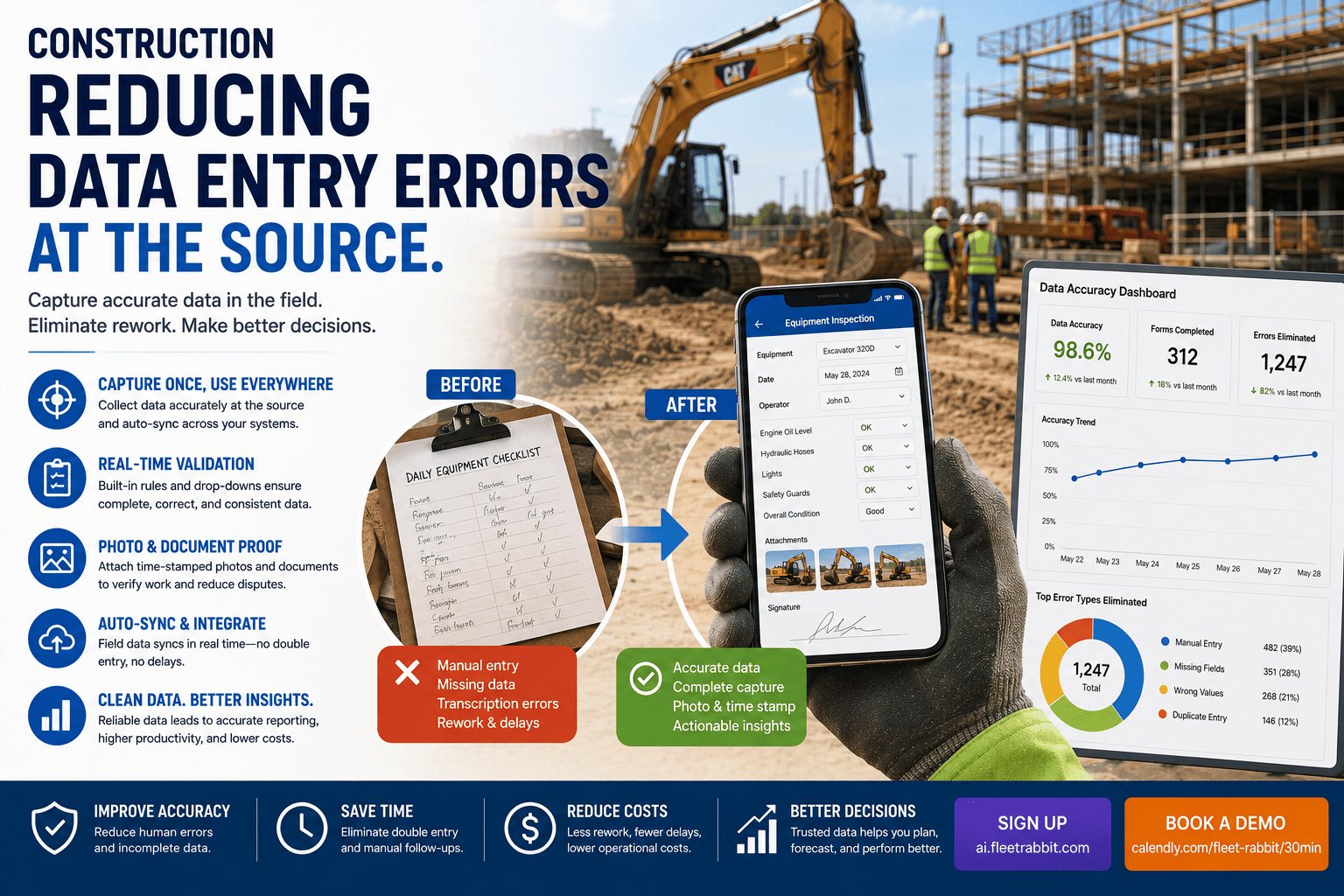
Ask any construction fleet manager where their numbers came from and the honest answer is usually a chain of handoffs: a technician scribbles an inspection note on paper, a foreman estimates engine hours from memory, an office clerk retypes it all into a spreadsheet days later. Every handoff is a chance for a number to change. By the time that data reaches a maintenance report or a job cost sheet, it may no longer reflect what actually happened on the equipment. Source data capture removes the retyping entirely by recording inspection, fuel, engine-hour, and maintenance data at the exact moment and place it happens, so the number in your system is the number a technician actually saw.
Manual re-entry of construction equipment data typically carries a 1 to 8 percent error rate, and field-recorded paper forms can run 10 to 15 percent inaccurate before they ever reach the office. Each retyped handoff multiplies the chance of a wrong reading. Source data capture eliminates re-keying by pulling inspection, fuel, engine-hour, and maintenance records directly from the point of entry, cutting documentation errors by roughly 40 percent and freeing hours of correction work every week.
Why Manual Data Entry Breaks Down On Construction Fleets
Every piece of equipment data on a job site travels through a chain of handoffs before it lands in a report. A technician records an inspection finding, engine-hour reading, or fuel fill-up on paper or from memory. That paper physically moves from the field to the office, where someone has to decipher handwriting, guess at missing units, and retype every figure into a spreadsheet or maintenance system. Each of those steps is a place where a number can drift from what actually happened at the machine.
Industry research consistently finds that a large majority of construction spreadsheets contain at least one error, and that most construction firms admit a meaningful share of their operational data is inaccurate. The problem is not carelessness. It is a process built around retyping information that was already correct once, at the source, before someone had to remember it, transcribe it, and hand it off again.
The Three Handoffs That Corrupt Equipment Data
Nearly every manual data entry error traces back to one of three transitions, each of which strips a little accuracy away from the original reading.
| Handoff | What Happens | Typical Error Rate |
|---|---|---|
| Machine To Paper | A technician records inspection notes, engine hours, or fuel volume from memory or a quick glance at end of shift | 10 to 15 percent |
| Paper To Office | Forms travel from the job site to a central office, where handwriting must be read and missing fields guessed at | 5 to 10 percent |
| Office To System | A clerk retypes every figure into a maintenance system, spreadsheet, or accounting software by hand | 1 to 8 percent |
What Happens After The Error Ships
A wrong engine-hour reading pushes a service interval past due. A missed inspection defect turns into an unplanned breakdown two weeks later. A mistyped fuel figure throws off cost-per-hour calculations for an entire piece of equipment. None of these mistakes announce themselves. They sit quietly inside a report until a technician, an accountant, or a customer notices the number does not add up, and by then the correction takes far longer than the original entry ever would have.
FleetRabbit records inspections, fuel, engine hours, and maintenance work directly from the field, so the figure in your dashboard is the figure a technician actually saw. Start a free trial and see how much cleaner your data looks in the first week.
Source Capture Versus Manual Entry, Side By Side
The difference between capturing data once at the source and re-entering it later is not a matter of degree. It is a different process with a different number of chances to introduce an error.
| Factor | Manual Re-Entry | Source Data Capture |
|---|---|---|
| Number Of Handoffs | Three or more, from field to paper to office to system | One, recorded directly at the point of inspection or fueling |
| Time To Report | Hours to days, depending on when paperwork reaches the office | Immediate, visible on the dashboard as it happens |
| Error Discovery | Usually found after the data has already fed a report or schedule | Flagged automatically at capture, before it enters any report |
| Correction Cost | High, since the wrong figure may already be built into other decisions | Low, since there is one authoritative record to fix |
| Staff Time Required | Data entry clerks, verification staff, and correction labor | A technician taps or scans once, no separate entry step needed |
How Source Data Capture Works On A Job Site
Source capture is not a single feature so much as a shift in where data gets recorded. Instead of writing something down to type up later, the field action and the digital record become the same event.
Digital Inspections
A technician completes a pre-shift or post-shift inspection on a mobile device, checking off items and photographing defects directly against the equipment. The record is complete and timestamped the moment the walk-around ends, with no paper form waiting to be transcribed.
Fuel Tracking
Fuel volume and location are logged automatically at the pump or through a connected fuel card, instead of being estimated later from a receipt stuffed into a glovebox.
Engine Hours
Telematics pull engine-hour and usage data straight from the machine, replacing the habit of rounding hours to the nearest whole number from memory at the end of a long day.
Maintenance Records
When a technician completes a repair, the work order, parts used, and labor time are captured on the spot, creating a permanent, searchable history instead of a handwritten note that may or may not make it back to the shop.
What Cleaner Data Actually Buys You
The value of source capture shows up well beyond the accuracy of a single report. When inspection, fuel, engine-hour, and maintenance figures can be trusted, every decision built on top of them gets sharper.
Metrics Worth Tracking After You Switch
You do not have to guess whether source capture is working. A few simple metrics show the shift within the first few weeks.
| Metric | What It Tells You | Target Direction |
|---|---|---|
| Data Correction Rate | How often a submitted record needs to be fixed after the fact | Should fall sharply within the first month |
| Time To Report | How long it takes for field activity to appear in your dashboard | Should drop from days to minutes |
| Missed Service Intervals | How many machines run past their scheduled maintenance point | Should trend toward zero |
| Admin Hours On Data Entry | Staff time spent typing, verifying, and chasing down paperwork | Should shrink as re-keying disappears |
Getting Started With Source Data Capture
Moving from paper and spreadsheets to source capture does not require overhauling your operation overnight. Most fleets start with the highest-friction workflow, usually inspections or engine hours, and expand from there once the team sees the time savings firsthand.
Step One: Digitize Inspections First
Inspections are typically the most error-prone paper process and the easiest to move to a mobile checklist, so they deliver the fastest visible improvement.
Step Two: Connect Fuel And Engine-Hour Feeds
Linking fuel cards and telematics removes two more manual logs, closing off the largest sources of estimation error in daily reporting.
Step Three: Fold In Maintenance Records
Once field capture is routine, digitizing work orders completes the picture, giving every machine a single, trustworthy history from inspection to repair.
Ready to see it on your own fleet? You can sign up and start a free trial with a handful of vehicles, or book a short demo and walk through your current workflow with our team before you commit to anything.
Frequently Asked Questions
Every retyped inspection, fuel log, and hour reading is a chance for your numbers to drift from reality. FleetRabbit captures equipment data at the source, so what you see on the dashboard is what actually happened in the field.