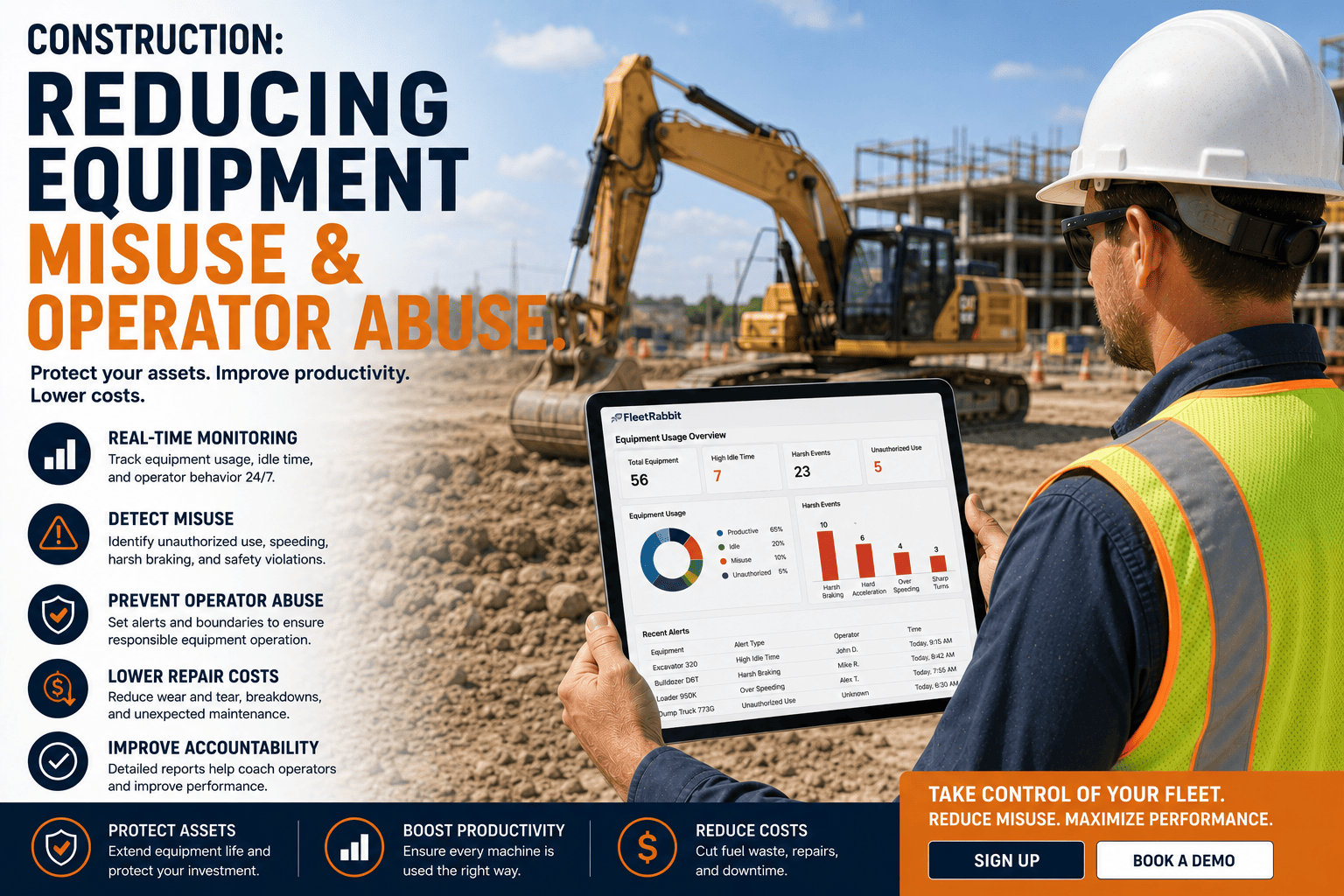
Two identical excavators, same model, same year, same job site conditions. One needs a hydraulic overhaul at 3,000 hours. The other runs smoothly past 6,000. The machines aren't different, the operators are. Equipment misuse rarely shows up as a single dramatic incident, it shows up as a pattern, overloading the bucket past rated capacity, slamming into gear instead of easing in, letting the engine idle for hours to avoid a restart. None of it looks like abuse in the moment. All of it adds up to thousands of dollars in avoidable repair costs and years of shortened equipment life.
Overloading is the number one cause of unscheduled maintenance across equipment fleets, and companies that invest in operator training and behavior monitoring report 25 to 40 percent lower repair costs. On a machine that would otherwise run up 24,000 dollars in repairs over its service life, that gap alone represents 6,000 to 9,600 dollars in avoidable cost, on a single asset.
What Equipment Misuse Actually Looks Like
Misuse rarely announces itself as recklessness. It's a set of habits that feel efficient in the short term and expensive in the long term. Four patterns account for most of the avoidable wear fleet managers see across construction equipment.
Why These Patterns Are Easy to Miss
Every one of these behaviors is invisible on a maintenance log. A machine doesn't get a work order for "operator idled it for six hours" or "operator overloaded the bucket eleven times this week." It gets a work order when the hydraulic pump finally fails, months after the pattern that caused it started. Without direct behavior data, the only signal a fleet manager gets is the repair bill itself, long after the cost was already locked in.
FleetRabbit monitors operator behavior in real time, flagging overloading, harsh events, excessive idling, and overspeeding by machine and by operator, before the pattern turns into a costly repair. Sign up free and see it running against your own fleet.
The Real Cost Difference Between Two Nearly Identical Machines
Consider an 80,000 dollar machine that accumulates roughly 24,000 dollars in maintenance and repair costs across 5,000 operating hours under typical, unmonitored operation. Applying consistent preventive maintenance and correcting misuse patterns through operator coaching has been shown to cut that cost by around 25 percent, down to approximately 18,000 dollars, on the exact same machine, over the exact same hours.
| Scenario | Maintenance Cost Over 5,000 Hours | Driving Factor |
|---|---|---|
| Unmonitored Operation | Approximately 24,000 dollars | Overloading, harsh operation, and idling go uncorrected |
| Monitored and Coached Operation | Approximately 18,000 dollars | Behavior flagged early, operators coached before repeat damage accrues |
| Cost Difference | Approximately 6,000 dollars per machine | Avoidable, based purely on operating behavior, not equipment quality |
From Alert to Coaching: Closing the Loop
Detecting misuse only creates value if it leads to a conversation with the operator, not just a data point in a dashboard nobody reads. A simple, repeatable loop turns behavior data into actual behavior change.
FleetRabbit tracks behavior trends by operator over time, giving supervisors the specific, evidence-based conversations that actually change habits and protect equipment. Book a demo to see how the coaching workflow fits your crews.
Why Enforcement Matters More Than Policy
Most fleets already have a policy against equipment misuse. The gap isn't the policy, it's enforcement. Without a way to see which operators are actually creating repeat patterns of overloading, harsh operation, or overspeeding, "don't abuse the equipment" stays a poster on the wall rather than a standard anyone is held to. Visibility is what turns a written policy into an actual practice.
Frequently Asked Questions
The Bottom Line
Equipment misuse is rarely a single bad decision, it's a pattern that builds quietly until it shows up as a repair bill nobody saw coming. The good news is that pattern is detectable long before that point, and correcting it doesn't require replacing operators, it requires giving supervisors the specific, timely data to coach with. Fleets that close that gap consistently see lower repair costs and longer equipment life from the exact same machines.
FleetRabbit detects overloading, harsh events, idling, and overspeeding automatically, giving managers the data to coach operators and protect equipment reliability across every job site. Get started free, no credit card required.