A subcontractor's crane operator skips a pre-shift inspection. Three weeks later, that same crane is involved in an OSHA citation. The subcontractor's name is on the citation, but so is yours, even though none of your own crew touched the equipment. Under OSHA's joint responsibility rules, a general contractor doesn't get to plead ignorance about equipment it never owned. It gets to prove it was watching.
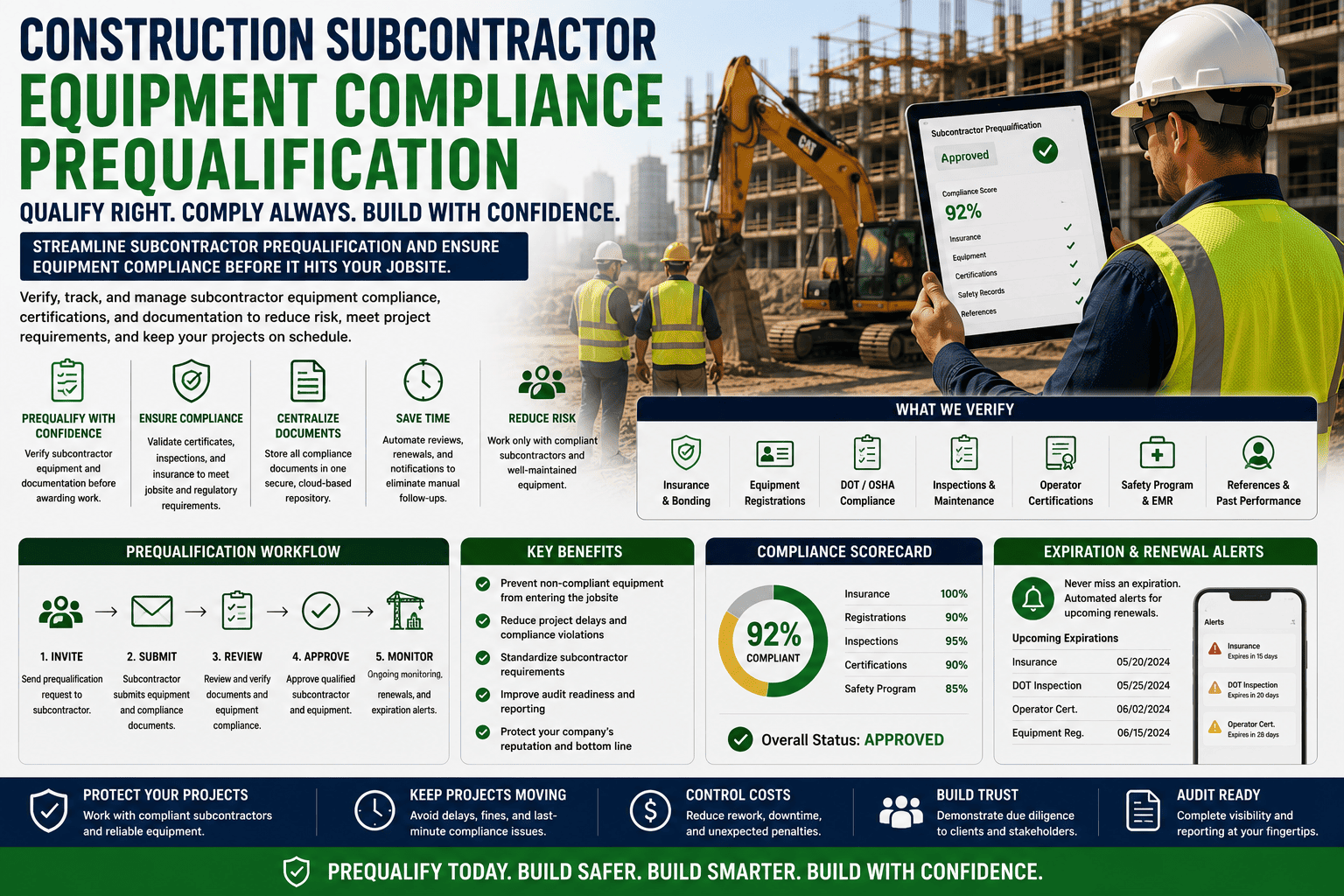
General contractors carry real exposure for subcontractor equipment under OSHA's multi-employer and joint responsibility rules, which means prequalification can't stop at reviewing a certificate of insurance once. Tracking subcontractor equipment inspections, certifications, and compliance status on an ongoing basis protects your project and your liability position. Sign up for FleetRabbit to start tracking subcontractor compliance in one place, or book a demo to see how it works across multiple subs.
Why Subcontractor Equipment Is Your Liability Too
Under 29 CFR 1926.16, subcontractors take on responsibility for their portion of the work, but the prime contractor's overall responsibility for the project never goes away. OSHA's Multi-Employer Citation Policy builds directly on this: an inspector can cite both a general contractor and the subcontractor whose equipment caused a hazard, even if the general contractor's own crew was nowhere near the incident. Courts have upheld this authority, which means the safest assumption for any GC is that a subcontractor's poorly maintained equipment is, functionally, a problem sitting inside your own compliance file.
What Investigators Actually Look For
When OSHA evaluates a controlling employer's exposure, the analysis centers on a few consistent questions: how well the GC knew the subcontractor's safety history, how frequently the GC inspected the subcontractor's work, and whether the GC confirmed that hazards it identified actually got corrected. A GC that can produce a documented history of equipment checks and follow-up is in a fundamentally different position than one that can only say it trusted the subcontractor's word.
What Belongs in a Subcontractor Compliance File
Prequalification paperwork tends to focus on financial and insurance documents, and those matter, but equipment-specific records are just as often the piece that's missing when it counts.
FleetRabbit keeps subcontractor inspection records, certifications, and compliance status organized alongside your own fleet, so nothing falls through the cracks between vendors. Sign up to bring your subcontractors into one system, or book a demo to see it running across a real project.
Prequalification Isn't a One-Time Checkbox
The most common mistake in subcontractor management is treating prequalification as a single gate at the start of a relationship. A subcontractor who was fully compliant when they won the bid can drift out of compliance six months into a multi-phase project, and nobody notices until an inspector or an incident forces the question.
Why Monitoring Gets Skipped in Practice
Prequalification at intake is usually well documented because it's tied to a bid decision someone has to sign off on. Ongoing monitoring gets skipped for a much simpler reason: nobody owns it once the project is underway, and spreadsheets built for a one-time review don't naturally track expiration dates or renewal cycles across a dozen active subcontractors on different job sites.
Building a System That Scales Beyond a Few Subs
A GC managing three subcontractors can track compliance by memory. A GC managing thirty can't, and that's exactly where informal tracking breaks down and real exposure starts to build. The fix isn't more paperwork, it's centralizing the paperwork that already exists so expiration dates, inspection gaps, and corrective actions are visible without someone manually chasing every vendor.
FleetRabbit brings subcontractor equipment records into the same system as your own fleet data, so inspection status, certifications, and compliance history are tracked with the same consistency across every vendor on your site. Sign up for a free trial to centralize your subcontractor compliance tracking, or book a demo to walk through it with our team.
Frequently Asked Questions
FleetRabbit tracks subcontractor equipment inspections, certifications, and compliance status alongside your own fleet, so every vendor on your project meets the same standard, and you can prove it.