Cranes are the most regulated, highest-liability assets in any construction fleet — a single tower crane represents a $500,000–$2,000,000 investment, requires OSHA-mandated daily, monthly, and annual inspections, and demands operator certifications that must be verified before every lift. Yet most construction companies manage crane compliance through paper logbooks, spreadsheet-based certification tracking, and manual inspection records that are already outdated by the time a safety auditor arrives on site. FleetRabbit transforms crane fleet management from reactive paperwork into automated compliance intelligence — tracking every inspection, every certification, every lift plan, and every maintenance interval in real time. Book a crane fleet management demo with FleetRabbit.
FleetRabbit Crane Intelligence
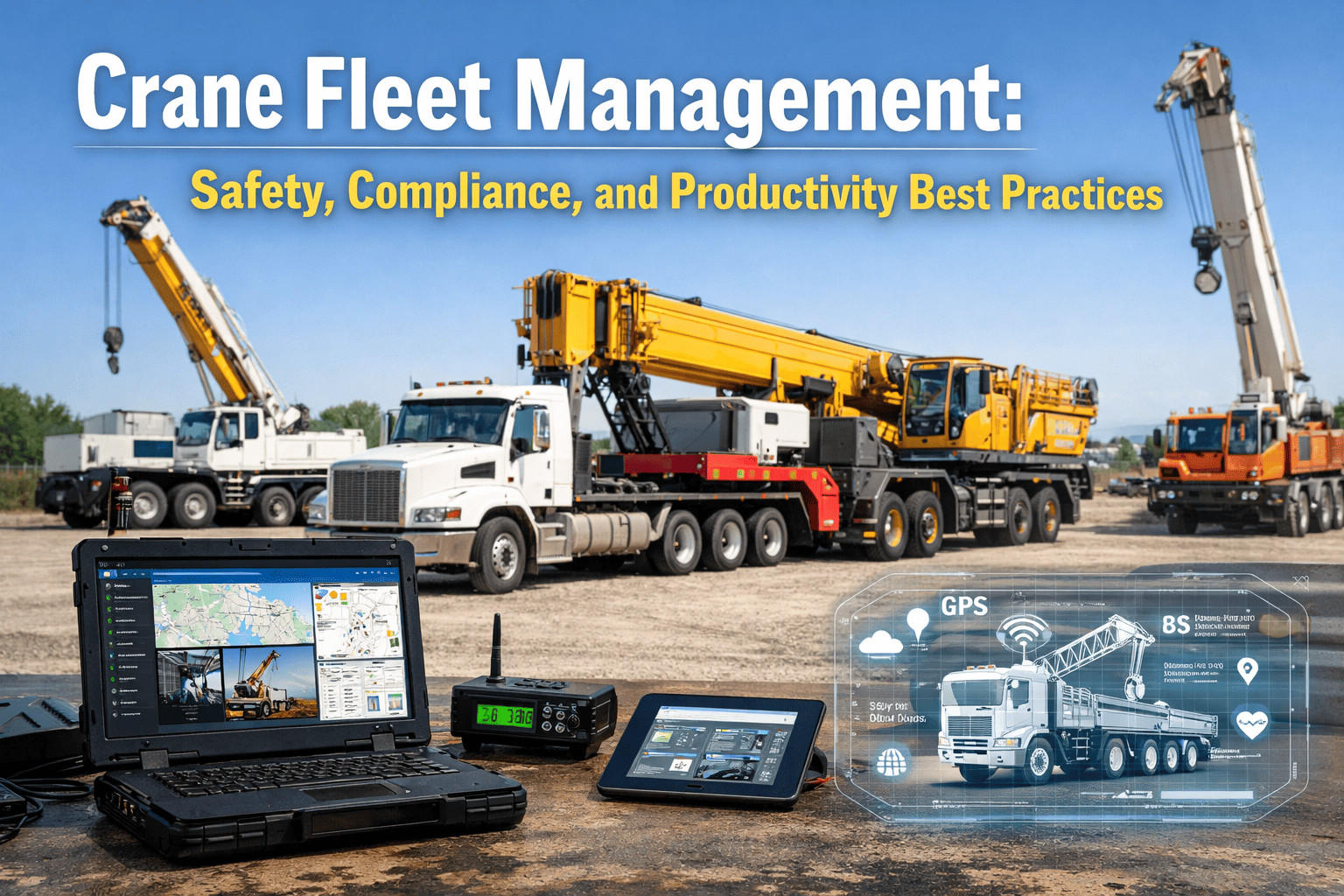
Crane Fleet Management: Safety, Compliance, and Productivity Best Practices
How digital crane fleet management eliminates compliance gaps, automates 3-tier inspection tracking, manages operator certifications, and delivers real-time productivity data — reducing OSHA citation risk while maximising crane utilisation across every project site.
$156KAverage OSHA Crane Citation Penalty
3-TierMandatory Inspection Protocol
NCCCOOperator Certification Standard
$2,500/hrAverage Crane Downtime Cost
OSHA's 3-Tier Crane Inspection Requirements
OSHA 1926.1412 through 1926.1414 mandates three distinct inspection tiers for every crane on every construction site. Missing any tier creates immediate citation exposure — and each tier requires different inspection scope, frequency, and documentation. FleetRabbit automates all three tiers with digital templates, automated scheduling, and permanent documentation storage.
Tier 1: Pre-Shift Inspection
Every Shift, Before Operation
Visual and functional check by the operator before each shift. Covers control functions, safety devices (anti-two-block, load moment indicator), wire rope condition, hook latch, outrigger/stabiliser position, and fluid levels. Must be documented — FleetRabbit captures inspection with timestamp, operator ID, GPS location, and photo evidence of any findings. Defects rated critical halt operation immediately; minor defects generate work orders for next service window.
Tier 2: Monthly / Periodic Inspection
Monthly or Per Manufacturer Interval
More comprehensive inspection by a qualified person (not necessarily the operator). Includes structural components, bolted connections, sheaves, drums, wire rope terminations, hydraulic system checks, electrical systems, and all safety device calibration. FleetRabbit schedules monthly inspections automatically, assigns qualified inspectors, and tracks completion. Inspection reports stored permanently with finding details and corrective action records.
Tier 3: Annual / Comprehensive
Every 12 Months by Qualified Inspector
Complete structural and mechanical inspection by a qualified third-party inspector. Includes non-destructive testing of critical welds, load testing, complete wire rope inspection with measurement, boom and jib structural evaluation, and full safety system certification. FleetRabbit tracks annual inspection due dates with 60-day advance alerts, stores third-party inspection certificates, and blocks equipment from assignment if certification lapses.
Operator Certification Management
OSHA 1926.1427 requires every crane operator to hold current certification from an accredited body — NCCCO (National Commission for the Certification of Crane Operators) is the industry standard. Certification is type-specific: a mobile crane operator certification does not cover tower crane operation. Certifications expire, medical evaluations lapse, and site-specific qualifications change. Managing this across multiple operators and crane types without a digital system guarantees compliance gaps.
01
NCCCO Certification Tracking
Every operator's NCCCO certification loaded into FleetRabbit with certification type (mobile crane, tower crane, overhead crane), issue date, expiry date, and certification number. Automated alerts at 90, 60, and 30 days before expiry. Operator cannot be assigned to a crane type not covered by their certification — system enforces matching automatically.
02
Medical Evaluation Compliance
Crane operators require medical evaluations confirming fitness to operate — vision, hearing, physical capability, and medication review. FleetRabbit tracks medical evaluation dates with automated renewal alerts. Expired medical evaluation flags operator as non-compliant and prevents crane assignment until documentation updated.
03
Site-Specific Orientation Records
Each project site requires crane operators to complete site-specific orientation covering hazard locations, underground utilities, overhead power lines, restricted lift zones, and emergency procedures. FleetRabbit records site orientation completion per operator per project — ensuring no operator begins crane work without verified site familiarisation.
04
Signal Person & Rigger Qualification
OSHA requires qualified signal persons and riggers for crane operations. FleetRabbit tracks signal person qualifications (NCCCO Signal Person certification or employer qualification) and rigger qualifications separately from operator certifications — ensuring every lift has qualified personnel in all three critical roles.
FleetRabbit Crane Compliance
Every Crane. Every Operator. Every Inspection. Every Certification. One Platform.
FleetRabbit automates crane fleet compliance management — 3-tier inspection scheduling, NCCCO certification tracking, medical evaluation monitoring, and complete audit-ready documentation. Eliminate compliance gaps before OSHA finds them.
Crane Maintenance: Hour-Based Scheduling for Maximum Uptime
Crane maintenance differs from standard construction equipment because crane failures carry catastrophic safety consequences — a hydraulic system failure during a lift, a wire rope break under load, or a boom structural failure can result in fatalities, not just equipment damage. Preventive maintenance must be rigorous, precisely timed, and fully documented. FleetRabbit's hour-based PM scheduling ensures every crane receives service at exactly the right interval based on actual operating hours from telematics — not calendar estimates that miss high-utilisation periods.
50 Hours
Wire rope visual inspection, hydraulic fluid level check, safety device function test (LMI, anti-two-block, boom angle indicator), grease all pivot points, check outrigger pad condition
250 Hours
Engine oil and filter change, hydraulic filter replacement, complete wire rope inspection with measurement, sheave and drum inspection, brake adjustment and test, electrical connection check
500 Hours
Hydraulic oil sample and analysis, swing bearing inspection and grease, boom and jib pin inspection, hook inspection with NDT, load test verification, complete structural bolt torque check
1,000 Hours
Major service — hydraulic oil change, coolant flush, wire rope replacement evaluation, boom structural inspection, complete safety system recalibration, crane geometry verification
From the Field
"We operate 8 cranes across 3 active construction sites — 2 tower cranes and 6 mobile cranes. Before FleetRabbit, our safety manager tracked NCCCO certifications in a spreadsheet and relied on operators to self-report pre-shift inspections on paper forms. During a surprise OSHA inspection, we couldn't produce 3 months of daily inspection records for one tower crane — the paper forms had been lost during a site trailer move. The citation cost us $78,000 and triggered a comprehensive audit of our entire crane program. After deploying FleetRabbit, every inspection is digital with timestamps, photos, and GPS verification. NCCCO certifications have automated expiry alerts. When OSHA returned 6 months later, we produced complete documentation for every crane, every operator, and every inspection in under 2 minutes from the FleetRabbit dashboard."
Safety Director
·
General Contractor — 8 Cranes — 3 Active Sites
Frequently Asked Questions
QDoes FleetRabbit include OSHA-compliant crane inspection templates?
Yes. FleetRabbit includes pre-built inspection templates for all three OSHA tiers — pre-shift (1926.1412), monthly (1926.1413), and annual (1926.1414) — customisable by crane type (mobile, tower, overhead). Templates include all required checkpoints with pass/fail/NA options, photo capture, and severity classification. Completed inspections are stored permanently with full audit trail including operator ID, timestamp, GPS location, and digital signature.
QCan FleetRabbit prevent an uncertified operator from being assigned to a crane?
Yes. FleetRabbit enforces certification matching — the system checks operator NCCCO certification type against crane type before allowing assignment. If an operator's certification has expired, their medical evaluation has lapsed, or their certification type doesn't match the crane category, the system blocks the assignment and alerts the fleet manager with specific details about the compliance gap.
QHow does FleetRabbit handle crane maintenance differently from other equipment?
Crane PM templates include safety-critical components not present in standard equipment templates — wire rope inspection with diameter measurement, load moment indicator calibration, anti-two-block device testing, hook NDT inspection, and boom structural evaluation. PM intervals are tighter (starting at 50 hours versus 250 for standard equipment), and critical safety component inspections cannot be deferred or rescheduled past due date without fleet manager override with documented justification.
FleetRabbit Crane Fleet Intelligence
Manage Every Crane, Every Operator, Every Inspection — With Zero Compliance Gaps
FleetRabbit delivers complete crane fleet management — 3-tier OSHA inspection automation, NCCCO certification tracking with expiry alerts, hour-based PM scheduling, operator-to-crane certification matching, and instant audit-ready documentation. One platform for complete crane fleet compliance and productivity.
3-Tier Inspections
NCCCO Tracking
Hour-Based PM
Operator Matching
Audit-Ready Docs
April 25, 2026
By Michael
All Posts