Forty-two to forty-four construction workers die in crane-related incidents every year in the United States, and almost every one of those incidents traces back to a defect that was visible at the last inspection. A crane doesn't fail like other equipment. There's no pulling to the shoulder and calling for a tow. A missed defect under load means a dropped load, a boom collapse, or worse, which is exactly why OSHA 29 CFR 1926 Subpart CC treats crane inspection as one of the most prescriptive requirements in all of construction safety.
A crane pre-lift inspection under OSHA Subpart CC requires a competent person to visually check the crane before each shift, covering wire rope, hooks and rigging, safety devices like the LMI and anti-two-block system, structural components, and ground and outrigger conditions. Any defect that could result in injury or death before the next inspection means the crane is removed from service immediately, no exceptions, no judgment calls.
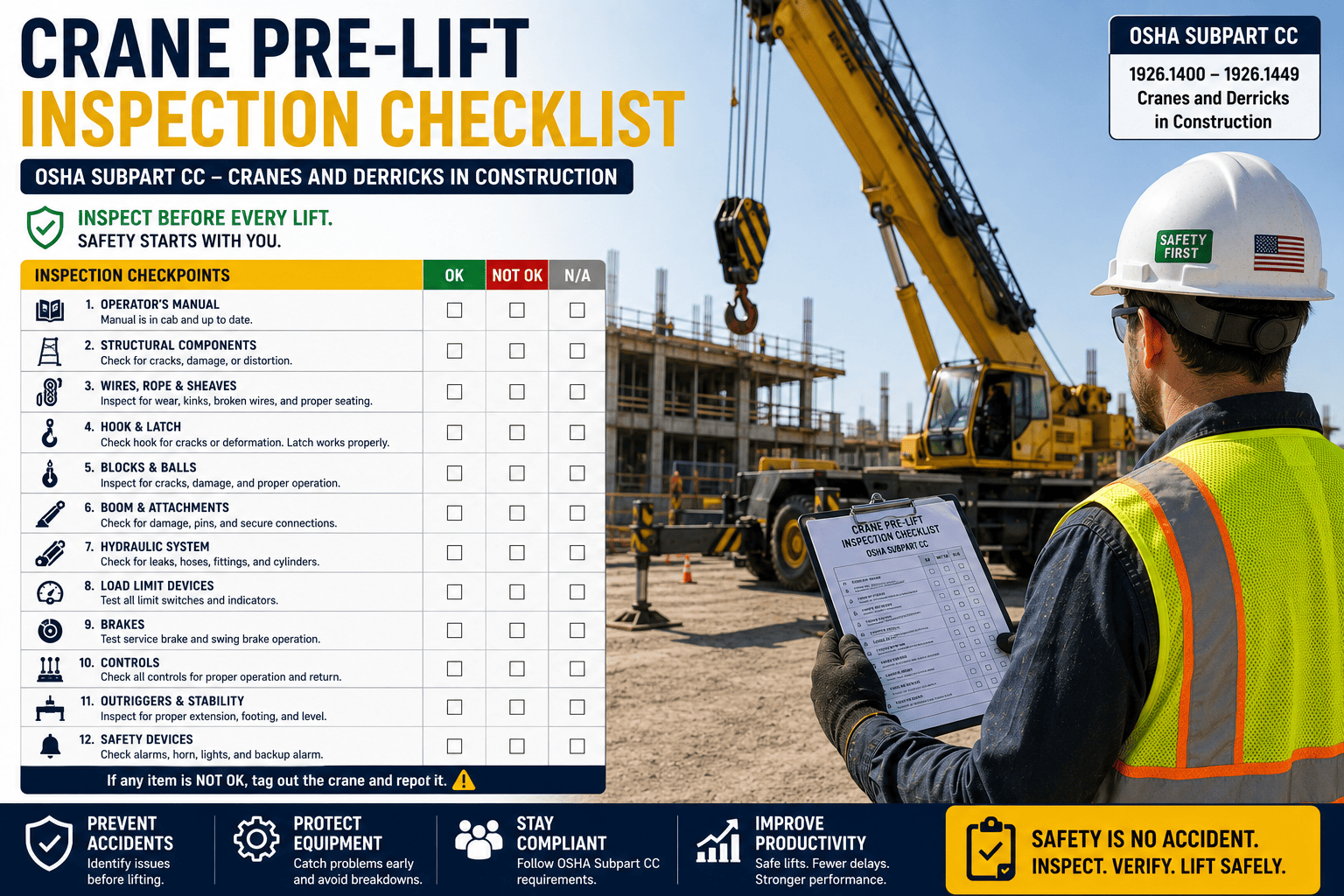
The Crane Pre-Lift Inspection Checklist
Under 29 CFR 1926.1412(d), a competent person must complete a visual inspection before the crane is used on every shift. Work through the crane in the same order every time so nothing gets skipped when the site is moving fast.
Wire Rope
Wire rope is the lifeline of the entire lift, and it gets its own dedicated standard under 1926.1413 for a reason. Check for broken wires, kinking, crushing, bird-caging, corrosion, and correct reeving through the sheaves and drum. Any rope that meets a removal criterion is a hard stop, not a judgment call.
Hooks And Rigging
Inspect the hook for cracks or twisting, and measure the throat opening against the manufacturer's specification rather than eyeballing it, since deformation past the allowed tolerance means the load can jump out of the hook mid-lift. Confirm the safety latch closes fully and operates freely, and check slings and rigging hardware for wear, cuts, or corrosion.
Safety Devices
Power on the load moment indicator and confirm it reads accurately for the current boom length and configuration. Test the anti-two-block device, verify the boom angle and length indicators read within tolerance, and check that upper and lower hoist limit switches trip correctly. These devices exist specifically to prevent the two most common fatal crane accidents, two-blocking and overloading, so a non-functional unit is an automatic out-of-service condition.
Structure, Ground, And Controls
Walk the boom and jib for cracks, weld defects, or deformation, and confirm pin connections on boom inserts and counterweights are properly retained. Check that outrigger pads are sized for the ground conditions and deploy fully, verify hydraulic hoses and fittings show no leaks, and test that all control levers and pedals return smoothly to neutral. Confirm load charts are posted and legible, and verify clearance from any overhead power lines before the first lift.
FleetRabbit walks operators through every crane system in the correct order, forces photo evidence on wire rope and hooks, and blocks a crane from a ready-to-lift status the moment a critical defect is flagged.
Wire Rope Rejection Criteria Under 1926.1413
Wire rope failure is the single most catastrophic crane defect, and it's also the most commonly cited crane deficiency during OSHA inspections. The rejection thresholds are specific and measurable, which means there's no room for a rope to be "probably fine."
| Condition Found | Rejection Criteria | Why It's A Hard Stop |
|---|---|---|
| Broken wires | Six random broken wires in one lay, or three in one strand | Remaining wires carry disproportionate load and can fail suddenly |
| Kinking or crushing | Any visible kink, crush, or bird-caging along the rope | Deforms internal wire strands and weakens load capacity unpredictably |
| Corrosion | Visible pitting or corrosion beyond surface discoloration | Internal corrosion is invisible until the rope fails under load |
| Core protrusion | Any core showing through outer strands | Indicates strand failure that visual wire counts alone can miss |
| Improper reeving | Rope not seated correctly in sheaves or drum | Causes uneven wear and can jump the sheave under load |
The Three OSHA Inspection Tiers
Subpart CC doesn't stop at the pre-shift check. Cranes require three distinct inspection tiers, and using the wrong person for the wrong tier is itself a violation.
Shift Inspection: Competent Person, Every Shift
This is the visual and functional walk-around covered above, performed before the crane is used on each shift. A competent person is someone capable of identifying hazards and authorized to take corrective action, typically the operator or a designated site supervisor with documented crane training.
Monthly Inspection: Documented And Retained
Everything in the shift inspection, plus deeper examination of structural members, measured wire rope condition, hook inspection, and brake system performance. Records must show the items checked, results, inspector name, and date, and must be retained for at least three months.
Annual Inspection: Qualified Person, Comprehensive
A complete evaluation of every load-sustaining structural component against manufacturer wear limits, full recalibration of the LMI, anti-two-block device, and all limit switches, and in some cases non-destructive testing of critical welds. This requires a qualified person, meaning someone with a recognized certification or demonstrated expertise, not just crane training. Annual records must be retained for at least twelve months.
| Inspection Tier | Who Performs It | Minimum Retention |
|---|---|---|
| Shift | Competent person | Recommended to keep on file for active project duration |
| Monthly | Competent or qualified person | 3 months minimum |
| Annual | Qualified person | 12 months minimum |
FleetRabbit tracks shift, monthly, and annual crane inspections in one place, with automatic interval reminders and retention that never expires early. When an inspector asks for three months of records, they're already in front of you.
Key Takeaways
A crane pre-lift inspection isn't a formality before the real work starts, it is the real work. Every wire rope check, every hook measurement, every LMI test is standing between a normal shift and a fatality, and OSHA built Subpart CC around that reality with three inspection tiers, hard rejection criteria, and documentation requirements that leave no room for guessing.
If your crane inspections still live on paper that's easy to lose between shifts, it's worth seeing what a guided digital workflow changes. Sign up for FleetRabbit to put shift, monthly, and annual crane checklists on every operator's phone, or book a demo to see how wire rope defects route straight to your maintenance team before the next lift.
FleetRabbit guides operators through OSHA Subpart CC pre-lift, monthly, and annual crane inspections, with mandatory photo evidence on wire rope and hooks, and a permanent record ready for any inspector.