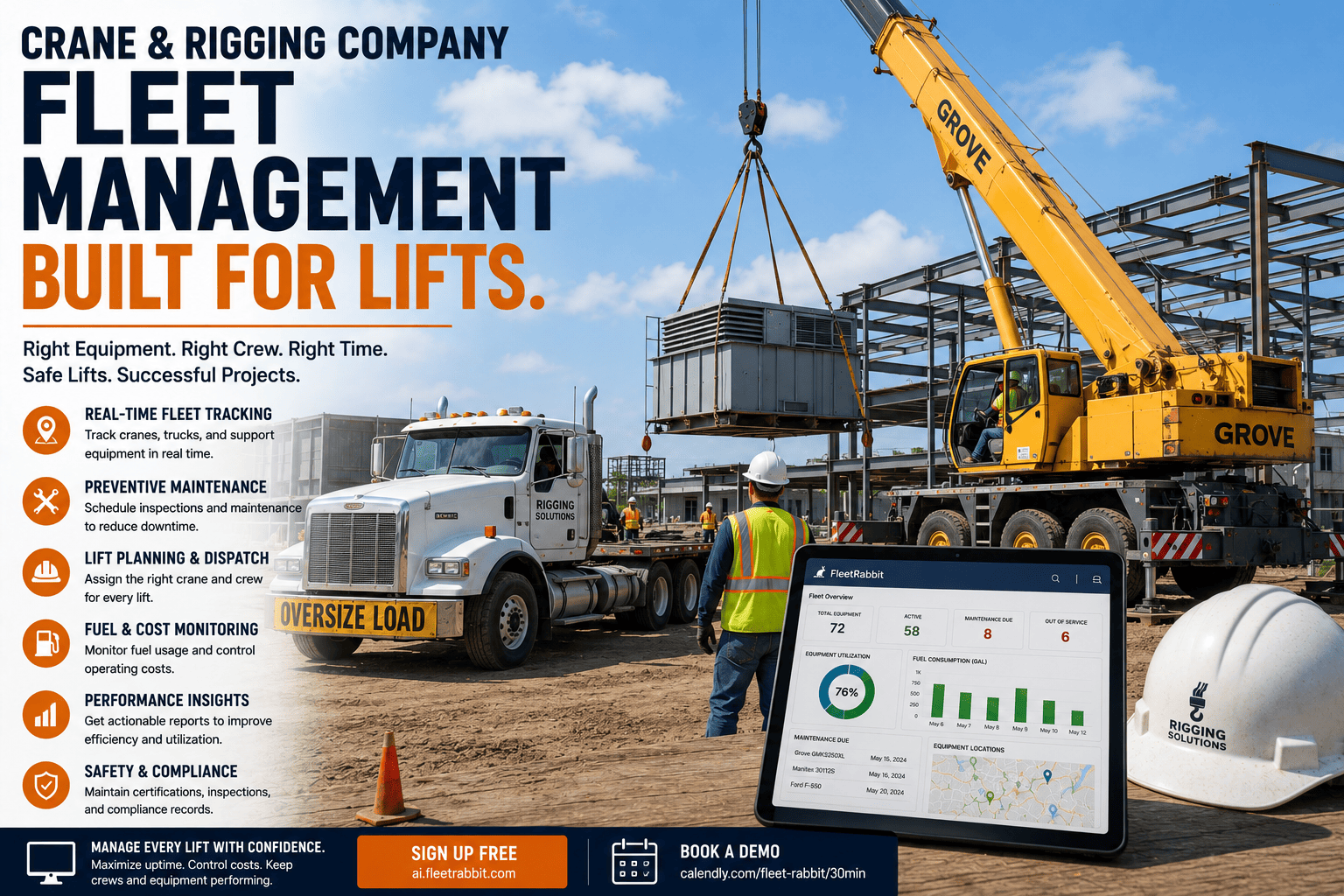
A crane does not just need to run. It needs to be legally allowed to lift. Between OSHA inspection rules, ASME B30 equipment standards, and NCCCO operator certifications that expire on their own separate calendars, a crane and rigging company is managing a compliance system as much as a fleet. Miss one inspection window or let one operator credential lapse, and a crane that is mechanically fine can still get red-tagged and pulled off the job the moment an inspector walks the site. Sign up for FleetRabbit to bring every crane, inspection, and certification into one dashboard, or book a demo to see how it fits your current fleet and crew.
Crane fleets run on three overlapping inspection tiers, shift, monthly, and annual, each tied to specific OSHA and ASME B30 checkpoints, plus operator, rigger, and signal person certifications that expire on independent five-year and annual cycles. Companies tracking this manually across paper binders and spreadsheets typically discover 3 to 6 lapsed credentials or overdue inspections a year, any one of which can trigger an out-of-service order and a full day or more of lost crane availability.
Why Crane Fleets Carry More Compliance Weight Than Any Other Equipment
Most heavy equipment only has to be mechanically sound to work. A crane has to be mechanically sound, inspected on schedule, operated by a currently certified person, rigged by a currently certified rigger, and directed by a qualified signal person, all at the same time. That layered requirement is what makes crane and rigging fleet management fundamentally different from managing dozers or dump trucks. A crane that passed its annual inspection in January can still be pulled from a lift in October because the operator's NCCCO card lapsed, or because the qualified person who last certified the wire rope is no longer on file.
The Three Inspection Tiers Every Crane Runs On
OSHA and ASME B30 standards break crane inspections into three overlapping tiers. Shift inspections happen before every use and cover the basics an operator can check in minutes, hooks, wire rope condition, and control response. Monthly inspections go deeper into hydraulic systems, brakes, and structural components, and have to be documented with findings on file. Annual inspections are the most comprehensive, typically performed by a qualified person and covering structural integrity, load charts, and full mechanical systems. Missing any single tier on any single crane is enough to put that unit out of compliance.
The Credential Web Behind Every Lift
Behind every compliant lift sits a web of individual certifications: the NCCCO or equivalent operator certification, rigger certifications for the crew connecting the load, signal person qualifications for anyone directing the lift, and qualified person credentials for whoever signs off on inspections. Each of these renews on its own timeline, some annually and some on a five-year cycle, and each one is tied to a specific person rather than the equipment itself. A fleet running 15 cranes across a dozen jobsites can easily be tracking 60 or more individual credentials at once.
FleetRabbit centralizes shift, monthly, and annual inspection schedules alongside operator, rigger, and signal person certifications, with alerts before anything expires. Sign up now to connect your fleet, or book a demo to see the certification dashboard in action.
Mapping the Inspection Tiers Against What Actually Gets Checked
Understanding what each inspection tier actually covers makes it easier to see why manual tracking breaks down as a fleet grows. Each tier has a different frequency, a different set of checkpoints, and often a different qualified person responsible for signing off.
| Inspection Tier | Frequency | Primary Checkpoints | Who Signs Off |
|---|---|---|---|
| Shift Inspection | Before every use | Hook condition, wire rope visual check, control response, warning devices | Crane operator |
| Monthly Inspection | Every 30 days | Hydraulic system pressure, brake function, wire rope wear measurement, structural fasteners | Qualified person |
| Annual Inspection | Every 12 months | Full structural integrity, load chart verification, complete mechanical and electrical systems | Qualified person or certified third-party inspector |
| Rigging Gear Inspection | Before every lift and periodically | Sling condition, shackle wear, chain and hardware integrity | Rigger or qualified person |
| Post-Incident Inspection | After any overload, collision, or abnormal event | Full structural and mechanical re-verification before return to service | Qualified person or certified third-party inspector |
Building a Compliance-Ready Crane Fleet Program
Companies that stay ahead of OSHA and ASME requirements share a few common habits. They treat certification tracking with the same discipline as mechanical maintenance, and they build systems that surface problems weeks before an inspector or a client ever asks for documentation.
Centralize Every Certification in One System
When operator, rigger, signal person, and qualified person credentials live in one searchable system instead of separate binders at each jobsite, a single dashboard can show exactly who is certified for what, and exactly when that certification runs out.
Set Alerts Well Before Expiration
Waiting until a card expires to renew it is how companies end up with an operator pulled off a crane mid-project. Alerts at 60, 30, and 14 days before expiration give scheduling teams enough runway to book recertification without touching the project timeline.
Tie Inspection Records to the Specific Crane
Every crane should carry its own digital inspection history, so a monthly hydraulic check or an annual structural inspection is instantly available if a client, insurer, or OSHA compliance officer asks for it on site.
Build Redundancy Into Operator Scheduling
Because operator and signal person certifications are tied to individuals, not equipment, a fleet with only one certified operator per crane type is one recertification delay away from a scheduling gap. Cross-training and maintaining a bench of certified operators keeps lifts moving even when one credential is mid-renewal.
What Strong Compliance Actually Buys a Crane Company
Beyond avoiding citations, a well-run compliance program is a sales advantage. General contractors and developers increasingly ask crane and rigging companies to show documentation before awarding work on safety-sensitive projects, and a company that can produce clean, current records for every crane and every credential wins that conversation faster than one still searching through binders. It also protects margin directly, since every avoided out-of-service order is an avoided rental crane, an avoided idle rigging crew, and an avoided renegotiation with a client over a missed lift date.
Frequently Asked Questions
Every lift depends on a crane that is mechanically sound, properly inspected, and operated by someone currently certified to run it. FleetRabbit brings all three into one system, so nothing slips past its deadline. Start your free trial with no credit card required, or book a demo to see it working with your fleet.