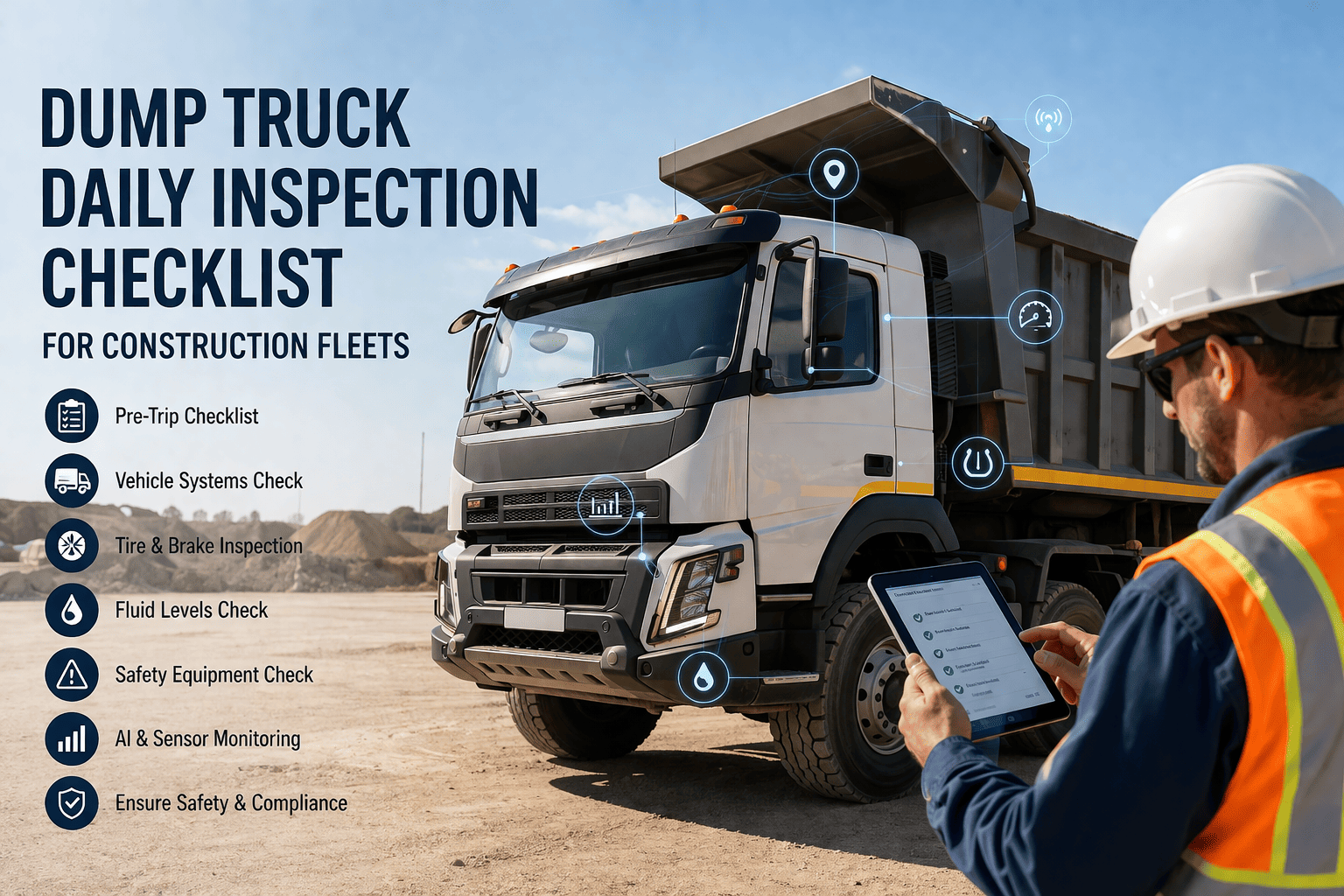
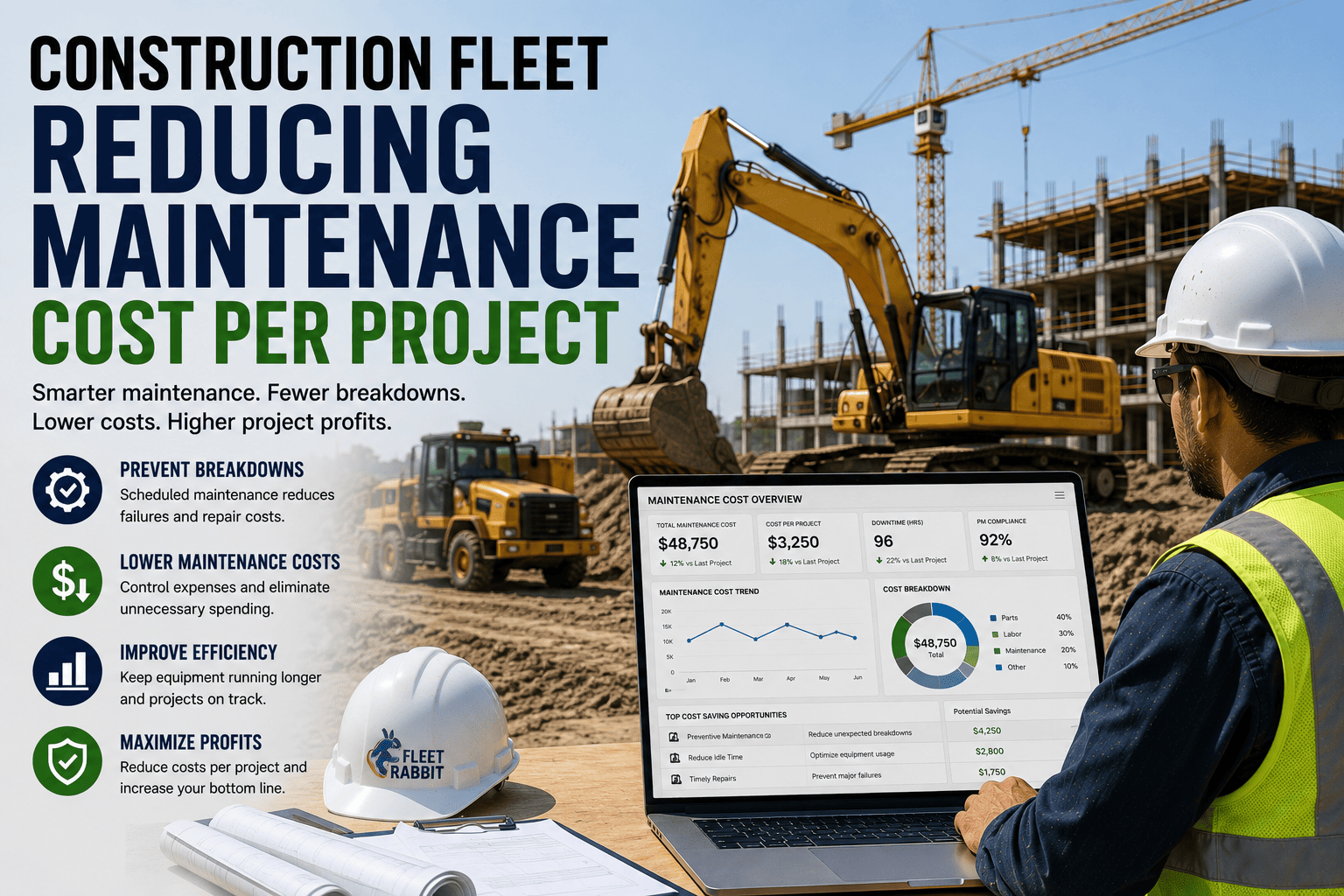
A dump truck operating on a construction site carries one of the highest daily risk profiles of any fleet vehicle — heavy gross vehicle weights, frequent reversing operations, hydraulic body systems that can fail catastrophically, and constant exposure to rough terrain that accelerates component wear. FMCSA 49 CFR 396.13 requires drivers to complete a vehicle inspection report before each trip and review the previous day's DVIR. This 64-point FMCSA and DOT-compliant daily inspection checklist covers every system a dump truck driver must verify before each shift. FleetRabbit digitises the entire process — mobile DVIR submission, automatic defect work orders, and audit-ready compliance records. Book a FleetRabbit compliance demo.
FleetRabbit DOT Compliance
Dump Truck Daily Inspection Checklist for Construction Fleets
A 64-point, 7-category FMCSA and DOT-compliant daily pre-trip inspection checklist for construction dump trucks — covering engine and fluids, brakes, tyres, lighting, hydraulic body, safety equipment, and DOT documentation requirements.
64 Check Points
7 Categories
FMCSA 396.13 Compliant
Pre-Trip Every Shift
CAT-01
Engine, Fluids & Under-Hood
Engine oil level on dipstick between MIN and MAX marks — low oil indicates consumption or leak requiring investigation before operation; do not start engine if oil is below minimum mark Coolant level in overflow reservoir — check without opening radiator cap on warm engine; low coolant indicates leak or internal consumption requiring pressure test before operating Power steering fluid at correct level — inadequate power steering fluid causes hard steering and pump damage; on heavy dump trucks this creates dangerous loss of directional control Windshield washer fluid reservoir filled — construction sites generate mud and concrete splatter that reduces visibility; empty washer reservoir is a DOT roadside inspection defect Transmission fluid at correct level and clear colour — dark, burned-smelling fluid indicates overheating or contamination; low level causes slipping, delayed engagement, and catastrophic failure No fluid leaks under truck or pooling on ground — walk perimeter checking for oil, coolant, fuel, and hydraulic fluid puddles; leaks indicate failed seals, cracked lines, or damaged components Air filter restriction indicator not in red zone — restricted air filter reduces power, increases fuel consumption, and can allow unfiltered air to damage turbocharger and engine internals Drive belts and hoses visually inspected — check for cracking, fraying, glazing, and correct tension on all accessory drive belts; inspect coolant hoses for bulging, softness, and cracked ends DEF (diesel exhaust fluid) level adequate for shift — Tier 4 engines require DEF to meet emissions standards; low DEF triggers warning lights and eventually derate engine to limp-home mode
CAT-03
Tyres, Wheels & Axles
All tyre pressures within manufacturer specification — check all tyres including duals; underinflated tyres on dual axles cause heat build-up, rapid wear, and blowouts that can cause loss of control at highway speeds Tread depth above DOT minimum (4/32" steer axle, 2/32" drive axle) — use tread depth gauge; bald or nearly bald tyres on construction-spec trucks operating on wet or muddy surfaces are a serious accident risk No cuts, bulges, embedded objects, or sidewall damage — run hand along all tyre sidewalls and tread areas; sidewall bulges indicate internal cord damage and imminent blowout risk All lug nuts present, correct, and tight — tap each lug nut with hammer; loose nuts produce a different sound; missing or loose lug nuts on a loaded dump truck can cause catastrophic wheel separation Dual tyre spacing correct — no debris, stones, or mud packed between dual tyres that contacts both tyre sidewalls; embedded debris causes tyre damage and heat build-up leading to blowout Wheel hubs checked for heat and bearing noise — after operating, hot hubs indicate failed wheel bearings or dragging brakes; check for grease weeping from hub seals indicating failed bearing seal Steer axle and suspension components checked — inspect tie rod ends for looseness, king pins for excessive play, and steering linkage for damage; worn steer axle components cause dangerous handling instability on loaded trucks Drive axle differential and housing inspected — no oil leaks from differential housing, axle seals, or breather; check for impact damage to axle housing from rough terrain operation common on construction sites
FleetRabbit DOT Compliance
Digital DVIR Submission — Eliminate Paper, Ensure Compliance, Pass Every DOT Inspection
FleetRabbit replaces paper DVIR forms with mobile digital inspections that auto-generate defect work orders, track driver completion rates, and produce audit-ready DOT compliance records in seconds. Every inspection timestamped, GPS-verified, and permanently stored.
CAT-04
Lights, Signals & Electrical
Headlights (low and high beam) operational on both sides — walk to front and verify both headlights illuminate; check aim is not excessively high or low; construction sites require early morning and after-dark operation Tail lights, brake lights, and reverse lights operational — have spotter verify all rear lights function while driver operates controls; brake lights are FMCSA-required safety equipment All turn signals functional front and rear — verify correct side illuminates and flashes at correct frequency; turn signals are required DOT equipment and their absence triggers roadside inspection citations Hazard warning flashers operational — all four corners must flash simultaneously; hazard lights required when dump truck is stopped for loading/unloading on or near traffic areas Clearance lights, marker lights, and reflectors present and functional — all required FMCSA marker lights illuminated; reflectors clean and undamaged; these make the truck visible to other drivers at night Backup alarm functional and audible — verify alarm sounds immediately when reverse engaged; backup alarm must be audible above construction site ambient noise; failed backup alarm creates immediate struck-by hazard Horn functional — test horn; horn must be loud enough to warn other workers and drivers; operational horn is FMCSA-required equipment and its absence is a DOT violation Dashboard warning lights verified clear after engine warm-up — check engine, ABS, air brake, DEF, oil pressure, and temperature warning lights all extinguish after start; illuminated warning lights require investigation before operation
CAT-05
Hydraulic Body & Dump System
Hydraulic fluid level at correct mark — check reservoir with body fully lowered; low hydraulic fluid causes slow or incomplete body raise, erratic operation, and pump damage that can strand truck on site Hydraulic lines, fittings, and hoses leak-free — visually inspect all hydraulic lines from pump through cylinders; any hydraulic fluid dripping near exhaust components is a fire hazard requiring immediate repair Dump body raises and lowers smoothly through full range — test cycle body from fully lowered to fully raised and back; operation must be smooth with no hesitation, jerking, or unusual noise indicating cylinder or valve issues Body prop (safety strut) present and functional — locate body prop and verify it can be deployed to hold body safely elevated for underbody maintenance; operating under a dump body without a body prop is a fatal hazard Tailgate latches, hinges, and chains inspected — verify tailgate opens and closes fully, latches secure both sides, and safety chains present; failed tailgate latch during transport causes load spillage creating hazards for following vehicles Body spreader bar and body bolts secure — spreader bar prevents body sides from spreading under load; missing or cracked spreader bar requires repair before hauling; check all body mounting bolts for tightness Tarp system functional (if equipped) — verify tarp deploys fully and retracts completely; many jurisdictions require tarping when transporting loose materials on public roads; failed tarp system creates citation risk Body interior inspected for damage, cracks, and excessive wear — check body floor, sides, and front panel for structural cracks, worn-through sections, and loose components that could fail under load impact
CAT-06
Cab & Operator Controls
Seat belt present, undamaged, and latches correctly — webbing not frayed or cut, latch buckle engages and releases positively, retractor (if equipped) locks under sudden pull; seat belt use is mandatory per FMCSA regulations Mirrors clean and adjusted — driver side, passenger side, and cross-view mirrors positioned for maximum rearward visibility; clean with no cracks or missing sections; dump trucks have large blind zones requiring all mirrors functioning Windshield free of cracks in driver's vision zone — FMCSA prohibits cracks in critical viewing area directly in front of driver; check for damage from rock chips or debris impact that has propagated into vision zone Windshield wipers operational in all positions — test both wiper speeds and washer pump; construction site mud, concrete, and dust require reliable wipers; failed wipers in rain create immediate visibility hazard All pedals (brake, clutch, accelerator) operate freely with correct free play — pedals must return to rest position when released; sticky or binding pedals create driver control issues at critical moments Cab steps and grab handles secure — construction dump truck drivers climb in and out of cab dozens of times per shift; loose steps, missing grab handles, and accumulated mud on steps cause slip-and-fall injuries Body hoist control operates correctly from cab — test PTO engagement, hoist lever operation, and hydraulic speed control; driver must be able to operate dump body from cab with controls responding predictably CB radio, two-way radio, or site communication device functional — construction sites require reliable communication for positioning, load coordination, and emergency response; verify channel assignment and signal quality
CAT-07
Safety Equipment & DOT Documentation
Fire extinguisher mounted, charged, and accessible — gauge in green zone, pin and seal intact, mounted in cab or exterior bracket within driver reach; FMCSA requires fire extinguisher on all CMVs Three emergency warning triangles (or flares) present in holder — FMCSA 393.95 requires three bidirectional emergency reflective triangles; verify all three present and in undamaged condition before departing Wheel chocks present and accessible — minimum two wheel chocks required for on-site use; verify chocks are in holder, undamaged, and accessible without climbing under truck First aid kit stocked and accessible — check kit for bandages, antiseptic, and basic first aid supplies; construction site proximity to trauma-capable facilities varies widely; stocked first aid kit is essential CDL and medical certificate current — driver must carry valid CDL for appropriate class and endorsements; current DOT medical examiner's certificate must be in driver's possession; expired documents are immediate out-of-service violations Vehicle registration and proof of insurance in cab — current registration card and insurance certificate or card in cab; required documents for all on-road operation; missing documents create citation risk at weigh stations and roadside inspections Previous DVIR reviewed and signed — driver must review previous day's DVIR, sign that defects were repaired or no repairs needed, and retain copy per FMCSA 396.11; failure to review previous DVIR is a regulatory violation Current DVIR completed and signed — complete today's pre-trip inspection report listing all defects or "no defects found"; submit digitally via FleetRabbit before departing; defects affecting safe operation must be repaired before truck operates Load securement equipment inspected — verify tarps, chains, load binders, and straps (if used) are present, undamaged, and within DOT weight rating; proper load securement prevents material spillage and protects following traffic
FleetRabbit Dump Truck Compliance
Digital DVIR for Every Dump Truck. Every Shift. Every Site.
FleetRabbit digitises dump truck pre-trip inspections with FMCSA-compliant mobile DVIR, automatic defect work orders, driver qualification tracking, and DOT audit-ready records. Eliminate paper, ensure compliance, and protect your drivers and your operation.
FMCSA 396.13
Digital DVIR
Defect Tracking
Driver Records
DOT Audit-Ready
All Posts