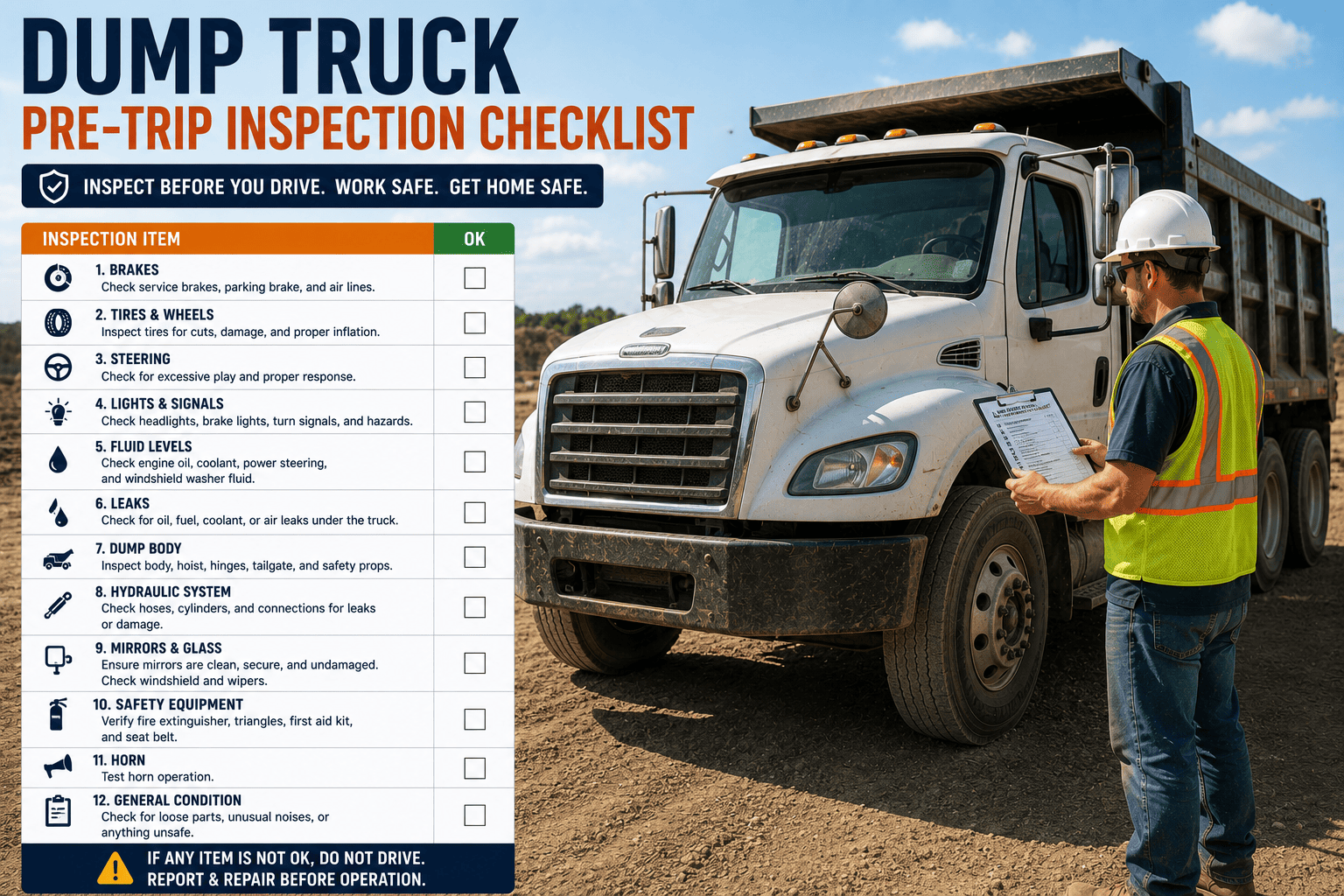
A construction dump truck lives a double life. At 6 a.m. it's a commercial motor vehicle merging onto the highway, subject to DOT brake and lighting rules like any long-haul rig. By 7 a.m. it's parked on a job site, raising a loaded bed near a crew, now governed by an entirely different set of OSHA safety expectations. Most pre-trip checklists are written for one world or the other. A dump truck needs both, checked the same morning, on the same vehicle, before a single yard of material moves.
A dump truck pre-trip inspection checklist for construction use has to satisfy two separate regulators at once: DOT and FMCSA rules for anything that happens on public roads, and OSHA rules for anything that happens on the job site. Federal regulation 49 CFR 396.11 requires a written inspection report at the end of each day's work, while OSHA 29 CFR 1926 requires frequent, competent-person inspections of the equipment itself, including confirming the dump body is blocked or supported whenever anyone works near or under it.
Why One Truck Answers to Two Different Rulebooks
Construction equipment inspections fall under OSHA, while commercial motor vehicles operating in interstate commerce fall under DOT and FMCSA. A dump truck that only ever worked a closed job site would fall under OSHA alone. The moment it travels a public road to get there, both sets of rules apply, and a fleet manager has to satisfy both without running two completely separate inspection programs every morning.
What Each Side Actually Cares About
DOT and FMCSA rules exist to prevent a mechanical failure or safety defect from causing a crash on the road: brakes, steering, lighting, tires, and coupling devices are the core focus. OSHA rules exist to prevent an incident on the job site itself: the dump body must be properly blocked or cribbed whenever it's raised for repair, and the equipment must be inspected regularly by a competent person before it goes anywhere near a crew.
Why Treating Them as One Checklist Saves Real Time
Building one dual-purpose inspection routine, run once before the truck leaves the yard, means an operator isn't stopping twice a day to satisfy two separate paperwork trails. It also means nothing falls through the gap between "that's a DOT item" and "that's an OSHA item," which is exactly where overlooked defects tend to hide.
DOT & FMCSA Focus
- Service brakes and air brake system function
- Steering mechanism and coupling devices
- Lighting devices, reflectors, and turn signals
- Tires, wheels, rims, and lug nut torque
- Horn, mirrors, and windshield wipers
OSHA Focus
- Dump body blocked or supported before anyone works near it
- Hydraulic hoist cylinder, hoses, and fittings for leaks
- Backup alarm tested and audible on site
- Tailgate latch and load securement condition
- Competent-person walk-around before first use
The Hydraulic Hoist System Deserves Extra Attention
Hydraulic systems on a dump truck cycle constantly and carry more mechanical stress than almost any other component on the vehicle. Because of the pressures involved, even a pinhole leak in a hydraulic line can be dangerous, which is why OSHA guidance is direct on one point: nobody should ever work under a raised dump body unless it's properly supported by a safety prop or hoist block.
What to Check Before Cycling the Bed
Inspect hoist cylinders, hoses, and fittings for leaks, cracks, or bulges before the first cycle of the day, and confirm the tailgate latch operates cleanly. When testing dump bed operation, make sure there's adequate clearance overhead and that nobody is standing near the truck during the cycle.
Running the Walk-Around in the Same Order Every Time
A systematic, repeatable pattern, moving clockwise around the vehicle every single day, is what keeps a pre-trip inspection thorough instead of rushed. Checking fluids while the engine is still cold gives the most accurate readings for oil, coolant, and hydraulic fluid levels.
Exterior and Engine Compartment
Walk the full exterior checking for leaks, tire and wheel condition, and lighting function, then open the hood to check engine oil, coolant, power steering fluid, and belt condition. A cracked serpentine belt that fails on the highway disables the truck immediately and can damage other components in the process.
Cab, Controls, and Emergency Equipment
Confirm the horn, wipers, mirrors, and gauges all respond correctly, and verify emergency equipment, fire extinguisher, reflective triangles, and seatbelts, are present and in good condition before the truck leaves the yard.
Run Your DOT and OSHA Checks in a Single Digital Inspection
FleetRabbit combines DOT pre-trip requirements and OSHA job site checks into one guided digital inspection, with photo documentation and instant defect routing. Sign up to build your first dump truck inspection workflow in minutes, or book a demo to see it running before you commit.
Understanding the DVIR Requirement
Under 49 CFR 396.11, drivers of commercial motor vehicles must inspect the vehicle and prepare a written report at the completion of each day's work. For property-carrying vehicles, a written Driver Vehicle Inspection Report is only strictly required when a defect is actually found, but most carriers require documentation of every inspection anyway, since it's the strongest protection available if an incident is ever reviewed.
The Chain of Custody That Protects Everyone
Before operating the truck, a driver must review the previous DVIR and, if a defect was noted, confirm the repair was made before signing off. That chain, defect reported, repair made, next driver verifies, is exactly what an auditor or investigator looks for first, and it's also the step most commonly broken when inspections get rushed.
DOT Requirements vs. OSHA Requirements at a Glance
Seeing both sets of obligations side by side makes it easier to build one checklist that actually covers everything a construction dump truck needs.
| Requirement | Governing Body | What It Covers | Documentation Needed |
|---|---|---|---|
| Daily written inspection report | DOT / FMCSA (49 CFR 396.11) | Brakes, steering, lights, tires, horn, wipers, coupling devices | Retained 3 months, required when a defect is found |
| Competent-person equipment inspection | OSHA (29 CFR 1926) | Dump body blocking, hydraulic hoist condition, structural integrity | Frequent and regular, documented before use |
| Annual periodic inspection | DOT / FMCSA (49 CFR 396 Appendix A) | Full mechanical inspection covering all safety-critical systems | Sticker or report retained 14 months, kept on vehicle |
Digital Inspections vs. Paper DVIRs
Paper pre-trip forms have been standard for decades, but they create the same problem across every vehicle and every day: findings depend on someone remembering to write them down, and there's no easy way to prove an inspection wasn't simply signed off without actually being done.
Why Falsification Is a Real Risk With Paper
Skipping the walk-around and signing the form anyway, sometimes called pencil whipping, is one of the most common violations found during roadside enforcement. Digital inspections with GPS verification, timestamps, and required photos make that kind of shortcut far harder to take, which protects both the driver and the fleet if an incident is ever reviewed.
Getting a Dual-Compliance Checklist Running Across Your Fleet
Building one inspection that satisfies DOT on the road and OSHA on site doesn't require juggling two separate systems. A digital checklist configured once, covering brakes and lighting alongside dump body blocking and hydraulic condition, can run as a single guided walk-around every morning, with completed reports stored automatically for whichever auditor asks first. If you'd like to see that dual-compliance setup before rolling it out, booking a demo is the fastest way to judge the fit for your fleet.
Frequently Asked Questions
Stay Compliant on the Road and On Site, Every Morning
A dump truck that satisfies DOT but skips OSHA, or the other way around, is still exposed. FleetRabbit runs one digital pre-trip inspection that covers both, with photo-documented, audit-ready records for every truck. Sign up for a free trial or book your demo today.