Most construction sites don't have reliable cell signal, and the ones that do often lose it the moment equipment moves behind a berm, into a cut, or deep into a structure under construction. That's a minor inconvenience for a phone call. For fault detection systems built to run in the cloud, it's a blind spot — every minute of dropped connectivity is a minute where a developing hydraulic failure or overheating engine goes completely unmonitored.
Edge AI solves this by not needing the connection in the first place. Instead of streaming raw sensor data to a cloud server for analysis, the equipment itself does the thinking, running fault detection models directly on a device installed on the machine. The signal comes back when it's ready. The analysis never waits for it.
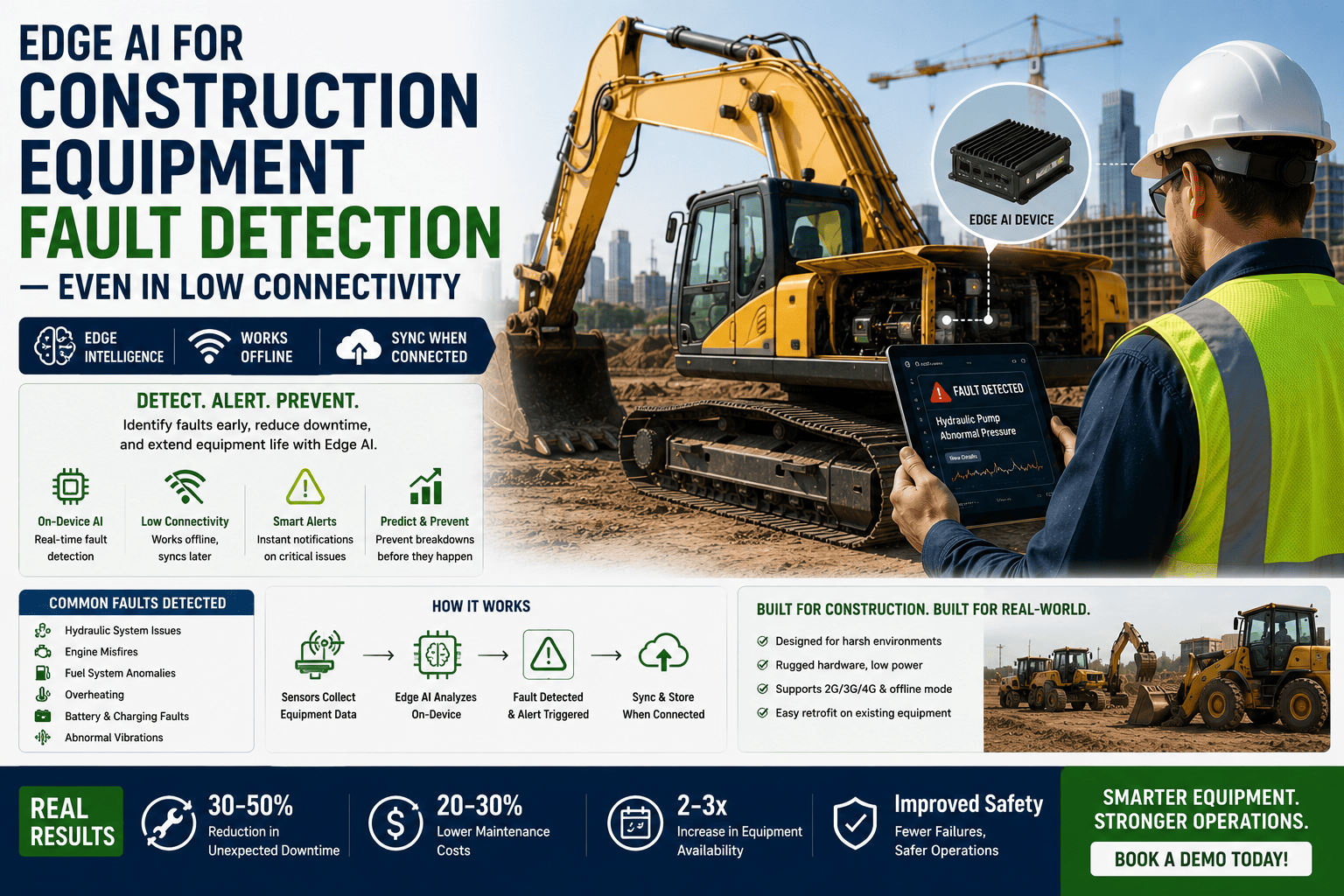
Edge AI for construction equipment processes sensor data directly on the machine instead of relying on a cloud connection, allowing fault detection to run continuously even in low-connectivity job sites. This architecture cuts alert latency from minutes to seconds and catches early-stage failure signatures — abnormal hydraulic pressure variance, coolant temperature deviation, injector degradation — before an OEM fault code would even trigger.
How On-Device Fault Detection Actually Works
The mechanics are simpler than the term "edge AI" makes them sound. It's a three-step loop that runs continuously on the machine, with or without a signal.
Sensor Data Capture
Hydraulic pressure, coolant temperature, vibration, and injector performance readings stream continuously from the equipment's onboard sensors into the edge device.
On-Device Inference
A machine learning model trained on millions of fault sequences runs locally, comparing live readings against known failure precursor patterns in real time — no cloud round-trip required.
Predictive Alert
When a fault precursor pattern is detected, the device transmits an alert with a predicted failure window the moment connectivity is available — not raw data waiting to be processed later.
Fleets running equipment across remote civil sites or dense urban structures where signal is unpredictable can see this architecture running on their own machines by booking a demo rather than reading about it in the abstract.
Edge AI Versus Cloud-Dependent Monitoring
Cloud AI isn't a bad idea — it's simply the wrong architecture for equipment that regularly loses connectivity. The difference shows up clearly once you compare how each approach behaves the moment a signal drops.
| Capability | Cloud-Dependent AI | Edge AI |
|---|---|---|
| During Connectivity Gaps | Fault detection pauses until signal returns | Continues running uninterrupted on-device |
| Alert Latency | Minutes, dependent on network round-trip | Seconds, processed locally before transmission |
| Data Transmitted | Raw sensor streams requiring constant bandwidth | Compact alerts with predicted failure windows |
| Remote Site Reliability | Degrades with signal quality | Unaffected by cellular conditions |
FleetRabbit's edge-AI devices process sensor data directly on your equipment, delivering predictive fault alerts across mixed-brand fleets regardless of job site connectivity — live from the first operational week.
The Fault Signatures Edge AI Catches Before A Code Triggers
OEM fault codes are built to fire once a threshold is crossed — by the time the light comes on, the failure is often already underway. Edge AI is trained to recognize the pattern building toward that threshold, days or weeks earlier.
Reading The Signals Before They Become Failures
Abnormal hydraulic pressure variance often precedes seal or pump failure well before pressure drops far enough to trip a standard warning. Rising coolant temperature deviation patterns — small, inconsistent upward drifts rather than a single spike — frequently signal a developing cooling system issue days before overheating becomes visible. Injector performance degradation trends show up as subtle timing shifts long before fuel efficiency or engine performance visibly suffers.
Why Pattern Recognition Beats Threshold Alerts
A threshold-based system asks one question: has this number crossed a fixed line. A pattern-trained model asks a more useful one: does this trend match the shape of a known failure building over time. That distinction is what allows edge AI to flag a developing problem while it's still an inexpensive fix, rather than after it's become an emergency repair.
FleetRabbit's edge-AI devices keep fault detection running on the machine itself, so a dead zone on your job site never means a blind spot in your maintenance program. See predictive alerts running on your own equipment.