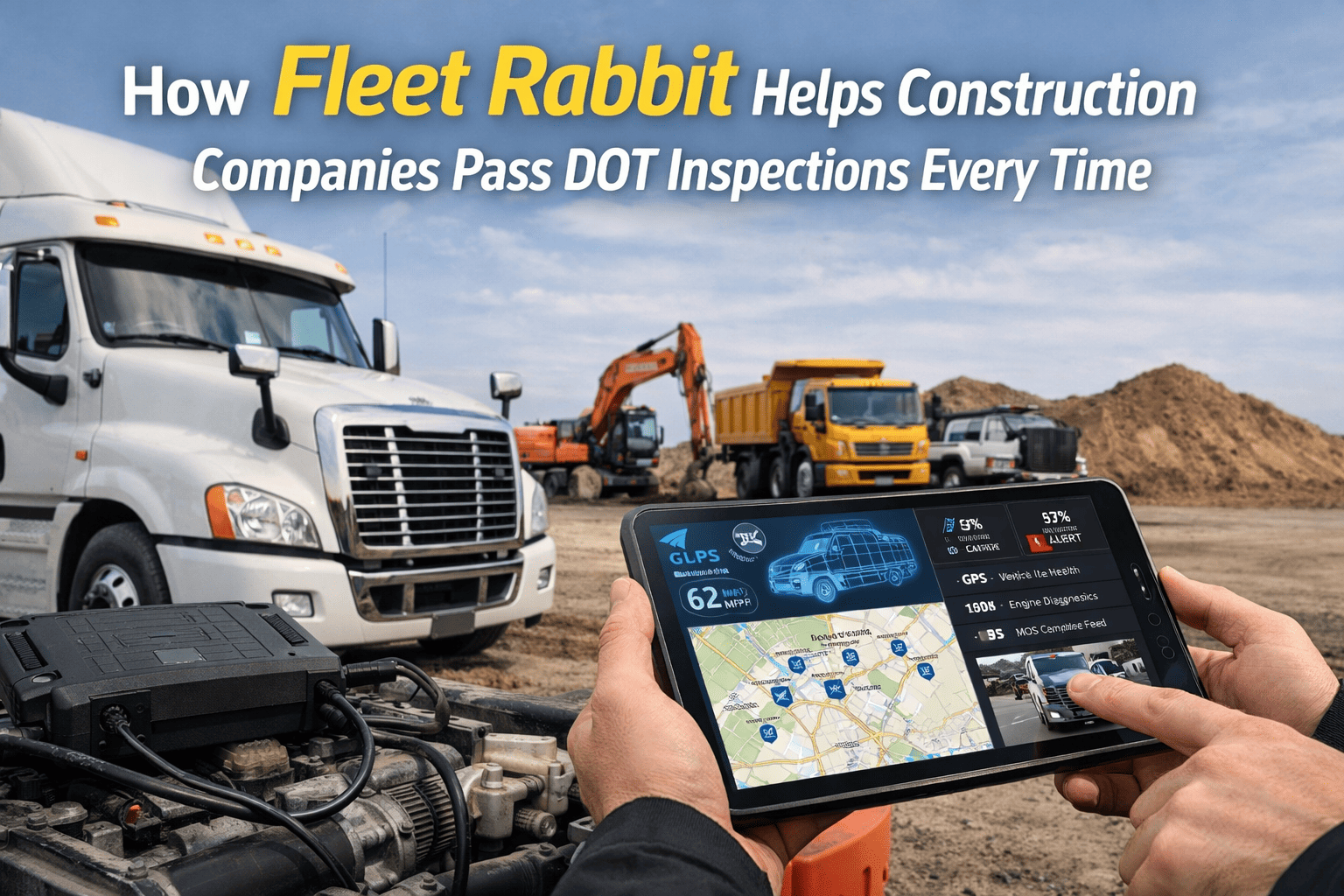
A failed DOT inspection costs a construction company $3,000–$16,000 per violation in fines, 2–5 days of vehicle downtime, and the kind of reputation damage that makes bonding companies raise your premiums. Construction fleets face disproportionately higher DOT scrutiny because they operate mixed-class vehicles — dump trucks, cranes, concrete mixers, pickup trucks, and heavy haulers — each with different compliance requirements, inspection intervals, and documentation standards. The FMCSA reports that 23% of construction vehicles inspected receive out-of-service orders, compared to 12% for general freight carriers. The difference isn't that construction equipment is worse — it's that construction companies lack the systems to track compliance across diverse vehicle types scattered across multiple job sites with operators who change assignments weekly. Fleet Rabbit's AI-powered compliance platform eliminates DOT inspection failures by automating DVIR documentation, ELD compliance, maintenance scheduling, and document management across your entire mixed fleet — so every vehicle is inspection-ready, every day, at every site. Book a demo to see DOT compliance automation in action.
Quick Answer
Fleet Rabbit helps construction companies pass DOT inspections by automating the three areas that cause 87% of violations: driver logbook errors (ELD compliance), maintenance documentation gaps (DVIR records), and missing permits/insurance (document management). The AI platform monitors compliance status across every vehicle in your fleet in real time, flags violations before they happen, and generates inspection-ready reports with one click — reducing DOT violation rates by 94% within the first 90 days of deployment.
1. Why DOT Compliance Is Harder for Construction Fleets
Mixed Fleets Create Mixed Compliance Nightmares
Construction companies don't operate simple fleets. A typical construction operation runs 15–80 vehicles across 5+ equipment classes — Class 3 pickups, Class 6 dump trucks, Class 7 concrete mixers, Class 8 haulers, and specialty cranes. Each vehicle class has different DOT inspection requirements, different CDL endorsement needs, different ELD exemption rules, and different maintenance intervals. A dump truck driver needs a CDL-A with air brake endorsement. A crane operator needs a specialized license. A pickup driver may be ELD-exempt under the short-haul exception — or may not be, depending on radius. Managing this complexity across 3–12 active job sites with operators rotating weekly is where construction companies fail DOT inspections — not because they don't care about compliance, but because they can't track it manually.
23%
Construction OOS Rate
$8.4K
Avg. Violation Cost
87%
Preventable Violations
1st
Driver Logbook / ELD Violations
38% of all construction DOT violations
Missing logs, falsified hours, HOS violations, incomplete driver records. Construction drivers frequently cross the 150-mile short-haul radius — accidentally triggering full ELD requirements without proper setup.
2nd
Maintenance & Vehicle Condition
31% of all construction DOT violations
Brake deficiencies, lighting failures, tire wear, missing or incomplete DVIR records. Construction vehicles endure harsh conditions — dust, mud, heavy loads — that accelerate wear beyond standard maintenance intervals.
3rd
Documentation & Permits
18% of all construction DOT violations
Expired insurance cards, missing operating permits, incomplete vehicle registration, absent medical examiner certificates. Documentation gets lost between job trailers, office files, and glove compartments.
2. Real-Time Fleet Monitoring — Prevent Violations Before Inspection
Live Tracking
GPS Tracking for Every Vehicle Class
Fleet Rabbit tracks every vehicle in your construction fleet — pickups, dump trucks, haulers, and specialty equipment — on a single real-time map. Know exactly where every vehicle is, how fast it's moving, and whether it's in a geofenced work zone or on a public highway where DOT enforcement is active. GPS data confirms short-haul radius compliance automatically — alerting you the moment any driver approaches the 150-mile ELD exemption boundary so you can switch from paper logs to ELD before a violation occurs.
Behavior Alerts
Unsafe Driving Detection & Coaching
Harsh braking, speeding, rapid acceleration, and excessive idling are tracked per driver and per vehicle. DOT inspectors increasingly use CSA scores to target fleets for inspection — a high unsafe driving score puts your fleet at the top of the inspection list. Fleet Rabbit's behavior monitoring reduces unsafe events by 42% within 60 days through real-time coaching alerts sent directly to the driver's mobile device. Lower CSA scores mean fewer targeted inspections.
Status Dashboard
Live Vehicle Status at Every Job Site
Real-time dashboard shows every vehicle's compliance status: green (inspection-ready), yellow (action needed within 7 days), red (out of compliance — do not dispatch). Fleet managers see the entire fleet on one screen — no more calling site supervisors to ask if the dump truck's registration is current. Filter by site, vehicle type, driver, or compliance category. Push alerts when any vehicle transitions from green to yellow.
DOT Compliance Automation
Stop Failing DOT Inspections — Start Preventing Violations
Fleet Rabbit monitors compliance across your entire construction fleet in real time. Every vehicle. Every driver. Every document. Every site. One platform.
94% Violation Reduction
14 Days To Full Deployment
3. Automated Driver Logbooks — ELD Compliance Without the Hassle
Digital Logs Replace Paper Chaos
Construction drivers hate paperwork — and paper logbooks are the #1 source of DOT violations in construction fleets. Fleet Rabbit's automated ELD system records driving time, on-duty time, sleeper berth time, and off-duty time automatically from vehicle telematics. No manual entries. No end-of-day guessing. No falsified logs that trigger $16,000 penalties.
Hours of Service (HOS) compliance is monitored continuously — the system alerts drivers and fleet managers when a driver approaches their 11-hour driving limit, 14-hour on-duty limit, or 60/70-hour weekly limit. Construction-specific intelligence: the system understands short-haul exemptions, adverse driving conditions exceptions, and construction-zone operating rules that generic ELD systems miss.
The short-haul exemption is a common trap for construction fleets. Drivers operating within 150 air-miles of their reporting location can use paper logs instead of ELDs — but the moment a driver crosses that boundary, full ELD compliance kicks in. Fleet Rabbit monitors every driver's distance from their home terminal in real time. When any driver reaches 120 miles, the system sends an automatic alert: "Approaching ELD boundary — switch to electronic logging." This single feature prevents the most expensive ELD violation in construction: operating without a required ELD device ($1,200–$16,000 per incident).
Drivers access their logs, HOS status, and remaining drive time from the Fleet Rabbit mobile app. Inspectors receive electronic log files via Bluetooth transfer or email — formatted exactly to FMCSA standards. Complete 30-day ELD record archives are always available and inspection-ready.
Fleet managers see a fleet-wide HOS dashboard showing every driver's current status: driving, on-duty, sleeper, or off-duty. Color-coded alerts — green (6+ hours remaining), yellow (under 2 hours), red (violation risk) — let dispatchers make assignment decisions based on actual driver availability, not guesswork. The system also tracks the 34-hour restart provision, ensuring drivers don't return to duty before their mandatory rest period is complete. For multi-day projects, Fleet Rabbit calculates cumulative 60/70-hour limits automatically and alerts when any driver is within 4 hours of their weekly maximum.
ELD Compliance Features
Automatic driving time recording from telematics
Real-time HOS countdown for every driver
Short-haul radius monitoring with auto-alert at 150 miles
Adverse driving conditions exception tracking
Driver self-certification with mobile app
Automatic log transfer to DOT inspectors via Bluetooth/email
30-day ELD record archive — always inspection-ready
Fleet-wide HOS dashboard with color-coded driver status
34-hour restart and 60/70-hour weekly limit tracking
Multi-state HOS rule compliance across all operating regions
4. Preventive Maintenance Scheduling — AI-Powered DVIR Compliance
AI Maintenance
Predict Failures Before They Become Violations
Fleet Rabbit's AI analyzes engine diagnostics, oil pressure trends, brake wear patterns, tire condition data, and historical repair records to predict component failures 5–15 days before breakdown. Maintenance alerts schedule service during planned downtime — not during a DOT roadside inspection. Digital DVIR (Driver Vehicle Inspection Reports) replace paper forms: operators complete pre-trip and post-trip inspections on the mobile app with photo documentation, defect severity rating, and automatic routing to the maintenance team. Every DVIR is time-stamped, GPS-tagged, and stored for 90 days — exceeding DOT record retention requirements. Construction vehicles endure extreme conditions — dust infiltration, heavy load stress, frequent cold starts — that accelerate wear beyond manufacturer schedules. Fleet Rabbit adjusts maintenance intervals based on actual operating conditions, not generic mileage thresholds.
Pre-Trip
Digital DVIR — Mobile Inspections
Operators complete FMCSA-compliant pre-trip inspections in 8–12 minutes on the Fleet Rabbit mobile app. Photo documentation of tires, brakes, lights, mirrors, and coupling devices. Defects flagged automatically with severity rating. Maintenance team notified instantly for critical defects — vehicle held until repair confirmed.
Tracking
Engine Health & Wear Monitoring
Real-time monitoring of engine hours, oil life, coolant temperature, brake pad thickness, tire pressure, and transmission health. AI-powered alerts trigger maintenance before DOT-reportable conditions develop. Track maintenance costs per vehicle, per site, per operator — identifying which assignments accelerate wear.
5. Smart Document Management — Never Fail on Paperwork
Vehicle Registration
Current registration for every vehicle. Expiration alerts 30 days before renewal. Digital copy accessible from mobile app during roadside inspection.
Insurance Certificates
Proof of insurance stored per vehicle. Policy change updates sync automatically. Expired insurance detected and flagged before dispatch.
Operating Permits
Oversize/overweight permits, special hauling permits, and state-specific operating authorities. GPS-based permit validation: alert if vehicle enters a state where current permit doesn't cover operation.
CDL & Medical Cards
Driver CDL verification, endorsement tracking, medical examiner certificate expiration monitoring. Prevent dispatch of drivers with expired credentials — automatic DOT compliance enforcement.
Maintenance Records
Complete service history per vehicle — accessible during DOT audit. Oil changes, brake jobs, tire replacements, component repairs all logged with date, mileage, technician, and cost.
DVIR Archives
90-day digital DVIR archive exceeding DOT requirement. Pre-trip and post-trip inspections with photo evidence, defect history, and repair confirmation — all searchable by vehicle, date, or defect type.
6. AI-Powered Risk Alerts — Proactive Compliance, Not Reactive Penalties
01
Detect Non-Compliance Patterns
Fleet Rabbit's AI monitors 40+ compliance variables across your fleet — analyzing trends that human oversight misses. The system detects patterns like "Driver Martinez consistently approaches HOS limits on Thursday/Friday routes" or "Dump trucks assigned to Site C have 3x the brake defect rate of other sites" — identifying systemic compliance risks before they produce violations. Pattern detection accuracy: 91% for predicting which vehicles will fail inspection within 14 days.
02
Predict Inspection Failures
Every vehicle in your fleet receives a daily "Inspection Readiness Score" from 0–100. Vehicles scoring below 80 trigger automatic review. Vehicles scoring below 60 are flagged "Do Not Dispatch Until Resolved." The score incorporates DVIR history, maintenance status, document currency, driver HOS position, and CSA score trends. Fleet managers see the entire fleet scored on one dashboard — prioritizing the highest-risk vehicles for immediate attention.
03
Suggest Corrective Actions
Alerts don't just say "problem detected" — they tell you exactly what to do. "Vehicle #34: brake pad thickness below DOT minimum on rear axle. Schedule brake service within 48 hours. Nearest certified shop: 4.2 miles from current location. Estimated repair: 2.5 hours, $340–$480." Actionable intelligence with location, cost, and timeline — not generic warnings that get ignored.
"We had 11 DOT violations in the 12 months before Fleet Rabbit — including two out-of-service orders that shut down dump trucks for 3 days each during our busiest concrete season. The fines totaled $23,000 and our insurance company raised premiums by 8%. Since deploying Fleet Rabbit 14 months ago, we've had zero violations across 340+ roadside inspections and 2 full fleet audits. The AI risk scoring system flags issues 5–10 days before they'd become violations. Our CSA score dropped from 67 to 22. Insurance premium increase was reversed. The platform paid for itself in avoided fines alone within the first quarter."
VP of Fleet Operations
Heavy Civil Contractor — 92 Vehicles — 8 Active Sites — Texas
7. Inspection-Ready Reports — One Click, Full Compliance
Generate Complete DOT Compliance Reports in 30 Seconds
When the DOT auditor arrives — or when a roadside inspector asks for records — Fleet Rabbit generates a complete compliance package for any vehicle or your entire fleet with one click. Vehicle maintenance history, DVIR records, driver HOS logs, insurance documentation, CDL verification, and inspection history — formatted exactly how DOT auditors expect to see it. No scrambling through filing cabinets. No calling the office. No "let me find that." The report is on the inspector's email before they finish their walkaround.
Per-vehicle compliance summary
Fleet-wide audit report
Driver HOS compliance history
Maintenance record export
DVIR archive with photos
CSA score tracking report
30 sec
Report Generation Time
100%
DOT Format Compliance
8. Reduced Downtime & Costs — The ROI of Compliance
What DOT Violations Actually Cost Your Construction Company
$8,400
Average Fine Per Violation
FMCSA penalties range from $1,200 for minor paperwork violations to $16,000+ for serious safety violations. Repeat offenders face doubled penalties.
3.2 Days
Average Vehicle Downtime
Out-of-service orders remove vehicles from operation until violations are corrected and re-inspected. Construction schedule delays cascade across projects.
8–15%
Insurance Premium Increase
Poor CSA scores and violation history trigger insurance premium increases that compound annually. A 10% increase on $200K fleet insurance costs $20K/year — every year.
$0
Cost with Fleet Rabbit
94% violation reduction within 90 days. Zero out-of-service orders for fleets using Fleet Rabbit's compliance automation. Insurance premium reductions of 5–12% within the first policy renewal cycle.
9. Built to Scale — Multi-Site, Multi-Vehicle, Enterprise-Ready
Full compliance automation for growing construction companies. Automated DVIR, ELD compliance, document management, and maintenance scheduling. Single-site or multi-site operation. Mobile app for operators plus web dashboard for fleet managers. Deploy in 7–10 days with zero hardware installation required if existing telematics hardware is present.
Advanced compliance intelligence for multi-site operations. AI risk scoring per vehicle and per driver. Cross-site compliance reporting. Automated scheduling with equipment rotation tracking. Dedicated onboarding specialist. Integration with existing fleet management and accounting systems. Customizable compliance rules per state or operating region.
Enterprise-grade compliance platform for large construction operations. Centralized fleet-wide dashboard with role-based access for executives, fleet managers, site supervisors, and operators. API integration with ERP, accounting, and project management systems. Custom reporting and analytics. Dedicated account management. SLA-backed uptime. Multi-region compliance management with state-specific rule engines.
10. Why Fleet Rabbit Is Different — AI-First Compliance
Not Just Tracking — Intelligent Compliance Automation
Most fleet management platforms track vehicles and hope you'll manage compliance yourself. Fleet Rabbit was built specifically for compliance-heavy industries like construction — where mixed fleets, changing regulations, and multiple job sites create compliance complexity that generic solutions can't handle. Our AI doesn't just monitor — it predicts, prevents, and resolves compliance issues before they produce violations.
01
AI-First Architecture — Predictive compliance, not reactive tracking. The system learns your fleet's patterns and anticipates risks before they develop.
02
Construction-Specific Intelligence — Understands mixed fleets, ELD exemptions, construction-zone rules, and heavy equipment maintenance cycles that generic platforms miss.
03
Easy Integration — Connects with 15+ telematics providers, existing ELD devices, fuel card systems, and accounting software. No rip-and-replace required.
04
14-Day Deployment — Full platform operational within 2 weeks for fleets up to 100 vehicles. Dedicated onboarding team handles configuration, training, and data migration.
Frequently Asked Questions
QWhat DOT violations does Fleet Rabbit prevent?
Fleet Rabbit prevents the three categories that cause 87% of construction DOT violations: ELD/logbook violations (automatic HOS tracking), maintenance/vehicle condition violations (AI-powered DVIR and predictive maintenance), and documentation violations (digital document management with expiration alerts). Our platform reduces total violation rates by 94% within 90 days.
Book a demo to see compliance automation.
QDoes Fleet Rabbit work with mixed construction fleets?
Yes — Fleet Rabbit is designed specifically for mixed fleets. The platform manages compliance for Class 3–8 vehicles simultaneously: pickups, dump trucks, concrete mixers, haulers, and specialty equipment. Each vehicle type has its own compliance profile with class-specific inspection requirements, maintenance intervals, and documentation standards.
QHow long does deployment take?
Full deployment takes 10–14 days for fleets up to 100 vehicles. Fleet Rabbit integrates with existing telematics hardware — no new device installation required in most cases. Our onboarding team handles platform configuration, driver training, and historical data migration. Most fleets see first compliance improvements within 3 weeks of deployment.
Start a free trial.
QCan Fleet Rabbit handle multi-state DOT compliance?
Absolutely. Fleet Rabbit's compliance engine includes state-specific rule sets for all 50 states. The system tracks which states each vehicle operates in via GPS and applies the correct compliance requirements automatically. Permit validation alerts when a vehicle enters a state where current permits don't cover operation. Multi-state HOS rules, weight limits, and inspection requirements are all managed automatically.
QWhat's the ROI of Fleet Rabbit for DOT compliance?
Average construction fleet with 50+ vehicles sees $67,000–$120,000 annual savings from: eliminated fines ($23K–$48K), reduced downtime ($18K–$32K), insurance premium reductions ($12K–$24K), and maintenance cost optimization ($14K–$16K). Most fleets achieve positive ROI within the first 45 days. The platform typically pays for itself through avoided fines alone within the first quarter.
Pass Every DOT Inspection — Starting in 14 Days
Fleet Rabbit's AI-powered compliance platform automates DVIR documentation, ELD compliance, maintenance scheduling, and document management across your entire construction fleet. Zero violations. Zero surprises. Zero excuses.
DVIR Automation
ELD Compliance
AI Risk Scoring
Document Management
Predictive Maintenance
Multi-Site Tracking
April 15, 2026
By Michael
All Posts